Technology
B.Tech Salary in India: What CSE, AI & ML Graduates Earn After Graduation
Get an idea of BTech salary trends in India for CSE, AI, and ML graduates. Compare fresher, experienced, top-paying specializations, and career after B.Tech.
14 June 2026

Table of Contents
Introduction
B.Tech CSE graduates in India typically start at ₹3–6 LPA. AI and ML specializations can push starting salaries to ₹6–12 LPA. In Delhi NCR and nearby tech hubs like Gurugram and Noida, salary ranges often move higher because of strong hiring demand from startups, GCCs, SaaS firms, and enterprise tech companies.
The IT sector contributes around 7.5% to India’s GDP, and NASSCOM projects India’s IT revenue is expected to surpass $300 billion in FY2026. That scale continues to attract massive competition, with over 11.7 lakh students appearing for JEE Main each year to compete for engineering seats across the country.
The question is not whether a B.Tech pays well. What matters is your specialization, the type of company you join, and the city you work in. Those factors decide whether you land in the top salary bracket from Day 1.
This blog breaks down salary trends by specialization, role, and location so you can make a more informed career decision.
B.Tech Salary in India (Delhi NCR Specific) Fresher to 5 Years
Delhi NCR is not a single salary market. It runs on three distinct tiers operating simultaneously.
Service-sector companies like TCS, Wipro, and HCL in Noida and Gurugram offer B.Tech CSE freshers salaries between ₹3.5–5 LPA. Mid-tier product and consulting firms like Adobe India, EY GCC, Bosch India, SAP Labs Gurugram, pay ₹7–14 LPA for the same degree. Global product companies and funded startups in Gurugram can offer ₹12–20 LPA for specialized AI and engineering roles.
After 2–3 years, many software developers and data professionals in NCR move into the ₹8–15 LPA bracket as they gain production-level experience. Engineers working in cloud computing, backend systems, DevOps, AI engineering, and analytics often see faster salary jumps because of strong enterprise demand in Gurugram and Noida.
By the 5-year mark, experienced engineers in strong product or AI-focused companies cross ₹18–25 LPA, particularly in specialized technical roles. This is one reason why students prefer a strong industry-oriented B.Tech university in Delhi NCR with active placement partnerships, startup exposure, and project-based learning opportunities.
Thinking about a B.Tech program in Delhi NCR? Explore Rishihood University's B.Tech in CS & AI, designed to put you on the product-track from semester one. |
B.Tech CSE Salary in Delhi NCR for Freshers and Experienced Roles
Among all engineering branches, B.Tech Computer Science and Engineering continues to deliver some of the strongest placement outcomes in India. The reason is straightforward. Almost every high-growth sector today depends on software infrastructure, cloud systems, AI tools, cybersecurity, data engineering, or digital products.
Here is how salary progresses for freshers in NCR:
Experience Level | IT Services | Mid-Tier Product/Startup | Top Product Companies |
Fresher (0–1 yr) | ₹3.5–5.5 LPA | ₹5–8 LPA | ₹10–18 LPA |
2–3 Years | ₹6–9 LPA | ₹10–15 LPA | ₹18–28 LPA |
4–5 Years | ₹8–13 LPA | ₹15–22 LPA | ₹25–40 LPA |
Source: https://www.ambitionbox.com/salaries/nasscom-salaries
Delhi NCR also benefits from proximity to enterprise hiring hubs. Companies like Microsoft, Google, Amazon, Adobe, and several fast-growing Indian SaaS firms regularly recruit engineering talent from the region.
For NCR freshers specifically, the internship-to-PPO (Pre-Placement Offer) pipeline is increasingly the most direct route to a top package. Candidates who secure internships at product companies in Noida or Gurugram in their third year regularly receive PPOs at ₹8–14 LPA, bypassing the general campus placement pool entirely.
Are there internship opportunities in Rishihood University?
Internships are part of the curriculum. Students engage in internships after their 2nd year with durations ranging from 2 to 6 months.
Want to secure a PPO before final year? Rishihood’s B.Tech CS and AI program reports internships for 93% of second-year students, with an average monthly stipend of ₹25,000. |
B.Tech AI and ML Salary in India with Role-Based Breakdown
Artificial Intelligence and Machine Learning have moved far beyond hype cycles. Companies across fintech, healthcare, e-commerce, manufacturing, logistics, cybersecurity, and education are actively investing in AI-led automation and decision systems. This demand is directly influencing salary benchmarks for engineering graduates with AI and ML skills.
Salary ranges across AI and ML roles in India
Role | Fresher (0–2 Yrs) | Mid-Level (3–5 Yrs) | Senior (6–10 Yrs) |
ML Engineer (IT Services) | ₹5.8–8 LPA | ₹12–20 LPA | ₹22–35 LPA |
AI Engineer (Product Co.) | ₹8–12 LPA | ₹18–30 LPA | ₹35–60 LPA |
Data Scientist | ₹6–10 LPA | ₹14–22 LPA | ₹25–45 LPA |
NLP / Computer Vision Specialist | ₹8–14 LPA | ₹20–35 LPA | ₹40–70 LPA |
Generative AI / LLM Engineer | ₹8–15 LPA | ₹20–40 LPA | ₹40–80 LPA+ |
MLOps Engineer | ₹7–12 LPA | ₹18–30 LPA | ₹40–60 LPA |
Source: Glassdoor India
Demand for GenAI jobs has grown 4x in recent years, according to NASSCOM. India produces nearly 15 lakh engineering graduates every year, but fewer than 3% have practical AI/ML skills that companies can actually use. That gap creates strong opportunities for students with real AI projects and practical portfolios, with many freshers securing ₹8–12 LPA packages without prior full-time experience.
Adding cloud skills like AWS SageMaker or Azure ML can further increase salary offers by 25–50%.
The degree opens the door, but practical skills decide how far and how fast you grow.
Ready to build GenAI skills from year one? Rishihood University's B.Tech in CS & AI integrates AI, ML, and industry projects from the first semester. Apply now. |
CSE vs AI vs ML Salary Comparison
Computer Science, Artificial Intelligence, and Machine Learning are closely connected domains, but their salary trajectories can differ significantly based on market demand, specialization depth, and job readiness.
Computer Science remains the most versatile engineering stream. It opens opportunities across software development, cloud computing, cybersecurity, DevOps, backend engineering, product engineering, and systems architecture.
AI and ML, however, are more specialization-driven fields. Companies hiring for these roles often expect candidates to possess advanced technical skills in statistics, algorithms, neural networks, data engineering, and AI model deployment.
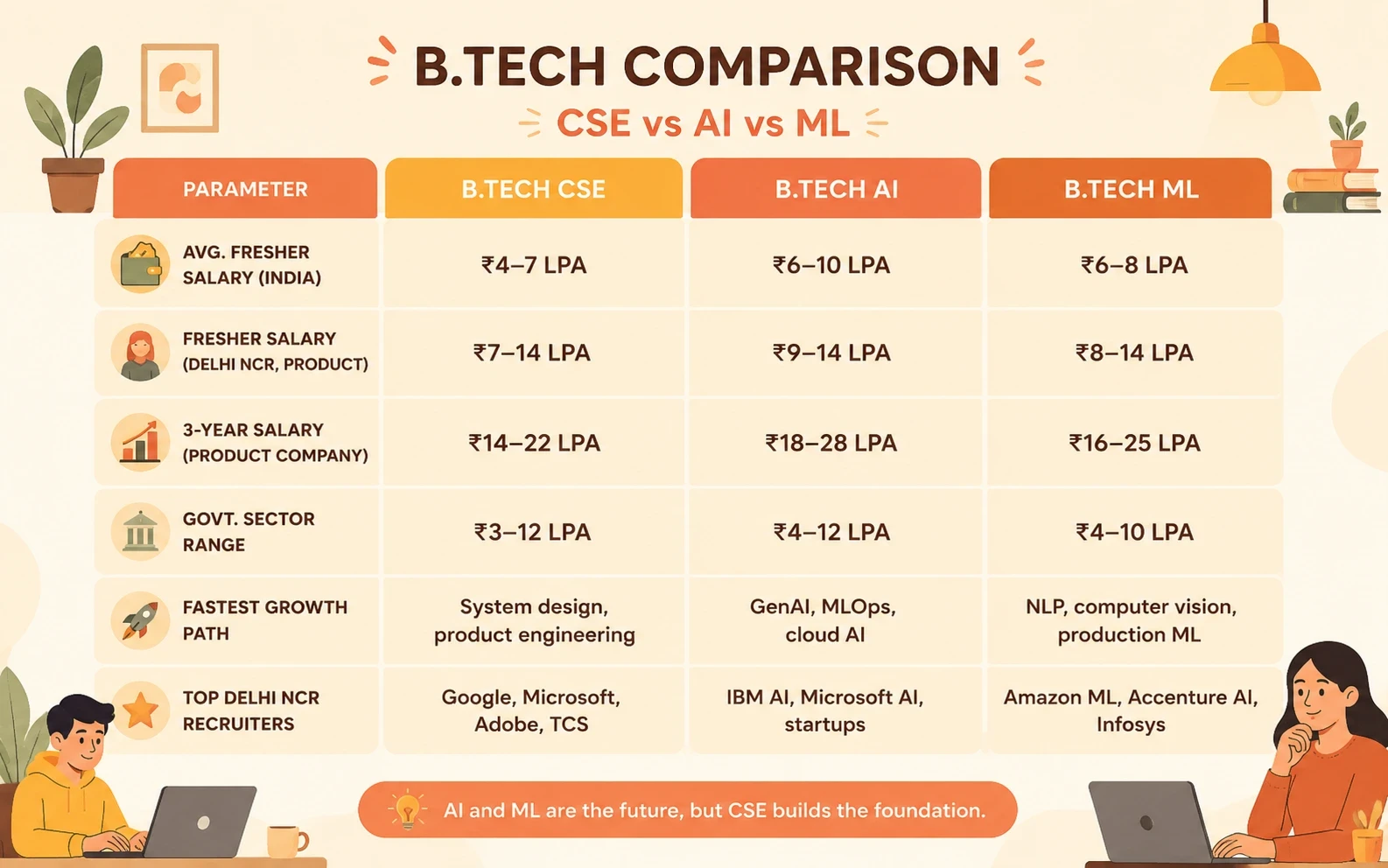
Below is the realistic comparison of salary trends across the three domains:
Parameter | B.Tech CSE | B.Tech AI | B.Tech ML |
Avg. Fresher Salary (India) | ₹4–7 LPA | ₹6–10 LPA | ₹6–8 LPA |
Fresher Salary (Delhi NCR, Product) | ₹7–14 LPA | ₹9–14 LPA | ₹8–14 LPA |
3-Year Salary (Product Company) | ₹14–22 LPA | ₹18–28 LPA | ₹16–25 LPA |
Govt. Sector Range | ₹3–12 LPA | ₹4–12 LPA | ₹4–10 LPA |
Fastest Growth Path | System design, product engineering | GenAI, MLOps, cloud AI | NLP, computer vision, production ML |
Top Delhi NCR Recruiters | Google, Microsoft, Adobe, TCS | IBM AI, Microsoft AI, startups | Amazon ML, Accenture AI, Infosys |
One important distinction is that CSE offers broader flexibility. Graduates can later transition into AI, cloud, cybersecurity, or product management roles. AI and ML programs, on the other hand, may offer faster salary growth when students build deep expertise early.
Recruiters also increasingly evaluate practical capability over branch labels. A CSE student with strong AI projects may outperform a pure AI graduate without deployment experience. Similarly, ML engineers with production-scale experience often earn more than general software developers within a few years.
Salary After B.Tech Based on Job Roles
The salary after a B.Tech degree depends heavily on the role a graduate enters, not just the specialization printed on the degree. Two students from the same branch can end up with very different salary outcomes based on skills, internships, project exposure, and the type of company they join.
Here is how salary ranges generally compare across major technical roles in India:
Job Role | Fresher Salary Range (India) | Fresher Salary Range (Delhi NCR) | Key Skills |
Backend Developer (Java/Python) | ₹3.5–6 LPA | ₹4–8 LPA | Spring Boot, APIs, SQL |
Full Stack Developer | ₹4–8 LPA | ₹5–10 LPA | React, Node, databases |
Data Analyst | ₹4–7 LPA | ₹5–9 LPA | SQL, Excel, Power BI, Python |
Data Scientist | ₹6–10 LPA | ₹7–12 LPA | Python, ML models, statistics |
ML Engineer | ₹6–10 LPA | ₹7–12 LPA | PyTorch, TensorFlow, pipelines |
AI Engineer | ₹8–12 LPA | ₹9–15 LPA | LLMs, deployment, Python |
Cloud Engineer | ₹5–9 LPA | ₹6–11 LPA | AWS, Azure, GCP, DevOps |
DevOps Engineer | ₹4.5–8 LPA | ₹5.5–10 LPA | Docker, Kubernetes, CI/CD |
A major difference today is that product companies and AI startups often reward deployable skills faster than traditional IT service firms. Candidates with strong GitHub portfolios, hackathon participation, internships, competitive coding profiles, and live deployment experience frequently secure better salary growth within the first few years.
Salary Growth Timeline After B.Tech
Salary growth after B.Tech is rarely linear. The first five years often determine long-term earning potential because this is when engineers build specialization, production experience, and domain expertise.
In Year 0–1, most graduates enter roles such as software developer, analyst, QA engineer, support engineer, or trainee AI engineer. Average salaries generally range between ₹3–8 LPA depending on specialization, internships, coding ability, and company type.
By Year 2–3, engineers who actively upskill in backend systems, cloud computing, AI tools, DevOps, cybersecurity, or data engineering often move into significantly higher salary brackets.
By Year 4–5, experienced professionals handling scalable systems, AI deployment, distributed architecture, or specialized data infrastructure frequently cross ₹15–30 LPA compensation levels.
A typical salary progression may look like this:
Experience Level | Typical Salary Range |
Fresher (0–1 Year) | ₹3–8 LPA |
Early Career (2–3 Years) | ₹8–18 LPA |
Mid-Level (4–5 Years) | ₹15–30+ LPA |
This is why students focus on building industry-ready skills during college itself through internships, hackathons, live projects, research work, startup exposure, and strong technical portfolios instead of relying only on classroom academics.
In the final year, Rishihood University offers students opportunities to work on real-world problem statements and applied projects, to help strengthen their practical portfolio before placements.
A first-year Rishihood student was selected for Google Summer of Code (GSoC) with Apache and received a ₹2.5 lakh stipend from Google. |
Salary by College Tier

The salary gap between top-tier engineering institutions and average colleges remains significant in India. While specialization matters, employer access, peer ecosystem, deployment experience, and placement quality influence compensation just as much as technical curriculum.
Graduates from IITs, top NITs, IIITs, and strong industry-connected private universities generally secure higher starting packages because recruiters trust the training ecosystem, coding culture, and talent pipeline of these institutions.
In contrast, many students from lower-tier colleges face challenges such as outdated curriculum, limited recruiter access, fewer internships, and weaker industry integration. This often affects both placement quality and long-term salary growth.
College Tier | Examples | Avg. Fresher Package | Top Campus Package |
Tier 1 (IITs, NITs) | IIT Delhi, NIT Kurukshetra | ₹12–20 LPA | ₹50 LPA–1 Cr+ |
Tier 2 (Top Govt. / Private) | DTU, NSUT, BITS Pilani | ₹7–14 LPA | ₹25–40 LPA |
Tier 3 (Reputed Private, NCR/Haryana) | Universities in Sonipat, Gurugram belt | ₹4.5–10 LPA | ₹12–15 LPA |
Tier 4 (Others) | Smaller state-affiliated colleges | ₹2.5–4.5 LPA | ₹6–8 LPA |
Important: The ROI question also matters. A 4-year IIT degree fee is ₹8–10 lakh. A reputed private B.Tech in Delhi NCR costs ₹15–23 lakh. The salary gap at the entry level is real, but it narrows significantly by Year 3.
Want to know what a B.Tech from Rishihood University actually leads to in terms of placements and salary? See the details here. |
B.Tech Course Details and Duration Linked to Salary Outcomes in India
B.Tech is a 4-year undergraduate engineering degree. That format is identical across all 3,500+ AICTE-approved colleges in India. What differs, and what determines salary outcome, is what gets built inside those four years.
B.Tech duration: 4 years (8 semesters). Eligibility: 10+2 with Physics, Chemistry, and Mathematics, minimum 50% aggregate. Primary entrance: JEE Main, CUET, RSAT (for Rishihood), or other state-level tests.
Year 1–2: Core fundamentals: Students who begin competitive programming and internship hunting here gain a 12–18 month head start on peers who wait until Year 3.
Year 3: The most salary-relevant year: Specialization courses kick in. Students typically study machine learning, database systems, algorithms, and AI fundamentals during this phase. This is when internships convert to PPOs and when the salary trajectory between students begins to diverge sharply.
Year 4: Final projects, and placements: Students who use this year to build production-quality projects beyond standard college assignments often perform better in placement interviews.
What Delhi NCR employers actually reward in 2026: Hiring managers at Gurugram and Noida GCCs increasingly prioritize demonstrated problem-solving ability over GPA.
The B.Tech course duration is 4 years everywhere. What changes is how effectively those years prepare you for high-paying careers. That is where Rishihood’s curriculum stands apart.
Highest Paying B.Tech Specializations in Delhi NCR Haryana
Based on 2025–26 placement and hiring data across the Delhi NCR and Haryana market, these are the specializations commanding the strongest starting packages:
B.Tech in CS, AI, or ML: Fresher salary: ₹6–12 LPA / 5-year growth potential: ₹40–70 LPA.
B.Tech CSE with Cloud or DevOps focus: Fresher salary: ₹5–9 LPA. Strong hiring demand in Gurugram’s GCC ecosystem.
B.Tech in Data Science and Business Analytics: Fresher salary: ₹6–10 LPA. Growing demand across fintech and e-commerce in NCR.
B.Tech CSE with Cybersecurity: Fresher salary: ₹5–8 LPA. Rising opportunities in government and BFSI sectors.
B.Tech CSE (General): Fresher salary: ₹3.5–6 LPA. Broadest hiring pool, but also the most competitive.
The Gurugram corridor specifically favors cloud and GCC roles, while Noida and Delhi tend to hire more across services, product, and analytics. Sonipat-based graduates benefit from proximity to both hiring corridors without the higher living costs of Gurugram or Delhi.
B.Tech University in Delhi NCR Haryana with Strong Salary Outcomes
When evaluating B.Tech colleges in Delhi NCR, most students compare placement packages without looking at curriculum design, industry partnerships, internship infrastructure, and the quality of the faculty.
Rishihood University, located on NH-44 (GT Road) in Sonipat, Haryana, is one of India's few universities explicitly built around impact-driven, industry-integrated education. It offers two B.Tech programs directly aligned with the highest-paying specializations of 2026: B.Tech in Computer Science & Artificial Intelligence and B.Tech in Computer Science, Data Science & Business Analytics (in partnership with KPMG India).
What sets Rishihood University apart:
93% of second-year B.Tech students secured internships, with an average stipend of ₹25,000 per month
The 2024 placement season recorded average package between ₹7–7.5 LPA, with the highest packages ranging from ₹10.8–12.5 LPA, with recruiters including Adobe, EY (Ernst & Young), Accenture, and Bosch.
The CS & AI program is co-designed with Newton School of Technology and delivered by industry experts including those from Google and Microsoft.
Students have access to a ₹50 Cr startup fund ecosystem, the ₹1 Cr StartX fund for venture funding, and a Makers Fund that has supported individual student ventures with grants of up to ₹10 lakh.
Admissions open. Apply to Rishihood University's B.Tech program and speak to the admissions team about scholarship options through the Bharat100 initiative.
FAQs
What is the average B.Tech salary in Delhi NCR for freshers?
B.Tech freshers in Delhi NCR earn ₹3.5–5 LPA at IT services companies and ₹7–14 LPA at product companies and GCCs. The company type matters more than the city average.
What is the salary after B.Tech in Computer Science in India?
The average B.Tech in Computer Science salary for freshers typically ranges between ₹4–8 LPA. With 4–5 years of experience, software engineers, backend developers, and cloud professionals often move into ₹15–30 LPA salary brackets.
Do AI and ML graduates earn more than CSE in Delhi NCR?
In many cases, yes. AI and ML graduates frequently secure higher starting salaries because of growing demand and limited specialized talent availability. However, CSE graduates with strong AI, cloud, or backend engineering skills can achieve similar or higher compensation growth over time.
What is the salary growth after 5 years of B.Tech?
After 5 years, experienced engineers working in software development, AI engineering, cloud infrastructure, cybersecurity, or data systems commonly earn between ₹15–30+ LPA depending on role specialization, company type, and technical expertise.