Design
Bachelor of Design (B.Design) 4-Year Program: Subjects You Will Study in India
A Bachelor of Design, or B.Des, is a four-year undergraduate program that trains students to think, research, and create through design. It has following subjects
20 August 2026
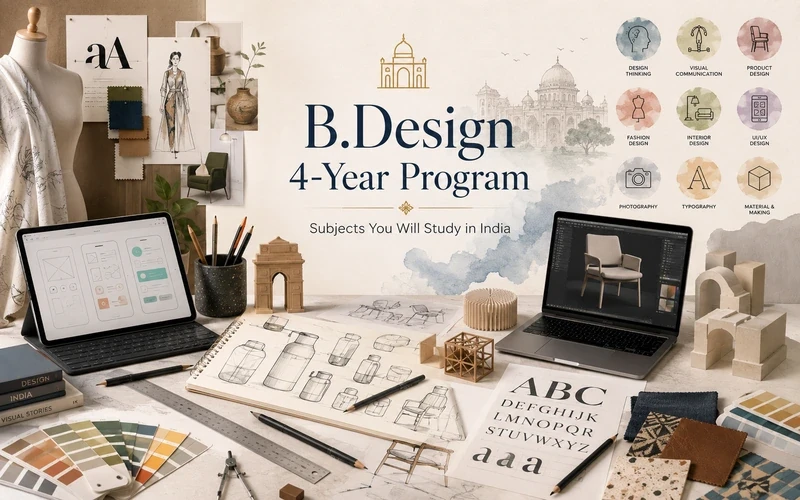
Table of Contents
Introduction
Design today is everywhere, in the app you opened this morning, the packaging of your breakfast, the sign you read on the highway, and the chair you are sitting on. What most people do not see is the years of structured thinking, tool practice, and people-centred problem-solving that went into each of those things.
That is exactly what a Bachelor of Design (B.Design) trains you for. Unlike traditional art programs that focus on self-expression, a B.Des course is built around solving real problems through design making it one of the most versatile undergraduate degrees available today.
India's demand for trained designers has never been higher. UX/UI design job postings grew by 40% between 2024 and 2026, and India's UX design market is projected to reach ₹2,244 crore by 2025. India now has over 1,00,000 registered startups, and nearly every funded startup today has at least one dedicated designer on the team.
This article walks you through each year of the four-year B.Design curriculum: the subjects, the skills, the studio work, and the tools so you can understand how the degree actually builds a career-ready designer.
What Is a Bachelor of Design (B.Des)?
A Bachelor of Design, or B.Des, is a four-year undergraduate program that trains students to think, research, and create through design. It is not a fine arts degree. It is not a technology degree. It sits at the intersection of both and pulls from sociology, business, psychology, materials science, and visual communication depending on the specialisation.
The learning approach is studio-based, which means most of your time in a B.Des course is spent building, prototyping, sketching, and presenting work, not sitting in lectures and memorising. Every subject connects to a real-world design challenge.
Most B.Des course programs in India begin with a common foundation year for all students, before splitting into specialisations from Year 2 onwards. Specialisations typically include Communication Design, UX and Interaction Design, and Product Design.
Design thinking i.e., the process of defining a problem, researching users, generating ideas, building prototypes, and testing is not a single subject in a B.Des. It is woven into every year of the curriculum.
After completing a B design course, graduates work as UX designers, product designers, communication designers, visual designers, design researchers, and increasingly, as founders of design-led businesses.
How the 4-Year B.Des Curriculum Is Structured
The four-year bachelor of design curriculum follows an eight-semester model. While specific subjects vary by university, the overall structure across leading Indian design programmes follows a consistent logic.
Year 1 (Semesters 1–2):
A common foundation year. All students, regardless of future specialisation, study design fundamentals, drawing, material exploration, visual communication, and design thinking. This year is about building a shared vocabulary and a strong perceptual base.
Year 2 (Semesters 3–4):
Students enter their chosen specialisation track. Core design skills deepen i.e., typography, user research, form studies, CAD, interaction principles, depending on the track. Studio projects become more complex and more tied to real briefs.
Year 3 (Semesters 5–6):
Advanced specialisation. Subjects become more focused, like branding, UX/UI, product development, motion design, systems thinking. Students take electives, engage in live client projects, and begin building a professional portfolio.
Year 4 (Semesters 7–8):
Professional practice. Students work on a substantial graduation project, complete a 6-month industry internship, and refine their portfolios for placement. Entrepreneurship and design management are introduced.
Most B.Des programs in India follow approximately 160 academic credits across eight semesters. Studio-based learning — where work is created, critiqued, revised, and presented — is the core pedagogy throughout. Every year builds directly on the one before.
First-Year B.Design Subjects: Building Design Foundations
The first year is the most important year of a Bdesign course, not because the subjects are the hardest, but because they shape how a student sees and thinks for the rest of the programme.
Across leading Indian B.Des programmes, Year 1 is a common foundation year for all students, regardless of which specialisation they will eventually choose. The subjects typically covered are:
Design Fundamentals:
Art Appreciation, Art & Design Criticism, and Design History
Observational Drawing
Design Fundamentals I & II
Understanding Geometry and Patterns
Fabrication Lab / Workshop
User Studies
Design Studio - Material Study and Behaviour
Visualisation and Representation
Visual Narratives
Interdisciplinary and Contextual Studies:
History and Philosophy of Design
Social Communication and Design Ethics
Cultural Studies and Understanding Society
Global Challenges and Design's Role
Principles of Design
What students actually learn: The drawing and observational work trains the eye to see proportion, light, structure, and detail precisely. Material study teaches how different substances behave, how they flex, break, absorb, and reflect which directly informs product and spatial design decisions later. User Studies introduces the habit of observing real people to understand their needs before designing anything. The interdisciplinary subjects ground all of this in cultural and social context, helping students understand the real-world consequences of design choices.
By the end of Year 1, a student has not yet designed a logo or an app. But they have built the perceptual, material, and research instincts that make everything after this year possible.
Second-Year B.Design Subjects: Developing Core Design Skills
Year 2 is where the curriculum is divided. Students enter their chosen specialisation track i.e., Communication Design, UX and Interaction Design, or Product Design and begin building the technical skills specific to their area.
Subjects across tracks in Year 2:
Communication Design track:
Typography I and Visual Language
Layout Design and Graphic Systems
Colour Systems and Application
Illustration and Image-making
UX and Interaction Design track:
Human-Computer Interaction Basics
Information Architecture
User Research Methods
Interaction Design Principles
Product Design track:
3D Form Studies
CAD Fundamentals (AutoCAD and basic modelling)
Material and Manufacturing Processes
Product Visualisation
Common across all tracks:
Research Methods in Design
Collaborative Studio Projects
Professional Communication
What students actually learn: Year 2 is when the distinction between ‘studying design’ and ‘thinking like a designer’ starts to feel real. A Communication Design student learns to control type like a visual tool, not just text. A UX student learns that a user flow is not just a diagram but a map of how someone feels as they move through a product. A Product Design student learns that every material choice affects cost, sustainability, and user experience simultaneously. Studio projects in Year 2 require students to apply these skills in response to real design challenges.
Want to explore what each specialisation actually covers? Read: What is Visual Communication Design? | What You Learn in a UX/UI B.Design Programme | Types of Product Design and Career Options
Third-Year B.Design Subjects: Specialisation and Advanced Learning
Year 3 is where the curriculum accelerates. Students are now deep inside their specialisation, working on complex, open-ended briefs that push beyond safe, predictable outcomes.
Subjects across tracks in Year 3:
Communication Design:
Brand Identity and Strategy
Advertising and Persuasive Communication
Motion Graphics and Animation Basics
Information Design and Data Visualisation
Digital and Print Publishing
UX and Interaction Design:
Advanced User Interface Design
Prototyping and Usability Testing
Systems Thinking in Design
Interaction Design for Emerging Tech (AR/VR, voice interfaces)
AI-Assisted Design Workflows (Midjourney, generative tools)
Product Design:
Product Strategy and Development
Sustainable and Circular Design
Ergonomics and Human Factors
Packaging and Retail Design
Electives (across all tracks): Most B.Des programmes offer a wide elective menu in Year 3, allowing students to combine their design specialisation with adjacent disciplines such as business strategy, digital marketing, gaming, film, or entrepreneurship. The number and variety of electives differs by institution; it is worth checking this when evaluating any programme.
What students actually learn: Year 3 is the year that separates designers who can execute from designers who can lead a brief. Industry-focused assignments in this year often involve real companies or community problems and not hypothetical exercises. The introduction of AI-assisted design tools prepares students for a workflow that is increasingly standard in professional design studios globally. Portfolio-building becomes a deliberate practice, with each project chosen and documented as a demonstration of design thinking, not just visual output.
Fourth-Year B.Design Subjects: Industry Projects and Professional Practice
Year 4 is designed to transition students from the classroom into the industry. The academic structure loosens, and real-world demands take over.
What Year 4 includes:
Semester 7:
Graduation Project (the substantial final project which is student-defined and mentor-guided)
Design Management and Project Leadership
Professional Ethics in Design
Portfolio Refinement and Presentation
Semester 8 Industry Internship:
In most strong B.Des programmes, Semester 8 is dedicated to a full industry internship of typically 4 to 6 months, where students work inside companies as contributing junior designers on live projects, not as observers. This is not a formality. It is the final, practical exam - everything learnt across three years is put to use in a real professional environment. Some programmes, like Rishihood University's B.Design, structure this as a paid engagement, so students earn a stipend while building real professional references.
Entrepreneurship and Venture Exposure: Year 4 increasingly includes exposure to how design-led businesses are built, covering topics like client management, studio economics, pricing design work, and building a design practice. Some universities offer formal entrepreneurship pathways: for instance, Rishihood's Venture Studio and School of Entrepreneurship give B.Des students a structured route into founding a studio, product company, or design consultancy if that is the direction they want to take.
Capstone presentation: The final graduation project is presented to a jury of faculty, practitioners, and industry professionals. This functions as both an academic evaluation and a professional pitch — the first real test of the graduate's ability to communicate design decisions under pressure.
Studio Learning and Practical Projects Throughout the Programme
Studio learning is what separates a design education from an ordinary course. In a design studio, work is made, not discussed. Students produce something tangible, a prototype, a poster, an interface, present it, receive critique, and go back to revise. This cycle of making, presenting, and improving is how design instinct is built.
Strong B.Des programmes embed intensive workshops throughout the four years. Focused, immersive sessions on specific skills or tools, not general electives. A single workshop might be entirely dedicated to packaging design, typographic systems, or building a physical prototype.
Fabrication Lab: Physical design work i.e., product prototypes, scale models, packaging mockups created in the fabrication lab. This gives students tactile, hands-on experience that purely digital tools cannot replicate.
Live Client Briefs: From as early as Year 2, students work on real briefs from companies or communities. These are not simulations. Real constraints (budget, timeline, user context) force students to design with clarity rather than creativity alone.
Design Critiques: Every studio project ends with a formal critique. Faculty, visiting practitioners, and fellow students give structured feedback. Over four years, students learn to defend their design choices and incorporate criticism constructively - a professional skill as valuable as the design skill itself.
Masterclasses from Industry Practitioners: The best programmes bring working professionals directly into the studio. At Rishihood University's School of Design, for instance, Vaibhav Kumaresh, two-time Emmy-nominated animator and creator of Lamput and the Vodafone ZooZoo ads conducted a deep-dive session on stop-motion animation, storyboarding, and creative storytelling. His central point: design begins with observation and honesty, not tools. These kinds of engagements give students direct access to the thinking of working professionals, not just their portfolios.
Industry-Informed Curriculum: What gets taught in the studio should be shaped by what the industry actually needs. Rishihood's School of Design hosted an annual Design Roundtable with JBM Group that brought senior leaders from MakeMyTrip, Blinkit, Maruti Suzuki, and Frog Design (Capgemini) into direct conversation with faculty and students. Their collective message: mindset, initiative, and consistency matter more than technical skill; and real-world briefs embedded in the curriculum are non-negotiable. When evaluating any B.Des programme, it is worth asking how regularly industry practitioners shape what is actually taught.
Design Software and Digital Tools Students Learn
Employers do not just want designers who can think, they want designers who can execute using the tools their teams already use. A strong B des course integrates software training throughout the curriculum rather than treating it as a one-semester add-on.
Here are the core digital tools taught across the four years of a B.Design programme:
Tool | Category | Typically Used In |
Adobe Photoshop | Image editing, photo manipulation | Communication Design, Year 1 onwards |
Adobe Illustrator | Vector graphics, illustration | Communication Design, branding |
Adobe InDesign | Layout and publication design | Communication Design, Year 2-3 |
Figma | UI/UX design, prototyping, collaboration | UXID, Year 2-4 |
Adobe XD | UX prototyping | UXID, Year 2-3 |
AutoCAD | Technical drawing, product drafting | Product Design, Year 2 |
Blender / Rhino | 3D modelling and rendering | Product Design, Year 2-3 |
Midjourney | AI-assisted design ideation | All tracks, Year 3 |
Miro | Research synthesis, collaborative mapping | All tracks, user research |
SketchUp | Spatial and interior modelling | Product/Lifestyle Design |
A good B.Des programme ensures that tool access is not a barrier and that software training is embedded throughout the curriculum, not compressed into a single course. When evaluating a programme, check whether tools are taught in context — within actual projects — rather than in isolation.
How B.Design Subjects Prepare You for Design Careers
Every subject in the B.Des curriculum maps directly to a professional skill. The table below shows how the core subject areas translate into careers.
B.Des Subject Area | Skills Built | Career Paths |
Observational Drawing + Visualisation | Visual perception, ideation speed | All design roles; essential for presenting concepts |
User Studies + Research Methods | Empathy mapping, interview design, synthesis | UX Researcher, Design Strategist, Service Designer |
Typography + Branding | Visual hierarchy, identity systems | Communication Designer, Art Director, Brand Manager |
Interaction Design + Figma | Prototyping, user flow design, usability | UX/UI Designer, Product Designer |
Form Studies + CAD | 3D spatial thinking, technical execution | Product Designer, Industrial Designer |
Systems Thinking + Information Design | Complexity management, data visualisation | Service Designer, Information Designer |
AI Tools + Emerging Tech | Generative design, creative speed | Digital Designer, Future Design Roles |
Internship + Capstone | Real-world execution, communication, pressure | Portfolio strength, first job readiness |
Entrepreneurship Exposure | Business model thinking, client management | Design Entrepreneur, Freelance Studio Founder |
Read more about the highest-paying design jobs in India and what skills they require →
B.Design Programme in India: What to Look For
Not all B.Des programmes are designed the same way. While most design schools offer similar specialisations and foundational subjects, the learning experience can vary significantly based on the curriculum, faculty, industry exposure, infrastructure, and opportunities available beyond the classroom.
When evaluating a B.Design programme, students should look beyond brochures and rankings. The real question is whether the programme can help them develop the skills, portfolio, and professional mindset required to succeed in the design industry.
1. Studio-Based Learning
Design is not learned through lectures alone.
The strongest design programmes are built around studios, workshops, projects, critiques, and hands-on experimentation. Students should spend a significant portion of their time making, testing, refining, and presenting their work rather than only studying theory.
Studio culture also teaches collaboration, feedback, iteration, and problem-solving, which are essential skills for every designer.
2. Industry Exposure and Real-World Projects
A good design curriculum should connect students with industry from an early stage.
This can include:
Live client projects
Industry-sponsored challenges
Design competitions
Workshops and masterclasses
Internships and apprenticeships
Portfolio reviews by practitioners
These experiences help students understand professional expectations and build confidence before entering the workforce.
3. Faculty with Industry Experience
Design is a rapidly evolving discipline. Learning from practitioners who have worked across branding, product design, user experience, technology, and creative industries can provide students with valuable real-world perspectives.
Faculty members should not only teach design principles but also help students understand how those principles are applied in professional practice.
4. Access to Tools, Technology, and Prototyping Facilities
Modern designers work across physical and digital environments.
A strong B.Des programme should provide access to industry-standard tools and technologies, including visual design software, prototyping equipment, fabrication facilities, and emerging technologies such as AI-assisted design workflows, XR, and digital product development.
More importantly, students should learn how to use these tools to solve problems rather than simply learning the software itself.
5. Interdisciplinary Learning
The most exciting design opportunities today exist at the intersection of multiple disciplines.
Designers increasingly collaborate with engineers, entrepreneurs, marketers, researchers, and technologists. Programmes that encourage interdisciplinary projects help students develop broader perspectives and prepare them for complex real-world challenges.
6. Strong Portfolio Development
In design, a portfolio often matters more than a résumé.
Students should graduate with a body of work that demonstrates creativity, process, problem-solving ability, and technical competence. A strong programme provides regular opportunities to build, refine, document, and present portfolio projects throughout the four years.
7. Entrepreneurship and Innovation Opportunities
Many of today's designers are not just joining companies. They are launching startups, building products, creating brands, and solving problems independently.
As design becomes increasingly connected with business and technology, students benefit from learning entrepreneurial thinking alongside creative practice. Exposure to venture creation, innovation frameworks, and business fundamentals can help designers transform ideas into real-world solutions. Research has consistently shown that entrepreneurship education can play an important role in shaping entrepreneurial intent and venture creation among university students.
Explore Rishihood University's B.Design programme →
Frequently Asked Questions
Q. What subjects are taught in B.Design?
A B.Design programme covers design fundamentals, drawing and visualisation, colour theory, typography, user research, form studies, material exploration, interaction design, branding, prototyping, and a 6-month industry internship. Subjects vary by specialisation i.e., Communication Design, UX/Interaction Design, or Product Design.
Q. Is B.Design a four-year course?
Yes. A bachelor of design in India is a four-year, eight-semester undergraduate programme. The first year is a common foundation year; specialisation begins from Year 2 onwards.
Q. Which software do B.Design students learn?
Students typically learn Adobe Photoshop, Illustrator, InDesign, Figma, AutoCAD, Blender, Rhino, Midjourney, and Miro, depending on their specialisation. The exact tools vary by programme and track. Tool training should be embedded into live projects throughout the curriculum, not taught as a standalone course.
Q. Does every B.Design student build a portfolio?
Yes. Portfolio development is a continuous process across all four years, not a final-semester activity. Each studio project, live client brief, and internship becomes documented portfolio content. A strong portfolio is the primary asset for placement.
Q. When do students choose a specialisation?
In most B.Des programmes in India, students complete a common foundation year and choose their specialisation at the start of Year 2 (Semester 3). Common specialisations include Communication Design, UX and Interaction Design, and Product Design though the specific tracks available vary by institution.
Q. What careers can I pursue after B.Design?
Graduates work as UX/UI Designers, Product Designers, Communication Designers, Visual Designers, Brand Managers, Motion Designers, UX Researchers, and Design Strategists. Those with entrepreneurial interests can build design studios or product companies. Read more about B.Des career scope and salary in India →
Explore the Programme
If you are considering a career in design and want a curriculum that teaches you the full range of skills, not just tool operation but design thinking, user research, studio practice, and entrepreneurial exposure — Rishihood University's B.Design programme is built for exactly that.
You can review the full curriculum and semester structure, understand the learner outcomes from the programme, explore the campus and studio facilities, or connect directly with the admissions team to ask about specific tracks, mentors, or internship pathways.
To go deeper before you decide, download the B.Design at Rishihood brochure for the full semester-by-semester curriculum, or read the Why Rishihood? guide to understand the programme's philosophy, pedagogy, and what makes it different from other B.Des options in India.
Design careers are built in studios, not classrooms. The four years you spend in a B.Des programme are the four years that determine whether you graduate with a degree or with a body of work. Make them count.