Design
Industrial Design vs Product Design vs UX Design: Which B.Design Career Pays Better in India?
This article breaks down all three careers, Industrial Design, Product Design, and UX Design across what each role actually does daily, what the salary trajectory looks like at each stage
25 August 2026
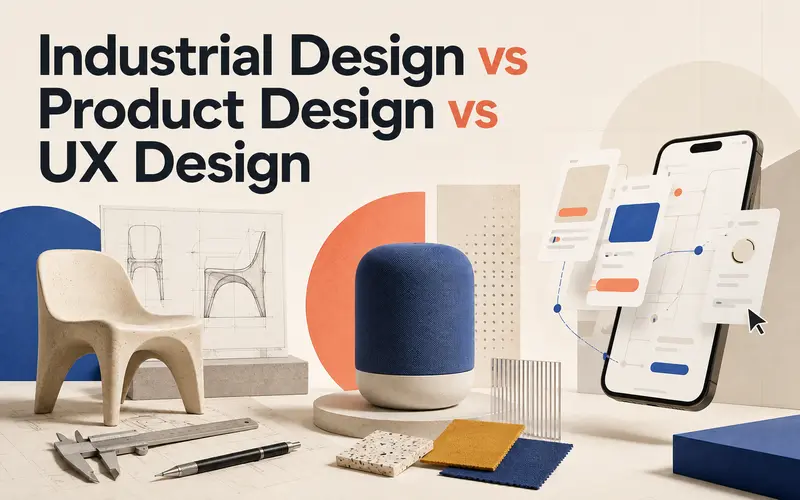
Table of Contents
Introduction
If you are choosing a B.Design specialisation and salary is one of your deciding factors, here is the direct answer: Product Design (digital) and UX Design currently offer the highest entry-level and mid-career salaries in India, while Industrial Design pays more modestly at the start but builds strong earnings in manufacturing-heavy sectors over time.
But salary figures alone do not tell the full story. What you earn three years into your career depends less on which track you picked and more on the industry you work in, the problems you are solving, and the strength of your portfolio. A UX Designer at a Series B fintech startup and a UX Designer at a mid-size agency can have a salary difference of INR 6–8 LPA for the same experience level.
This article breaks down all three careers, Industrial Design, Product Design, and UX Design across what each role actually does daily, what the salary trajectory looks like at each stage, which industries pay the most, and how to decide which path fits your strengths. The goal is to help you make a more informed B.Des course decision, not just pick the highest number.
Industrial Design vs Product Design vs UX Design: Quick Comparison
Before going deep, here is a side-by-side overview:
Industrial Design | Product Design | UX Design | |
Core Output | Physical products i.e., furniture, appliances, vehicles | Digital product experiences (end-to-end) | User research, flows, interactions within digital products |
Work Environment | Design studios, R&D labs, factories | Startup or tech teams, sometimes remote | Tech companies, agencies, startups |
Primary Collaborators | Engineers, manufacturers, material suppliers | Engineers, product managers, business teams | UI designers, developers, researchers, PMs |
Key Skills | Sketching, CAD, materials, ergonomics | UX, UI, strategy, prototyping | Research, information architecture, usability testing |
Primary Tools | Rhino, SolidWorks, AutoCAD, KeyShot | Figma, Sketch, Adobe XD, prototyping tools | Figma, Miro, UserZoom, Hotjar |
Typical Employers | Automotive, consumer electronics, FMCG, medical devices | SaaS, fintech, e-commerce, EdTech startups | SaaS, healthcare, fintech, enterprise software |
India Job Market | Concentrated in manufacturing hubs (Pune, NCR, Chennai) | Strong across Bengaluru, Hyderabad, Delhi NCR | Strong nationally, especially Bengaluru, Mumbai, Gurugram |
Entry Salary (India) | INR 2.5–6 LPA | INR 4–8 LPA | INR 2.5–5 LPA |
Senior Salary (India) | INR 12–25 LPA | INR 16–40 LPA | INR 12–35 LPA |
The table reveals something important: Product Design (digital) and UX Design have a higher salary floor and ceiling in today's market, largely because tech and SaaS companies pay more than manufacturing companies do. But Industrial Design has a depth of career that remains irreplaceable in sectors India is investing heavily in automotive, defence, consumer electronics, and medical devices.
What Does an Industrial Designer Do?
Industrial Design is the oldest and most tangible of the three disciplines. An industrial designer creates physical objects i.e., things you can hold, sit on, drive, or use. The work begins with understanding a user's needs and context, then moves through a process of sketching, material research, prototyping, and iterative refinement until a manufacturable product is ready.
Day-to-day responsibilities:
Concept sketching and 2D/3D visualisation of product ideas
Material selection and manufacturing process research
Ergonomics and anthropometric analysis (how the human body interacts with the object)
Building physical prototypes or digital mock-ups in CAD software
Collaborating with mechanical engineers to check structural feasibility
Preparing technical drawings and specification documents for manufacture
Presenting design rationale to clients and product teams
Industrial designers work across a wide range of product categories like kitchen appliances, furniture, medical equipment, automobiles, sporting goods, personal electronics, and packaging. The role requires both creative and technical thinking: a beautiful chair that is uncomfortable, too expensive to manufacture, or structurally unsafe is a failure regardless of how good it looks.
In India, Industrial Design graduates find strong employment in automotive companies (Tata, Maruti Suzuki, Mahindra), consumer electronics firms, FMCG packaging, medical device manufacturers, and furniture and lifestyle product companies. The Delhi NCR and Pune regions, in particular, have a dense manufacturing ecosystem that creates consistent demand for trained industrial designers.
Read more: Types of Product Design and Career Options →
What Does a Product Designer Do?
The term ‘Product Designer’ in 2025 almost always refers to someone working on digital products like apps, platforms, SaaS tools, and consumer-facing software experiences. This is a relatively recent evolution of the title, but it has become one of the most in-demand roles in the Indian startup and tech ecosystem.
A Product Designer has a broader ownership scope than a UX or UI Designer. They do not just research users or design interfaces, they take responsibility for the complete experience of a digital product, from initial discovery through to retention. They sit at the intersection of user needs, business goals, and technical constraints, and are expected to work fluently across all three.
Day-to-day responsibilities:
End-to-end user experience ownership for a product or feature set
Conducting user research and translating findings into design decisions
Creating wireframes, user flows, interactive prototypes, and high-fidelity visual designs
Working closely with product managers on feature scope and prioritisation
Partnering with engineering teams to communicate design intent during development
Running usability tests and using product analytics to identify pain points
Contributing to design systems that maintain consistency at scale
Presenting design decisions with business and user rationale to stakeholders
At startups, a Product Designer often does everything i.e., research, UX, UI, and handoff which gives breadth of experience quickly. At larger companies, the role is more specialised, with separate UX researchers and UI designers, and the Product Designer focuses on higher-level experience strategy. Read more about what UX/UI design looks like in a B.Design programme →
What Does a UX Designer Do?
A UX Designer focuses specifically on how a user experiences and interacts with a product, system, or service. Where a Product Designer owns the full product outcome, a UX Designer goes deep into understanding user behaviour and designing the structure and flow of the interaction.
Day-to-day responsibilities:
Conducting user interviews, contextual inquiry, and usability studies
Building personas, user journey maps, and empathy maps
Designing information architecture: how content and features are organised
Creating low-fidelity wireframes and mid-fidelity interaction flows
Facilitating collaborative design workshops with cross-functional teams
Running and analysing A/B tests and usability testing sessions
Documenting research insights and sharing findings with stakeholders
Defining interaction patterns and micro-interactions that improve usability
The distinction from Product Design is important: a UX Designer is primarily research and interaction-led, while a Product Designer carries broader strategic and visual design responsibility. In many companies, especially early-stage startups, these roles overlap significantly. In larger organisations, enterprise software, healthcare technology, government services, UX is a distinct function with its own research methodology, tools, and workflow.
UX Design is currently one of the most in-demand skills in the Indian job market, with UX/UI job postings growing 40% between 2024 and 2026.
B.Design Salary Comparison in India: Industrial vs Product vs UX Design
Here is a consolidated salary table based on Glassdoor India, AmbitionBox, Naukri, and Strate School of Design's analysis for 2025–2026:
Experience Level | Industrial Designer | Product Designer (Digital) | UX Designer |
Entry (0–2 yrs) | INR 2.5–6 LPA | INR 4–8 LPA | INR 2.5–5 LPA |
Mid (3–6 yrs) | INR 6–12 LPA | INR 8–18 LPA | INR 7–15 LPA |
Senior (6–10 yrs) | INR 12–25 LPA | INR 16–34 LPA | INR 12–28 LPA |
Lead/Director (10+ yrs) | INR 20–35 LPA | INR 30–45 LPA+ | INR 25–55 LPA |
Key factors that shift salary within each band:
Industry: Tech and SaaS companies pay 30–50% more than manufacturing or agency environments at equivalent experience levels. A UX Designer at a Bengaluru unicorn earns significantly more than a UX Designer at a mid-size design agency.
Location: Delhi NCR, Bengaluru, and Mumbai offer the highest salaries across all three roles. Glassdoor India data consistently shows a 20–35% gap between Tier-1 and Tier-2 city salaries.
Portfolio and domain expertise: A Product Designer with a strong case study showing measurable product outcomes commands significantly better offers than one with the same years of experience but a weaker portfolio. Across all three careers, portfolio quality is the single biggest lever on starting salary.
Company stage: Well-funded startups and tech-first companies typically offer ESOPs, higher cash compensation, and faster promotion cycles compared to traditional manufacturing or service businesses.
Skills, Tools & Portfolio Expectations
All three careers share a foundation of design thinking, visual communication, and user empathy. But the specific tools and portfolio expectations diverge meaningfully.
Common skills across all three: Design thinking and problem framing, user research basics, visual communication, presentation and storytelling, cross-functional collaboration.
Role-specific technical skills:
Industrial Designer | Product Designer | UX Designer | |
Core Technical Skills | CAD modelling, materials science, manufacturing knowledge, ergonomics | End-to-end product design, design systems, data-informed decision-making | User research methods, information architecture, interaction design, usability testing |
Key Software | Rhino, SolidWorks, AutoCAD, KeyShot, Adobe Illustrator | Figma, Sketch, Adobe XD, Principle, Zeplin | Figma, Miro, UserZoom, Maze, Hotjar |
Emerging Tools | 3D printing software, generative design tools, AR visualization | AI-assisted design (Figma AI, Midjourney for ideation), no-code prototyping | AI research tools, automated usability testing, analytics platforms |
Portfolio differences: An Industrial Designer's portfolio shows physical objects i.e., photographs of prototypes, technical drawings, material experiments, and the process from sketch to manufactured product. A Product Designer's portfolio shows end-to-end case studies of digital products, with emphasis on research, decision rationale, and outcome metrics. A UX Designer's portfolio is research-heavy such as journey maps, persona frameworks, usability findings, and how they make informed design decisions, even when the final visual output is modest. Across all three, the best portfolios show the thinking behind the work, not just the final output.
Industries Hiring These Designers in India
Understanding which industries hire each type of designer helps you match your interests to where real job demand exists.
Industrial Designers are hired by: Automotive (Tata Motors, Mahindra, Maruti Suzuki, Hero MotoCorp), consumer electronics (Samsung India, Philips, Havells, Boat), medical devices, furniture and lifestyle brands, FMCG packaging, and defence design establishments. Manufacturing-dense regions like Delhi NCR (particularly Gurugram, Faridabad, and Manesar), Pune, Chennai, and Ahmedabad concentrate most of the industrial design hiring in India.
Product Designers are hired by: SaaS companies, e-commerce platforms (Flipkart, Myntra, Meesho), fintech (PhonePe, Razorpay, CRED), EdTech (BYJU'S, Unacademy, Vedantu), consumer apps, and global capability centres across Bengaluru, Hyderabad, and Delhi NCR. Enterprise software companies and consulting firms also hire product designers for their digital transformation teams.
UX Designers are hired by: Healthcare technology platforms, banking and financial services (HDFC Bank's design team, Paytm, Zerodha), enterprise SaaS, e-government platforms, and accessibility-focused organisations. Large IT services companies like TCS, Infosys, and Wipro also have growing UX practices serving enterprise clients.
Delhi NCR and Haryana specifically: The NCR region is unusual in that it has strong hiring across all three disciplines, automotive and manufacturing companies in Gurugram and Faridabad for Industrial Design, and a thriving startup and MNC ecosystem in Gurugram and Noida for Product and UX Design. For students in Haryana or the Delhi NCR area, proximity to this ecosystem is a meaningful career advantage for accessing internships and first roles.
The JBM Group, a major automotive components manufacturer headquartered in the NCR exemplifies the kind of industry that actively bridges design thinking with manufacturing reality. Rishihood University's annual Design Roundtable with JBM Group brought together senior design leaders from MakeMyTrip, Blinkit, Maruti Suzuki, and Frog Design (Capgemini), a cross-section that reflects exactly how the NCR design ecosystem spans physical, digital, and service design disciplines.
B.Design Career Growth & Future Trends
All three careers have clear growth pathways, and the emerging design landscape is creating new roles that blend across traditional boundaries.
Leadership pathways: Industrial Designers move from junior designer to senior designer to design director or head of industrial design. Senior roles in automotive or product companies come with significant influence over product strategy. Product and UX Designers progress to Lead Designer, Design Manager, Head of Design, VP of Design, or Chief Design Officer, roles that are increasingly prominent at India's funded tech companies.
Freelancing and consulting: Industrial Designers with a strong portfolio can build a consulting practice serving small businesses or startups that need physical product development without a full-time hire. UX and Product Designers are in even stronger demand as freelancers, with platforms like Toptal, Contra, and Dribbble facilitating global freelance work.
Entrepreneurship and studio founding: The skills built in any of these three careers translate directly into founding a design studio or product company. Vaibhav Kumaresh, the two-time Emmy-nominated founder of Vaibhav Studios and creator of the Vodafone ZooZoo ads and Lamput, is one example of what a design-led independent practice can look like — built on craft, client trust, and creative ownership over decades. The entrepreneurial path in design is as viable as the corporate one.
AI-assisted design workflows: AI is changing design work, but not eliminating it. Tools like Figma AI, Midjourney, and generative 3D design tools are compressing the time it takes to go from brief to prototype. Designers who understand how to use these tools strategically, to accelerate ideation, explore materials, or generate layout options are increasingly differentiated from those who do not.
Emerging interdisciplinary roles: New roles are blurring the boundaries between the three careers: Service Design (spans physical and digital), Design Strategy, Design Operations, Experience Research, and AI-UX Design are all growing disciplines that a B.Des graduate with cross-functional curiosity is well-positioned to move into. Students like Preksha Baid, a second-year B.Design student at Rishihood who reached the Top 5 at DesignUp 2025 against 730+ global designers represent the kind of cross-disciplinary, concept-first thinking that the next generation of design roles will reward.
Which Design Career Should You Choose?
Instead of picking the highest salary, use this decision framework based on your actual interests and working style.
Choose Industrial Design if: You are drawn to physical objects, enjoy working with materials, want to understand how things are made, and find satisfaction in a product that exists in the world, not just on a screen. You are comfortable with ambiguity between creative and technical work, and you are interested in sectors like automotive, consumer electronics, furniture, or medical devices.
Choose Product Design if: You enjoy owning problems end-to-end, like working at the intersection of user needs and business outcomes, are comfortable with ambiguity at both the visual and strategic level, and want to work in fast-moving tech or startup environments where your decisions directly affect how a product performs.
Choose UX Design if: You are fascinated by human behaviour, find research and analysis as satisfying as design output, prefer going deep into understanding a specific problem before jumping to solutions, and enjoy working with data and user feedback as much as sketching or building.
The honest answer: At the beginning of a B.Des course, most students do not know for certain which of these matches them best. The foundation year of a B.Des with its drawing, material study, user research, and studio projects exists precisely to help you discover this. Choose a programme with a genuine foundation year that does not push you into specialisation before you have the context to make a good decision.
Explore the B.Design specialisations at Rishihood University → Read more: Is B.Des a good career option in India? →
Frequently Asked Questions
Which design career pays the highest in India?
Product Design (digital) currently offers the highest ceiling, with senior designers at funded startups and tech companies earning INR 30–45 LPA or more. UX Design reaches similar levels at director and head-of-design roles. Industrial Design tops out at INR 20–35 LPA in most sectors, though automotive and defence roles can go higher.
Can Industrial Designers transition to Product Design?
Yes, and it happens often. Industrial Designers who build proficiency in Figma, interaction design, and digital prototyping can move into product design for hardware-adjacent tech products such as wearables, IoT devices, smart home products. The transition is smoother for those who have a mix of physical and digital project experience.
Is UX Design a good career after B.Des?
Yes. UX Design is one of the most consistently in-demand design roles in India, with UX/UI job postings growing 40% between 2024 and 2026. A B.Des foundation, particularly one that includes user research, visualisation, and studio projects prepares graduates well for UX roles.
Which specialisation has the highest demand?
UX and Product Design have the highest volume of open positions in India's current job market, concentrated in tech, fintech, and SaaS. Industrial Design has lower volume but more stable, specialised demand from manufacturing sectors.
Which role requires coding?
None of the three formally requires coding, but UX and Product Designers who understand basic HTML, CSS, and front-end constraints work more effectively with engineering teams. Industrial Designers with parametric design or CAD scripting knowledge have an advantage in advanced manufacturing workflows.
Which portfolio is most important?
All three careers are portfolio-driven. Your portfolio matters more than your grades. An Industrial Designer needs physical prototypes and process documentation. A Product Designer needs end-to-end case studies with clear research and outcome evidence. A UX Designer needs research artefacts and interaction flows that demonstrate user-centred thinking, even if the visual output is simple.
Explore the Right Programme for Your Career
Choosing a b design course is a long-term decision. The right programme should expose you to all three design disciplines in the foundation year, let you specialise meaningfully from Year 2 onwards, connect you to real industry mentors and live projects, and give you a portfolio-ready body of work before you graduate.
Rishihood University's B.Design programme offers specialisations in Communication Design, UX and Interaction Design, and Product Design, with a structured common foundation year, 6 months of paid industry experience, and 50+ industry mentors. Download the B.Design brochure for the full curriculum and semester structure, or read the Why Rishihood? guide to understand how the programme is built around real design practice and industry connection. For admissions queries, connect with the team directly.