Technology
What Recruiters Actually Check in B.Tech CS Freshers in India in 2026
What are recruiters actually looking for? In 2026, a B.Tech Computer Science degree alone isn't enough to stand out.
11 August 2026
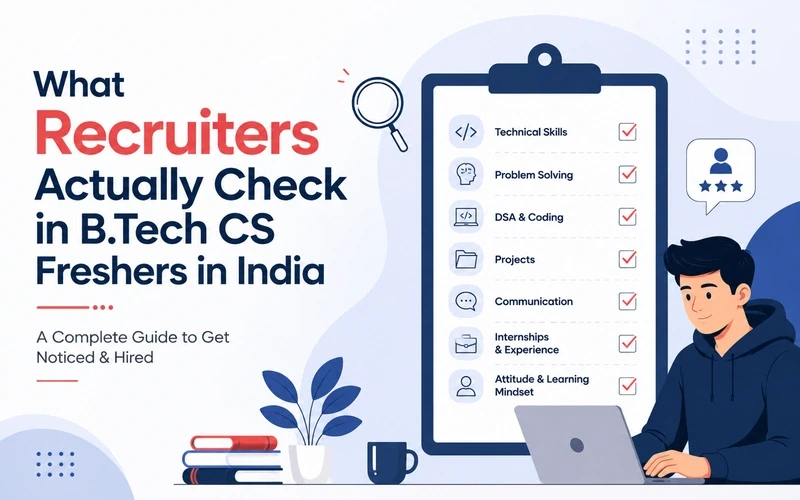
Table of Contents
Introduction
Before landing your first software engineering job, there's one question worth asking: What are recruiters actually looking for? In 2026, a B.Tech Computer Science degree alone isn't enough to stand out. Employers want graduates who can build, solve, communicate, and adapt to real-world challenges. Whether you're interested in AI, cybersecurity, software development, cloud computing, or business analytics, your portfolio, projects, internships, and practical skills often matter just as much as your academic performance. So, how do you prepare for the hiring process before you even graduate? In this article, we'll break down what recruiters evaluate at every stage of hiring and how engineering students can build the skills that truly make them industry-ready.
India Tech Hiring Trends for Freshers in 2026
The way tech companies hire engineering graduates has changed. In 2026, having a B.Tech degree is still important—but it's no longer what sets you apart. Recruiters want to know what you've built, the problems you've solved, and whether you can apply your knowledge in real-world situations.
From coding challenges and technical interviews to project portfolios and internships, companies are looking for students who can demonstrate their skills, not just talk about them. Many recruiters also use AI-powered tools to screen resumes, making it more important than ever to showcase relevant projects, technical expertise, and practical experience.
Whether you're aiming for a role in software development, AI, cybersecurity, cloud computing, or data analytics, the students who stand out are those who graduate with both strong fundamentals and hands-on experience. Today's hiring landscape rewards curiosity, initiative, and the ability to solve real problems—qualities that employers value just as much as academic performance.
Meet the B.Tech CS & Data Science learners who secured internships at Pertech, a US-based company. |
What Recruiters Notice Before They Even Read Your Resume
Here's something most engineering students don't realize: your resume isn't the first thing recruiters evaluate.
Before they look at your projects or technical skills, recruiters (and often AI-powered hiring systems) quickly check whether your profile meets the basic requirements. That includes your academic background, specialization, consistency in performance, and whether your resume clearly communicates what you bring to the table.
But once you clear that first filter, what really makes you stand out isn't your CGPA—it's what you've actually built.
That's why at Rishihood University's B.Tech CS & Data Science program, students don't wait until their final year to work on real projects. From the very first year, the curriculum is designed around building practical skills through hands-on coding, open-source contributions, industry-led projects, hackathons, and internships. By the time students begin applying for internships and placements, they already have a portfolio that demonstrates their ability—not just a degree.
Why Your Resume Needs to Work for Humans and AI
Today, your resume is often read by software before it's read by a recruiter.
Most technology companies use Applicant Tracking Systems (ATS) to screen thousands of applications. These systems look for relevant programming languages, frameworks, technical skills, internships, certifications, and project experience before deciding whether your resume should move to the next stage.
A strong project section, clear internship experience, and the right technical keywords can significantly improve your chances of getting shortlisted.
This is another reason practical learning matters. Throughout the curriculum at Rishihood, students continuously build software, solve real-world problems, and work on industry projects. Whether it's developing applications, participating in hackathons, contributing to open-source projects, or completing internships, every experience helps strengthen both their skills and their resume.
The takeaway is simple: recruiters don't just hire graduates—they hire people who can demonstrate what they know. The strongest resumes are backed by real work, meaningful projects, and experiences that prove you're ready to contribute from day one.
Build the Skills Recruiters Actually Hire For |
What Technical Skills Do Recruiters Actually Look For?
A B.Tech degree gets your foot in the door—but your skills are what get you hired.
When recruiters interview engineering graduates, they're looking for people who understand the fundamentals and can apply them to solve real problems. It's not about memorizing concepts for exams; it's about showing that you can think like an engineer.
Here's what recruiters expect every Computer Science graduate to know:
Programming Languages: Be comfortable writing code in languages like Python, Java, C++, or JavaScript.
Data Structures & Algorithms (DSA): Solve coding problems efficiently using arrays, strings, linked lists, trees, graphs, and dynamic programming.
Databases: Understand SQL, database design, and how to work with large datasets.
Operating Systems: Know the basics of memory management, processes, scheduling, and file systems.
Computer Networks: Understand how the internet works—from HTTP and TCP/IP to DNS and network security.
Object-Oriented Programming (OOP): Apply concepts like inheritance, polymorphism, abstraction, and encapsulation while building software.
Cloud Fundamentals: Gain familiarity with cloud platforms, deployment, storage, and modern application architecture.
The difference between an average candidate and a standout one? Hands-on experience.
That's what learning by doing looks like. Watch Lakshay, a B.Tech CS & Data Science learner at SASTech, talk about winning a hackathon at IIT Roorkee and how hands-on learning helped him compete with some of the country's best engineering students. |
That's why the curriculum at SASTech, Rishihood University is built around learning by doing. Instead of waiting until your final year, you'll work on real projects, contribute to open-source software, participate in hackathons, build AI applications, and gain industry experience through internships from the very beginning.
By the time you graduate, you'll have more than technical knowledge—you'll have a portfolio that demonstrates what you can build.
Why DSA Still Matters
If there's one skill that almost every technology recruiter tests, it's Data Structures and Algorithms (DSA).
Whether you're interviewing for a startup or a global tech company, coding assessments almost always include DSA-based questions. Recruiters want to see how you approach problems, optimize your code, and think under pressure.
Some of the most commonly tested topics include:
Arrays and Strings
Linked Lists
Stacks and Queues
Trees and Graphs
Recursion and Backtracking
Dynamic Programming
Searching and Sorting Algorithms
Hash Maps and Sets
At SASTech, DSA isn't treated as just another subject. Students regularly practice coding challenges, participate in competitive programming, work on real-world projects, and receive mentorship from industry experts—building the confidence to tackle technical interviews from day one.
Ready to Build the Skills Recruiters Want?
The best engineering graduates don't just earn a degree—they graduate with projects, internships, coding experience, and the confidence to solve real-world problems.
Apply to SASTech's B.Tech Computer Science & Data Science program and start building the skills that technology companies are hiring for. |
Why Internships Matter More Than Ever
An internship is more than a line on your resume—it's proof that you can apply what you've learned in a real workplace.
When recruiters review internship experience, they're not just looking at the company name. They want to understand what you worked on, the problems you solved, and the impact you created.
The strongest internships usually include:
Working on live products, software, or client projects.
Taking ownership of real tasks instead of simply observing.
Building features, fixing bugs, analyzing data, or automating workflows.
Collaborating with teams using industry tools and best practices.
Delivering measurable outcomes that you can confidently talk about during interviews.
This is why internships are embedded into the learning journey at SASTech, Rishihood University. Students gain hands-on industry exposure through internships, live projects, hackathons, and startup collaborations, ensuring they graduate with experience—not just coursework.
Your Degree Builds the Foundation. Your Projects Build Your Career
Every B.Tech Computer Science curriculum teaches programming, databases, operating systems, computer networks, and software engineering.
But today's recruiters expect much more.
They want graduates who can:
Build and deploy real applications.
Work with Git and modern development tools.
Collaborate in teams using industry workflows.
Solve practical engineering problems.
Communicate their ideas clearly.
Adapt quickly to new technologies.
That's exactly why SASTech follows a foundations-first, learning-by-building approach. From the first year onwards, students work on industry projects, open-source contributions, hackathons, internships, and product development experiences that bridge the gap between classroom learning and workplace expectations.
By graduation, students don't just understand computer science—they know how to apply it.
What Recruiters Expect from AI & Machine Learning Graduates
The demand for AI and Machine Learning professionals continues to grow—but employers are looking for much more than a specialization on your degree.
Recruiters want graduates who can:
Build and train machine learning models.
Work with real-world datasets.
Use Python libraries like NumPy, Pandas, and Scikit-learn.
Understand model deployment and cloud-based AI workflows.
Showcase AI projects that solve real problems.
A strong portfolio often makes a bigger impression than simply listing "AI & ML" on your resume.
At SASTech, students don't just study AI—they build with it. Through project-based learning, mentorship, hackathons, and industry collaborations, they gain the confidence to develop solutions that reflect real business and societal needs.
Why Business Analytics Is Becoming a Must-Have Skill
Technology is no longer just about writing code—it's about making better decisions with data.
That's why companies increasingly value engineers who understand both technology and business.
Some of the most sought-after skills include:
Writing SQL queries to work with large datasets.
Creating dashboards and reports that drive business decisions.
Identifying patterns and trends using data.
Presenting insights in a way that stakeholders can understand.
Using analytics tools to solve real business challenges.
Graduates who combine technical expertise with analytical thinking are often better prepared for roles in product management, consulting, business intelligence, data analytics, and AI.
At SASTech, students develop these skills by working on interdisciplinary projects that combine engineering, AI, data science, and business problem-solving—preparing them for the careers shaping the future.
Ready to Build More Than Just a Degree?
The engineers who stand out in 2026 aren't the ones who simply complete a syllabus—they're the ones who graduate with real projects, internships, technical expertise, and the confidence to solve meaningful problems.
If you're looking for a program that combines strong computer science fundamentals with hands-on learning, industry exposure, AI, data science, and real-world experience, SASTech's B.Tech Computer Science & Data Science is built for you.
Apply today and start building the skills recruiters are looking for—long before graduation.