Design
Why Bachelor of Design (B.Des) Might Be the Only Degree AI Can’t Replace in India
Bachelor of Design students learn both design cognition & AI and it creates stronger long-term adaptability that reduces chances of getting replaced by AI
24 June 2026
Table of Contents
Introduction
India’s artificial intelligence market is projected to cross $17 billion by 2027, while the country’s digital economy could contribute nearly 20% of GDP by 2030. At the same time, automation fears are accelerating across engineering, coding, content production, and repetitive jobs.
Students across Delhi NCR, Gurgaon, Noida, Faridabad, and Haryana increasingly ask one question: which degree is relevant when AI tools can already generate code, presentations, designs, and business reports within seconds? The answer may come from picking a career in design.
AI generates outputs using patterns. Designers solve real-world friction using research, testing, cultural interpretation, and emotional usability analysis. That difference matters.
This article explains why the bachelor of design may become one of India’s strongest AI-resistant degrees, especially for students evaluating long-term employability in Delhi NCR and Haryana.
What Is a Bachelor of Design (B.Des) in India?
A Bachelor of Design is a four-year undergraduate degree focused on human-centered problem solving, visual systems, user behavior, product development, and communication strategy.
Unlike traditional fine arts programs, a B.Design course combines creativity with structured research, technology integration, usability testing, and industry execution. Students learn how humans interact with products, interfaces, services, environments, and digital ecosystems.
Most bachelor of design colleges in India offer specializations such as:
UX/UI Design
Product Design
Communication Design
Industrial Design
Fashion Communication
Animation Design
Interaction Design
Service Design
A modern B.Design course includes studio learning, prototyping, design systems, portfolio development, and collaborative industry projects. Students often work with startups, product companies, SaaS businesses, and digital agencies during internships.
The core difference between fine arts and B.Design programs lies in objective-driven problem solving. Fine arts focus heavily on expression. A bachelor of design degree focuses on solving measurable user problems through research-backed systems.
For example, a UX designer studies why users abandon an app checkout page. A product designer analyzes physical ergonomics for elderly users. A communication designer builds brand systems for different regional audiences in India.
That industry orientation makes the degree more resilient against automation.
Explore such immersive and comprehensive courses at Rishihood University with insightful interactive sessions conducted by prominent trailblazers & companies in the field and a glorious win by our student. |
Why AI Replaces Repetitive Jobs Faster Than Creative Decision-Making
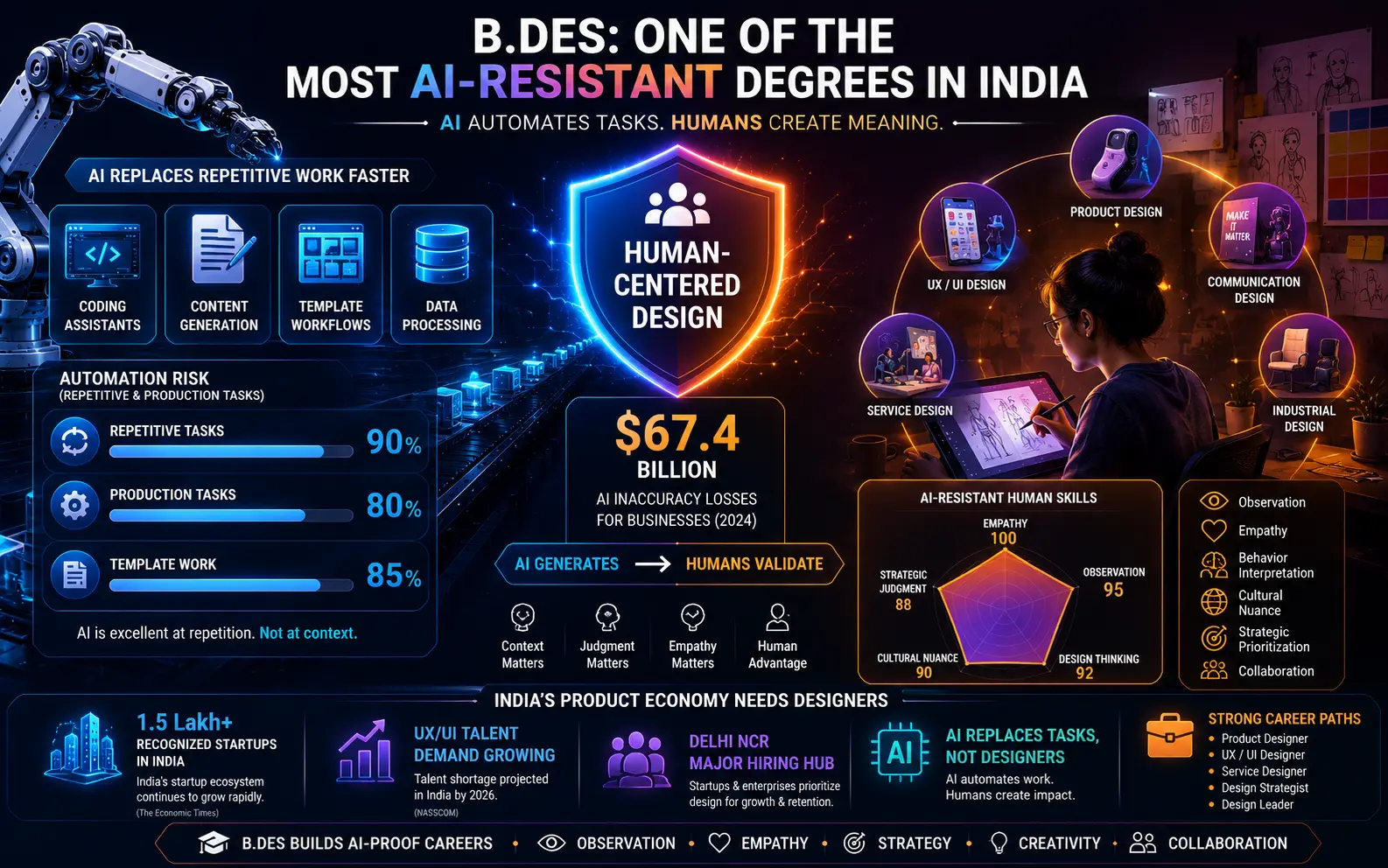
Generative AI automates repetitive production tasks faster than contextual human research. That explains why coding assistants, automated writing tools, and template-based workflows expanded rapidly across industries in 2025 and 2026.
However, AI still struggles with contextual judgment.
AI models generate outputs using historical pattern prediction. They do not conduct ethnographic observation, field interviews, emotional interpretation, or human pain-point analysis.
AI tools can generate 50 homepage variations within minutes. They still cannot reliably identify why users in Tier-2 Indian cities abandon fintech onboarding flows due to trust signals, language friction, or payment anxiety. That distinction matters in India’s digital economy.
AI also continues affecting enterprise adoption. Reports estimate global business losses from AI-generated inaccuracies reached $67.4 billion in 2024. Businesses increasingly require human validation and contextual supervision before implementation.
Human-centered design relies on:
Observation
Empathy
Behavioral interpretation
Cultural nuance
Strategic prioritization
Interdisciplinary collaboration
These are not repetitive tasks. That makes many design functions structurally harder to automate compared to production-oriented workflows.
Despite AI’s capabilities, CEO of Microsoft Satya Nadella affirms that while AI is particularly good at repetitive tasks, it still lacks common sense and human judgment.
Aided by Founder of DeepLearning.AI, CEO of Landing AI, General Partner at AI Fund having firmly believed that AI will replace tasks, not jobs. And the tasks most easily replaced are repetitive ones.
B.Design Specializations AI Cannot Fully Replace in India
Several B.Design course specializations remain heavily dependent on human cognition and observation.
Product Design: Product designers analyze usability, ergonomics, safety, consumer behavior, and manufacturing feasibility. AI can generate concepts but cannot physically observe user interaction in real environments.
UX/UI Design: India’s digital product ecosystem depends on user retention and behavioral optimization. UX designers conduct interviews, usability testing, journey mapping, accessibility analysis, and friction identification.
Communication Design: Communication designers build visual systems aligned with audience psychology, language sensitivity, and regional identity. Cultural interpretation remains difficult for AI systems.
Industrial Design: Industrial designers work with physical prototyping, material behavior, manufacturing constraints, and human ergonomics. AI-generated visuals alone cannot replace iterative physical testing.
Service Design: Service design requires systems thinking across healthcare, banking, transport, and government experiences. Human observation drives workflow improvements.
The strongest AI-resistant factor across these fields is research dependency. AI produces outputs from existing dataset while designers create frameworks based on live human behavior. That difference explains why product companies continue hiring designers even after adopting generative AI tools.
At Rishihood University, students explore these specializations through interdisciplinary projects, industry interaction, and practical studio learning connected to real user and market challenges.
B.Design vs B.Tech Artificial Intelligence in India
Students increasingly compare Bachelor of Design degrees with B.Tech AI programs because both appear future-focused. However, the automation exposure differs significantly.
AI engineers build systems that may eventually automate portions of technical implementation work. Designers define how humans interact with those systems.
A product still requires:
User Flows
Accessibility Logic
Emotional Usability
Behavioral Mapping
Trust Architecture
Visual Hierarchy
Onboarding Optimization
Therefore affirming that AI-powered products would always require human-centered interfaces.
Delhi NCR startups increasingly hire hybrid professionals who understand AI-assisted design workflows while maintaining strong research and communication capabilities.
That combination creates long-term career flexibility for B.Design graduates.
Why Human Observation Still Dominates Product and UX Design
User research remains one of the strongest barriers against full automation which includes observations stated below as AI systems cannot independently make them. ;
Hesitation Patterns
Emotional Reactions
Accessibility Friction
Navigation Confusion
Behavioral Inconsistencies
Trust Issues
For example, healthcare app users in Haryana may struggle with English-heavy interfaces and elderly banking users in Delhi NCR may require larger interaction zones and simpler navigation structures. These problems emerge through observation, not pattern generation alone, which means that you will always need human intervention.
Human-centered design depends on:
Contextual Interviews
Usability Testing
Non-Verbal Interpretation
Emotional Feedback Analysis
Accessibility Prioritization
AI can summarize interview transcripts but cannot fully understand human discomfort signals, hesitation behavior, or socio-cultural interpretation. That limitation keeps UX and product design highly relevant despite rapid AI adoption.
India’s expanding app economy strengthens this demand further. SaaS companies, fintech startups, ecommerce platforms, and healthcare applications continuously optimize retention and usability metrics and human observation remains central to that process.
Communication Design Courses in India and AI Resistance
Communication design remains harder to automate because branding decisions rely heavily on interpretation, positioning, and audience psychology. While AI can generate posters, logos, or layouts. It still struggles with:
Regional Cultural Nuance
Campaign Emotion
Political Sensitivity
Consumer Trust Signaling
Long-Term Brand Consistency
Communication design courses in India increasingly teach:
Visual Systems
Storytelling Frameworks
Advertising Psychology
Typography Strategy
Motion Communication
Brand Architecture
Indian markets also require multilingual adaptation across Hindi, English, Punjabi, Haryanvi, Tamil, Bengali, and regional audience groups.
That complexity creates stronger human dependency.
For example, startup brands in Gurgaon or Noida targeting Gen Z users require completely different communication systems compared to healthcare brands targeting middle-aged audiences in Haryana.
AI generates outputs based on prompts. Communication designers build strategic positioning systems and that strategic layer remains difficult to automate fully.
Product Design Careers in India After AI Adoption
India’s startup ecosystem crossed more than 1.5 lakh recognized startups, creating strong demand for product-focused professionals. (The Economic Times)
The country’s SaaS, fintech, mobility, healthtech, and ecommerce sectors continue expanding rapidly across Bangalore, Delhi NCR, Hyderabad, and Pune.
Product design demand increased because companies compete heavily on:
Usability
Retention
Onboarding Efficiency
Customer Experience
Accessibility
Product Simplicity
The Indian UI/UX market also faces a projected talent shortage by 2026, while hiring demand continues growing across digital businesses.
Delhi NCR has become a major hiring hub for:
Ux Designers
Product Designers
Interaction Designers
Service Designers
Communication Designers
Large enterprises and startups increasingly prefer designers who understand AI-assisted workflows without depending entirely on automation.
Industrial product demand also remains strong in:
Consumer Electronics
Healthcare Devices
Automotive Systems
Smart Appliances
Wearable Technology
These sectors require physical prototyping, ergonomic testing, and contextual human evaluation.
AI tools support workflows. Human-centered design still drives execution decisions.
AI-Proof Skills Students Build in a B.Design Course
A modern B.Design course develops interdisciplinary skills that extend beyond visual production.
Problem Framing -Designers identify root causes before generating solutions. AI tools usually operate after receiving structured prompts.
Strategic Thinking -Students learn system mapping, product alignment, and business-context analysis.
User Empathy - Empathy-driven observation remains difficult for automation systems.
Design Systems- Design students build scalable interface and branding systems instead of isolated outputs.
Communication Skills - Designers continuously collaborate with developers, marketers, researchers, founders, and stakeholders.
Interdisciplinary Collaboration -A bachelor of design program often combines psychology, technology, storytelling, business logic, and visual communication.
These skills create adaptability across industries.
For example, a UX designer may later transition into:
Product Management
Service Strategy
Design Leadership
Startup Consulting
Customer Experience Systems
That flexibility strengthens long-term employability compared to narrowly repetitive technical workflows.
At Rishihood University, this interdisciplinary approach combines design with entrepreneurship, psychology, storytelling, technology, and systems thinking through experiential projects and collaborative learning environments.
Bachelor of Design Colleges in India: What Students Should Evaluate
Students evaluating Bachelor of Design colleges in India should focus on employability signals instead of only campus branding.
Accreditation: Institutes should maintain recognized academic and industry credibility.
Studio Learning
Strong design education depends heavily on practical studio exposure instead of theoretical memorization.
Internship Access
Industry internships improve portfolio quality and placement outcomes.
Live Projects
Students should work on real product or communication problems.
Portfolio Development
Employers prioritize portfolios more than academic marks in design hiring.
Placement Ecosystem
Students in Delhi NCR and Haryana should evaluate industry partnerships with startups, SaaS firms, product companies, and digital agencies.
Important evaluation factors include: A strong B.Design program should train students to work alongside AI tools while maintaining human-centered strategic thinking.
Salary and Hiring Trends for B.Des Graduates in India
UX/UI and product design salaries in India increased significantly due to digital transformation and hiring shortages.
Entry-level salary ranges for B.Des graduates typically include:
Role | Average Entry Salary | Information Source |
UX/UI Designer | ₹4–7 LPA | |
Product Designer | ₹7–18 LPA | |
Communication Designer | ₹5–12 LPA | |
Interaction Designer | ₹7–17 LPA |
Mid-level product designers in major startup ecosystems often cross ₹15–25 LPA depending on specialization and portfolio strength.
Delhi NCR, Bangalore, Hyderabad, and Pune remain major hiring markets.
Remote work opportunities also expanded after widespread digital adoption. Indian designers increasingly work with international SaaS companies and global product teams.
India’s digital economy growth projection toward 20% GDP contribution by 2030 continues supporting design hiring across industries. (The Economic Times)
As businesses adopt AI systems, demand for human-centered product experiences also rises that creates an important shift:
AI automation increases the need for better interface design and usability optimization instead of replacing designers entirely, AI often increases demand for higher-level design strategy roles.
Can AI Become a Tool Instead of a Threat for Designers?
AI increasingly functions as a productivity layer for designers instead of a direct replacement.
Modern design workflows already use AI for:
Wireframe Generation
Image Production
Rapid Ideation
Copy Suggestions
Layout Exploration
Research Summarization
However, human supervision remains necessary for:
Contextual Accuracy
Accessibility Decisions
Emotional Usability
Strategic Alignment
Cultural Sensitivity
Ethical Evaluation
The strongest designers in India will likely become hybrid professionals who combine human-centered research with AI-assisted execution.
That shift changes workflows, not the relevance of design itself.
Students entering a Bachelor of Design program today should learn both design cognition and AI collaboration systems and it will be this combination that creates stronger long-term adaptability which enables and empowers the workforce of the present day.
Frequently Asked Questions :
1. What makes a B.Design degree different from other professional degrees?
A Bachelor of Design (B.Des) focuses on creativity, empathy, innovation, visual storytelling, and human-centered problem solving. Unlike repetitive technical tasks, design requires emotional intelligence and originality—areas where AI still has limitations.
2. Why is AI less likely to replace designers completely?
AI can generate content and automate processes, but it cannot fully understand human emotions, cultural nuances, aesthetics, or lived experiences the way human designers can. Designers create meaning, not just outputs.
3. How is design becoming important in India’s growing economy?
India’s digital economy, startups, e-commerce platforms, gaming industry, and tech ecosystem increasingly rely on UI/UX, product design, branding, animation, and communication design to improve user experience and customer engagement.
4. Can AI tools help B.Design students instead of replacing them?
Yes. AI acts as a support tool for designers by assisting with ideation, prototyping, editing, and automation. Designers who learn to work alongside AI will likely become more productive and valuable.
5. Which B.Design specializations are most future-proof?
There are a number of fields under Design that includes the list below that are expected to remain highly relevant because they depend heavily on creativity and human insight ;
UI/UX Design
Product Design
Animation & Game Design
Fashion Design
Interaction Design
Visual Communication
6. Why is empathy important in design?
A good design solves real human problems. Understanding emotions, behavior, accessibility, and social needs requires empathy—something AI cannot genuinely experience or replicate.
7. Is design only for artistic students?
No. B.Design combines creativity with research, psychology, technology, strategy, and communication. Many successful designers are analytical thinkers who enjoy solving practical problems creatively.
8. How does India’s cultural diversity benefit design careers?
India’s multilingual and multicultural society creates huge demand for localized and culturally sensitive designs in media, fashion, advertising, education, and digital platforms.
9. What industries hire B.Design graduates in India?
B.Des graduates are hired in:
IT & tech companies
Startups
Advertising agencies
Fashion and lifestyle brands
Gaming and entertainment
Architecture and product companies
Government innovation and public communication sectors
10. Can a B.Design graduate earn well in India?
Yes. Skilled designers in UI/UX, product design, animation, and branding can earn highly competitive salaries, especially with strong portfolios and industry experience.
11. Why are companies investing more in design thinking today?
Businesses now understand that user experience directly impacts customer satisfaction and profits. Design thinking helps organizations innovate, simplify products, and connect better with people.
12. What is the biggest reason AI cannot fully replace a B.Design graduate?
The core of design lies in imagination, ethics, intuition, storytelling, and human connection. AI may imitate creativity, but truly meaningful and socially relevant design still requires a human mind and perspective.