Technology
B.Tech Computer Science Syllabus 2026: What You’ll Actually Study (With AI & Industry Skills)
Explore the complete B. Tech computer science syllabus for 2026 with year-wise subjects, AI and ML topics, programming tools, course duration, and career outcomes.
01 June 2026
Table of Contents
Introduction
B.Tech Computer Science is a 4-year degree built on a structured credit system. Most programs in India require around 160–165 total credits and include 40–50 subjects spread across theory, labs, electives, and projects.
Most students want to know what they will study each year and how it prepares them for a real job.
That is a fair question. The B.Tech CSE syllabus in 2026 is not the same as it was in 2020. AI and machine learning are no longer optional extras. They are now part of the core curriculum in most good programs, including colleges in Delhi NCR and Haryana.
Software developer jobs are projected to grow by 25% between 2022 and 2032. AI and Data Science roles are growing even faster at 30% plus. The syllabus you follow determines how ready you are for those roles.
This post breaks down the B.Tech Computer Science syllabus and how it connects to your career.
B.Tech Computer Science: Course Structure at a Glance
The B.Tech Computer Science syllabus in 2026 is designed to move from fundamentals to specialization.
These subjects form the core of B.Tech Computer Science and define your technical foundation.
Year | Semestar | Focus |
Year 1 | 1 and 2 | Foundation: Maths, Physics, Basic Programming |
Year 2 | 3 and 4 | Core CS: Data Structures, OS, Databases |
Year 3 | 5 and 6 | Advanced: Networks, AI/ML, Specialisation Electives |
Year 4 | 7 and 8 | MAjor projects, Internships, Placements |
Standard program structure:
Duration: 4 years
Semesters: 8
Total credits: Approximately 160–165
Subject volume: Around 40–50 courses
Mandatory internships: Minimum 6–8 weeks
Final-year capstone projects: Industry or research focused
At Rishihood University in Haryana, this structure is strengthened through interdisciplinary learning, startup exposure, and industry-aligned curriculum.
Year 1: Mostly common across all engineering branches. It helps build the base, mathematics, logic, and basic coding.
Year 2: You move into core computer science subjects. This is where students either start loving the program or struggle with it.
Year 3: Here you pick electives like AI, cybersecurity, cloud, or data science. The subjects become more advanced and job-focused.
Year 4: Your major project, internship, and final electives all happen here.This year strongly influences your placement outcomes.
What makes 2026 different from earlier years
Several subjects that were earlier electives are now part of the core curriculum, especially in AI, cloud, and data systems.
First Year Subjects in B.Tech Computer Science
Year 1 is the same for almost every engineering student, regardless of branch.
What You Study in First Year
Engineering Mathematics I and II: Covers calculus, linear algebra, and basic probability. This becomes critical later for algorithms, AI, and data science.
Engineering Physics or Chemistry: Builds scientific fundamentals depending on the semester or university structure.
Basic Electrical and Electronics Engineering: Introduces circuits, current, voltage, and basic electronic components.
Programming for Problem Solving: Usually taught using C or Python, this is your first step into coding. You learn logic, loops, functions, and basic problem-solving.
Engineering Mechanics and Graphics: Covers physical systems and basic design concepts, often with practical lab work.
Labs and Practical Exposure
Along with theory, first year includes:
Programming lab
Physics or chemistry lab
Electrical lab
Workshop or engineering drawing sessions
A common mistake students make in Year 1
Many students underestimate the first year because it does not feel “core CS” yet. The first year may look broad, but it sets the base for advanced coding, systems, and AI coursework later.
At Rishihood University, students begin applying concepts early through projects and workshops, building a stronger foundation from Year 1.
Meet Ayush Vishnoi, a first-year B.Tech CSDS learner at Rishihood University who is building his clean chocolate brand, Origine 1847 with a clear focus of combining taste and health. |
Second Year Subjects in B.Tech Computer Science
This is where you move from basic coding to real systems.
Core Subjects You Study
Data Structures and Algorithms (DSA): This is the backbone of Computer Science. You learn how to organize data efficiently using arrays, stacks, queues, trees, and graphs.
Object-Oriented Programming (OOP): Usually taught using Java or C++, this introduces concepts like classes, objects, inheritance, and polymorphism.
Computer Organization and Architecture: Helps you understand how computers process instructions, memory, and hardware.
Discrete Mathematics: Covers logic, sets, graphs, and combinatorics, which are important for algorithms and problem-solving.
Operating Systems (Introductory): Introduces how systems manage processes, memory, and resources.
What these subjects actually build in you
Data Structures and Algorithms is the most important subject in your entire B.Tech. Every technical interview, from Google, product companies to a funded startup, tests this.
Database Management Systems teaches you how large amounts of data are stored and retrieved. This directly connects to real-world applications.
Operating Systems explains how your computer actually works beneath the surface. It is foundational for cloud computing, cybersecurity, and backend development roles.
Software Engineering is where you learn how large teams build and maintain real software products.
The Year 2 reality check
This year most students decide whether they enjoy Computer Science or not. At Rishihood University, students apply these subjects through real projects by Semester 4, making the learning more practical.
Third Year Subjects and Specializations in B.Tech CSE
By third year, students move into advanced systems and specialization.
Common third-year B.Tech CSE subjects:
Operating Systems (Advanced): Covers process scheduling, memory management, concurrency, and system performance.
Database Management Systems (DBMS): You learn how large-scale data is stored, retrieved, and optimized using SQL and database design.
Computer Networks: Explains how systems communicate over the internet, including protocols, security basics, and network architecture.
Software Engineering: Focuses on how large applications are designed, developed, tested, and maintained in teams.
What these subjects deliver
Computer Networks explains how data moves across the internet. It is foundational for cloud engineering, DevOps, and cybersecurity roles.
Artificial Intelligence and Machine Learning are core subjects in Year 3. This is where you start working with real datasets and building models.
Cloud Computing introduces platforms like AWS and Azure. Most software jobs today involve cloud in some form, so this subject directly maps to workplace skills.
Electives in Year 3 let you go deeper into a specific tracks, whether that is Data Science, Cybersecurity, or full stack development.
Final Year in B.Tech CSE: Projects, Internships, and Placements
Year 4 is less about studying and more about applying everything you have learned. The focus shifts to projects, internships, and placements.
Major Final Year Project
Every B.Tech CSE student is required to complete a major project, often spanning one or two semesters.
Typical project types include:
Full-stack web or mobile applications
AI or machine learning models
Data analytics dashboards
Cloud-based systems
Automation tools or software products
In strong programs, these projects are:
Industry-linked
Problem-driven
Built in teams
Evaluated on real-world usability
The placement reality
Most placements happen in Semester 7 and early Semester 8. That means your preparation needs to start in Year 3, not Year 4.
At Rishihood University, students do not wait until Year 4 to get industry exposure. With paid internships starting from Year 2 and mentorship from 100 plus industry leaders, most students enter their final year already ahead of the curve.
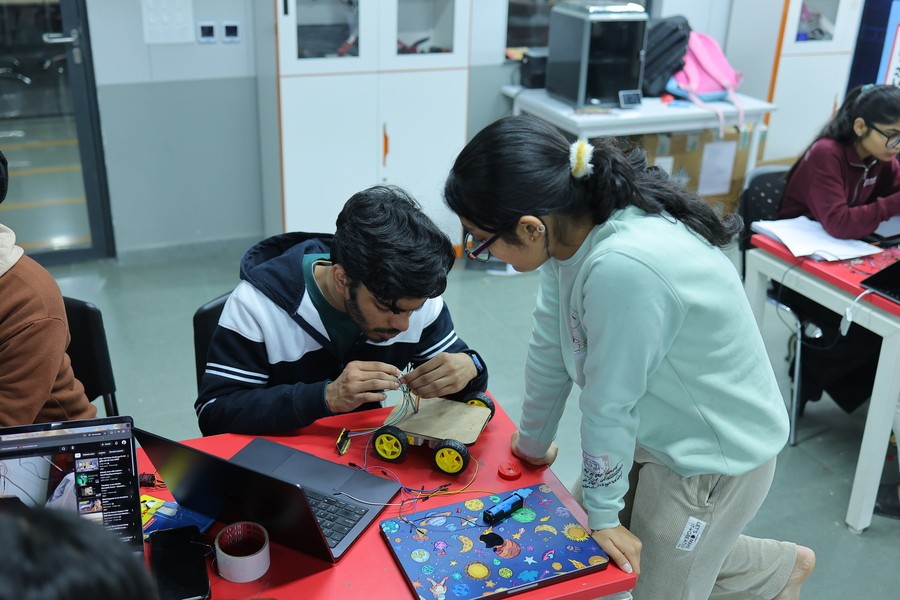
Tuhinsuvra Roy, a Rishihood-NST student, built a precision solid-fuel rocket in his first year. |
AI and Machine Learning Subjects in B.Tech CSE
AI and machine learning are now a standard part of the B. Tech Computer Science syllabus, especially in universities like Rishihood and across Delhi NCR and Haryana.
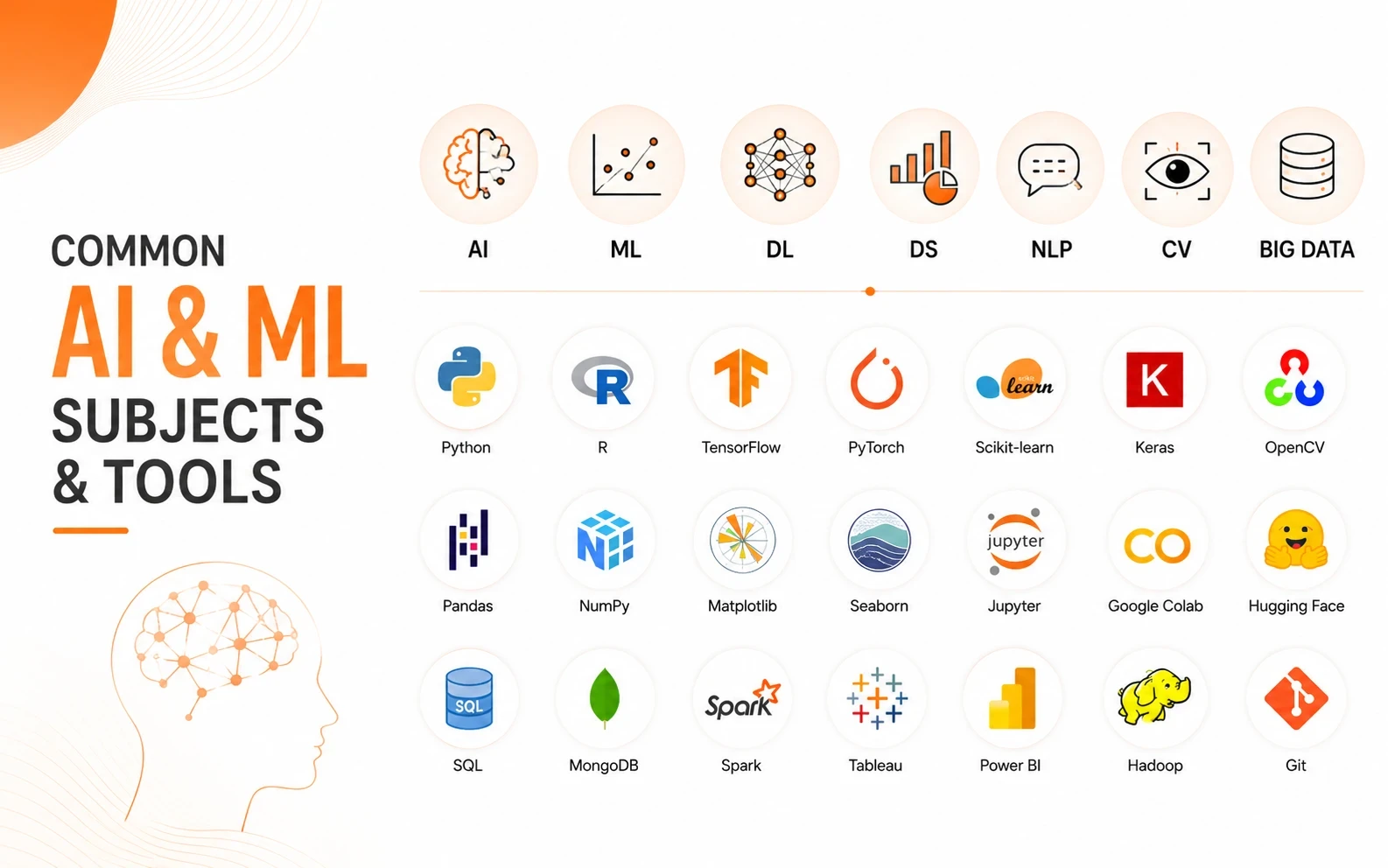
Common AI and ML subjects include:
Artificial Intelligence
Machine Learning
Deep Learning
Data Science Fundamentals
Natural Language Processing
Computer Vision
Big Data Analytics
How this connects to careers
Machine Learning teaches you how to train models using real datasets. Deep Learning goes further into neural networks and computer vision. Natural Language Processing covers how machines understand human language.
The tools you work with include Python, TensorFlow, Scikit-learn, and Pandas.
AI job postings in India grew by 320% year over year. Demand is outpacing supply by 4 to 1 right now.
Tools You Actually Use in B.Tech CSE
A modern B.Tech Computer Science syllabus goes beyond theory. It also includes the programming languages and tools that define how you actually build software.
Tool | Year | What You Use It For |
C / Python | Year 1 | First programs, logic building |
Java or C++ | Year 2 | OOP projects, structured apps |
SQL | Year 2 | Storing and retrieving data |
Git and GitHub | Year 2 onwards | Saving and sharing your code with teams |
Python + Pandas | Year 3 | Cleaning and analysing data |
Scikit-learn, TensorFlow | Year 3 | Building ML and AI models |
AWS or Azure basics | Year 3 | Deploying apps on the cloud |
Your syllabus builds theory, but practical skills make you job-ready.
Read: Why Divya Bhatt, a second year BSc Psychology learner who scored the highest marks in Psychology in CUET UG, chose Rishihood over top central universities. |
B.Tech Course Fees in Delhi NCR Colleges
The cost of a B.Tech Computer Science degree in Delhi NCR varies based on the type of institution and the level of industry exposure offered.
College Type | Annual Fee Range |
Government Colleges (Haryana) | Rs 20,000 to Rs 80,000 per year |
State NITs | Rs 1.25 to 1.5 lakh per year |
Mid-tier Private Colleges | Rs 1 to 2 lakh per year |
Premium Private Universities | Rs 3 to 5 lakh per year |
What matters beyond fees
Fee alone does not determine value. The real return depends on:
Internship opportunities
Industry exposure
Placement outcomes
Skill development
At Rishihood University, the focus is on employability, interdisciplinary learning, and practical exposure.
The university also offers scholarships based on Class 12 marks and interview performance. Students can earn stipends from internships starting Year 2, which helps reduce the overall fee burden.
B.Tech Admission Process in Haryana and Delhi NCR Colleges
The admission route depends on the type of college you are applying to.
1. Government and NIT admissions
Appear for JEE Main (Over 11 lakh students appear each year)
Register for JoSAA counselling
Admission is based on rank, category, and seat availability
2. State Counselling (Haryana, Delhi NCR)
Conducted through centralized counselling processes
Admission based on JEE rank or Class 12 marks (in some cases)
Usually includes multiple rounds, allowing upgrades in branch or college
3. Private universities like Rishihood University
No JEE score required
Minimum 60% in Class 12 Science stream with PCM
Followed by a personal interview
Faster process than national counselling
Students who have not appeared for JEE can still secure a strong B.Tech seat through this route.
Rishihood University Offering B.Tech CSE with AI in Haryana
Rishihood University in Sonipat offers B.Tech in CS and AI and B.Tech in CS and Data Science under the Rishihood-Newton School of Technology.
What makes it different
Curriculum designed with inputs from industry experts
Early exposure to AI, machine learning, and real-world problem-solving
Internships and live projects starting from early semesters
Focus on building job-ready skills alongside core CS fundamentals
Students are not limited to theory. They work on real applications, participate in tech competitions, and build portfolios that align with current hiring expectations.
Programs to explore
Career Roles After B.Tech CSE in India
CSE graduates often secure some of the highest offers. The degree opens doors across software, AI, cloud, cybersecurity, product development, and data-driven industries.
Career Role | Average Starting Salary (India) | Average Starting Salary (Delhi NCR) |
Software Developer | Rs 4 to 7 LPA | Rs 5 to 10 LPA |
Backend Engineer | Rs 5 to 8 LPA | Rs 6 to 12 LPA |
Data Analyst | Rs 4 to 6 LPA | Rs 5 to 9 LPA |
ML and AI Engineer | Rs 6 to 10 LPA | Rs 8 to 14 LPA |
Cloud Engineer | Rs 5 to 9 LPA | Rs 7 to 12 LPA |
Cybersecurity Analyst | Rs 4 to 8 LPA | Rs 6 to 11 LPA |
DevOps Engineer | Rs 5 to 9 LPA | Rs 7 to 13 LPA |
Full Stack Developer | Rs 5 to 8 LPA | Rs 6 to 12 LPA |
Key insights:
Software Developer roles are still the highest in volume across India. AI and ML roles are expected to grow significantly by 2030 (McKinsey report).
Delhi NCR salaries are typically 10 to 30% higher than the national average. This is because of the high concentration of GCCs, product companies, and funded startups in Gurgaon and Noida.
India's IT sector employs over 5.4 million professionals. Software developer jobs are projected to grow by 25% between 2022 and 2032. The demand is real. But outcomes depend on how well your syllabus prepares you.
At Rishihood University, top recruiters include companies from product, IT services, analytics, and startup sectors across Delhi NCR.
FAQs
What subjects are included in B.Tech Computer Science syllabus in Haryana?
B.Tech Computer Science typically includes Mathematics, Physics, programming, Data Structures, Algorithms, DBMS, Operating Systems, Computer Networks, Software Engineering, AI, Machine Learning, and final-year projects or internships.
Is AI and ML included in B.Tech CSE in Sonipat colleges?
Yes. Many modern institutions, including Rishihood University, increasingly integrate AI, Machine Learning, and Data Science into their Computer Science curriculum.
What is the duration of B.Tech CSE in Haryana universities?
The standard duration is 4 years, with approximately 160–165 credits required for graduation.
What are the fees for B.Tech Computer Science in Haryana?
Fees vary by institution. Government colleges may range from ₹50,000–₹2 lakh annually, while private universities often range from ₹1.5–₹5 lakh+ per year.
How many semesters are in B.Tech CSE?
A B.Tech Computer Science degree consists of 8 semesters over 4 years, covering core subjects, electives, labs, internships, and a final-year project.
What is the admission process for B.Tech in Haryana?
Students can apply through JEE Main, Haryana state counselling, or direct admission in private universities. Institutions like Rishihood University admit students through their own aptitude test (RSAT) and interview, with no JEE score required.