Technology
B.Tech Course Details Explained: Subjects, Duration, Fees and Career Scope After 12th
B.Tech (Bachelor of Technology) is a 4-year engineering degree that turn science & maths concepts into practical skills. It employs 5.4 million+ professionals
19 May 2026
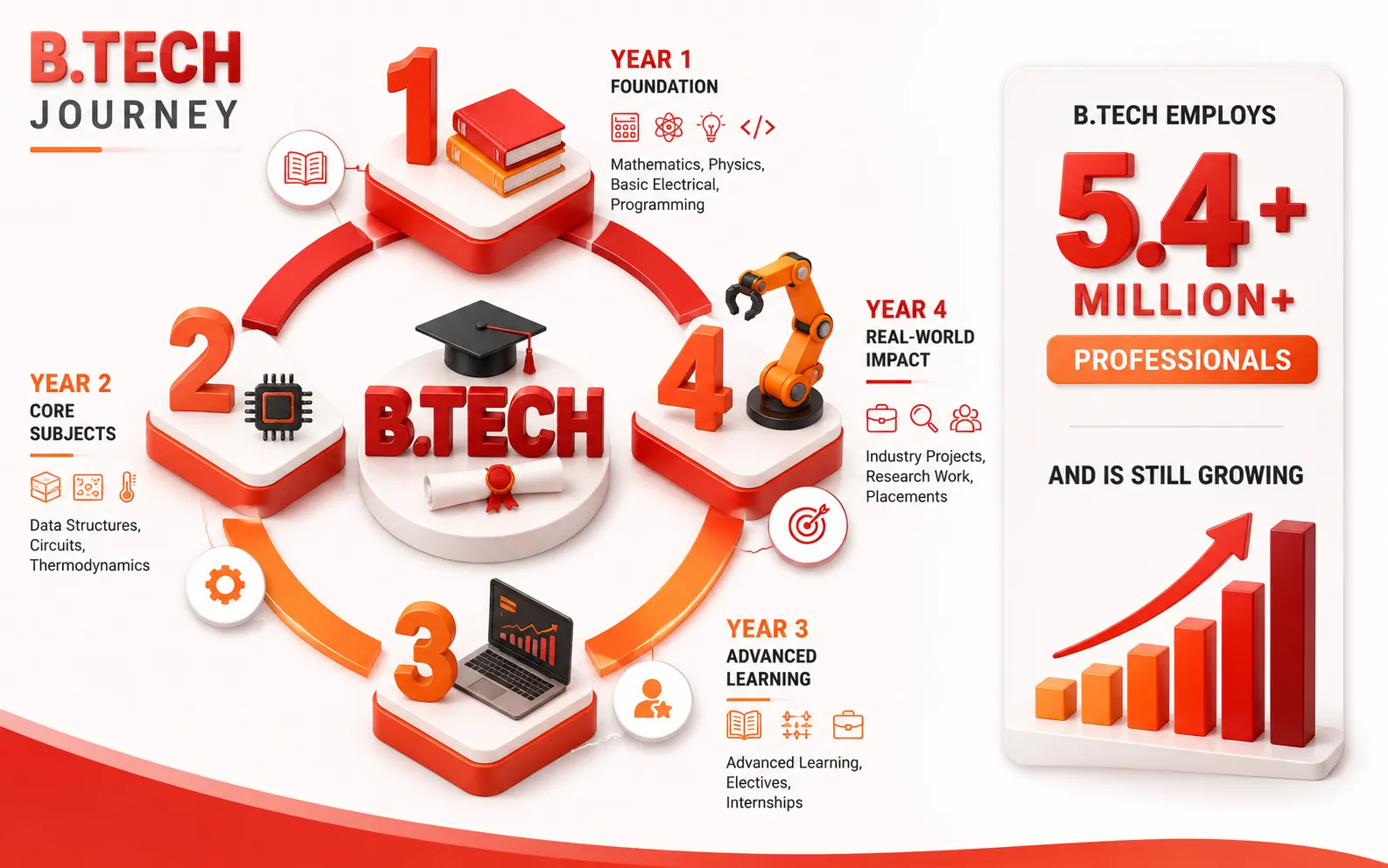
Table of Contents
Introduction
Finished Class 12 and thinking about B.Tech? Read this article before you fill out a form.
Every year over 11.7 lakh students appear for JEE Main, all competing for one goal. A B.Tech seat that actually pays off four years later. But most students focus on the wrong question: Which college should I join? The smarter question is: Which branch should you choose?
Pick the right branch, especially in 2026 when AI and Data Science roles are expanding rapidly, and you improve your chances of better internships and stronger starting salaries.
For students in Delhi NCR, nearby education hubs like Sonipat add a unique advantage: access to a larger job market, internships, startups, and better affordability. This guide breaks down everything: what you’ll study, what it costs, which branch fits you, and what kind of ROI you can realistically expect from your B.Tech program.
What is B.Tech: Duration and course structure?
B.Tech (Bachelor of Technology) is a four-year engineering degree designed to turn science and maths concepts into practical skills. It connects directly to India’s tech economy, which employs 5.4 million+ professionals and is still growing.
Typical B.Tech subjects include:
Year 1: Foundation subjects like Mathematics, Physics, Basic Electrical, and Programming
Year 2: Core subjects such as Data Structures, Circuits, or Thermodynamics
Year 3: Advanced learning, electives, and internships
Year 4: Industry projects, research work, and placements.
In Delhi NCR and Sonipat, several universities offer residential B.Tech with industry-integrated curricula. For instance, students at Rishihood University do not need to wait for Year 3 to get real-world exposure. Internships and live projects begin from Year 1 or 2.
What does B.Tech actually feel like on the ground?
For most students, the answer depends on the environment they choose. At colleges with industry-integrated curricula, the gap between classroom and career closes much faster. At Rishihood University, that shift begins in the first semester, where students do not wait for placement season to start thinking about their future.
Read: Why Divya Bhatt, a second year BSc Psychology learner who scored the highest marks in Psychology in CUET UG, chose Rishihood over top central universities.
B.Tech eligibility criteria
To apply for B.Tech after 12th, students usually need:
Subjects required: Physics, Chemistry, and Mathematics (PCM)
Minimum marks: 45% to 75% marks in Class 12 (varies by college/category)
Entrance exams:
JEE Main: ~11.7 lakh candidates compete every year
State counselling (like Haryana): usually 3+ rounds of seat allocation
For private universities like Rishihood University, Sonipat: Minimum 60% in Class 12 (Science stream) + RSAT aptitude test + personal interview. No JEE score required.
B.Tech courses list in India
B.Tech offers a wide range of specializations, and each leads to very different career paths.
High-demand tech branches
Computer Science Engineering (CSE)
Artificial Intelligence & Machine Learning
Data Science
Information Technology
Cyber Security
Core engineering branches
Mechanical Engineering
Civil Engineering
Electrical Engineering
Electronics & Communication Engineering
Emerging / Niche branches
Robotics Engineering
Biotechnology
Mechatronics
Automobile Engineering
Aerospace Engineering
Environmental Engineering
Which B.Tech should you choose? Quick decision path for PCM students after 12th?
Choosing a B.Tech branch becomes much easier when you break it into steps:
Step 1: Identify your interest
Coding, apps, data → CSE, AI, Data Science
Circuits, electronics → ECE, Electrical
Machines, production → Mechanical
Infrastructure, construction → Civil
Step 2: Check market demand
High growth: CSE, AI, Data Science
Stable: Core engineering branches
Step 3: Compare colleges (especially in Delhi NCR)
Placement records
Internship opportunities
Fees vs ROI
Step 4: Start early
Learn basic coding before Year 1
Build projects by Year 2
This simple framework helps you avoid the most common mistake: choosing a branch based on availability instead of long-term outcomes.
B.Tech Computer Science and Engineering overview
B.Tech Computer Science and Engineering (CSE) continues to attract a large share of students. This is because it connects directly with high-growth industries such as software, cloud, cybersecurity, fintech, gaming, analytics, and AI.
A B.Tech computer science degree teaches students how computers work, how software is built, and how large systems handle data securely and efficiently.
You’ll work with:
Programming languages (C, C++, Java, Python)
Core subjects like Data Structures, Algorithms, Operating Systems, and Databases
Practical skills like app development, web systems, and cloud basics
The real advantage: CSE skills are flexible. You’re not locked into one industry. Software talent is needed across almost every industry.
B.Tech CSE with AI and ML specialisation
B.Tech CSE with AI and ML builds on core computer science and adds specialised learning in artificial intelligence, machine learning, and data-driven systems. It is ideal for students who want to work on automation, smart products, recommendation systems, analytics, and future-facing technologies.
However, AI/ML roles are still fewer than general software roles. Most students start with core development roles before moving into AI or data-focused positions. At Rishihood University, the B.Tech CS & AI is a 4-year course offered in partnership with the Rishihood-Newton School of Technology (NST).
Key highlights of Rishihood’s B.Tech CSE program:
Curriculum designed and taught by experts from Google and Microsoft
93% of 2nd-year students secured paid internships
20+ high-intensity tech and AI workshops
Mentorship from 100+ CXOs, VCs, and startup founders
Participation opportunities in GSOC, ICPC, and global competitions
Dedicated Research Labs
This is the real difference between industry-integrated learning and a course that simply adds “AI” to its name.
Build your future with Code and AI. Apply for a 4-year B.Tech degree in CS and AI |
B.Tech course list in first year (all branches)
The first year of B.Tech is common across almost all branches.
Here’s what you’ll study:
Engineering Mathematics I and II: calculus, algebra, basic probability
Engineering Physics / Chemistry: depending on the semester
Basic Electrical and Electronics Engineering
Engineering Mechanics
Programming for Problem Solving (usually C or Python)
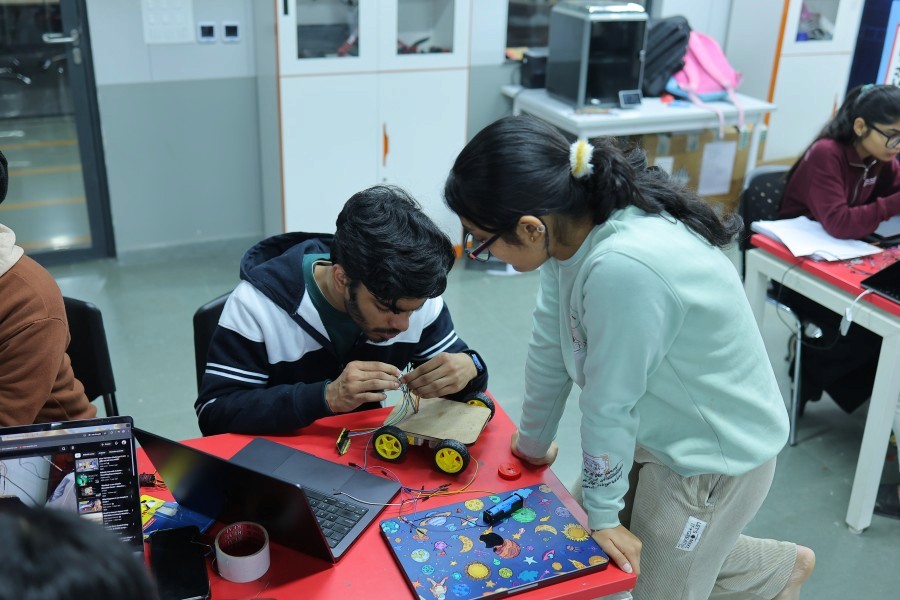
Engineering Graphics / Workshop (hands-on practicals)
Alongside theory, you’ll have:
Lab sessions (coding, physics, electrical)
Internal assessments + end-sem exams
Most students underestimate this year. But this year quietly sets up everything that follows, especially for coding and analytical subjects in later semesters.
B.Tech Computer Science syllabus
The B.Tech CS syllabus becomes sharply focused from the second year onward.
Year 1: Foundation
Mathematics, basic programming, physics, electrical fundamentals
Year 2: Core coding + logic
Data Structures and Algorithms
Object-Oriented Programming (Java/C++)
Computer Organization & Architecture
Year 3: Systems + specialization
Operating Systems
Database Management Systems (DBMS)
Computer Networks
Intro to AI / electives (cloud, cybersecurity, etc.)
Year 4: Application + industry readiness
Major project (often internship-linked)
Advanced electives (AI, ML, Data Science, DevOps)
By the end of 4 years, the syllabus of Rishihood University moves you from writing basic code → building full systems → solving real-world problems.
Meet Tuhinsuvra Roy, a Rishihood-NST student who built a precision solid-fuel rocket in his first year. |
B.Tech course fees in India (Govt vs private)
B.Tech fees vary by college type, location, and facilities.
Government Colleges
IITs: approximately ₹2–2.5 lakh per year
NITs: approximately ₹1.25–1.5 lakh per year
State Govt. Colleges (Haryana): ₹20,000–₹80,000 per year
Private Universities
Mid-tier private colleges: ₹1–2 lakh per year
Premium private universities: ₹3–5 lakh per year
In Delhi NCR and nearby hubs like Sonipat, you often get a middle ground:
Lower fees than top-tier private universities in metros
Access to NCR’s job and internship ecosystem
A ₹10–12 lakh private degree with strong placements can outperform a low-cost degree with weak industry exposure.
Rishihood University, Sonipat offers scholarships based on Class 12 marks and interview performance. It also provides paid internships from 2nd year onwards with an average stipend of ₹25,000 reducing overall fee burden.
B.Tech admission process in India
The B.Tech admission process in India follows a standard path.
Step 1: Check eligibility: Ensure you meet PCM and minimum marks requirements.
Step 2: Appear for entrance exams: Common routes include:
JEE Main
State counselling admissions
University entrance tests
Merit-based private admissions
Step 3: Register for counselling: Fill choices of colleges and branches.
Step 4: Seat allotment: Seats are allotted based on rank, category, preferences, and availability.
Step 5: Document verification: Typical documents required:
Class 10 marksheet
Class 12 marksheet
ID proof
Entrance scorecard
Category certificate (if applicable)
Step 6: Fee payment and final admission: Many states conduct 3 or more counseling rounds, helping students upgrade their branches or college choices based on available seats.
B.Tech branch comparison: Salary, demand and scope
Here’s what fresh graduates actually earn:
CSE, AI, Data Science: Highest demand + fastest salary growth
ECE, Electrical: Moderate demand + hybrid roles (core + IT)
Mechanical, Civil: Lower demand growth + slower salary progression
In Delhi NCR, salaries can be 10–30% higher due to:
More startups and tech companies
Higher demand for developers and analysts
Better internship pipelines during college
A student who combines the right branch with strong projects and internships often outperforms peers who rely only on college brand value.
Branch + skills + location = salary. Ignore any one, and your ROI drops.
Career scope and in-demand skills after B.Tech Computer Science
Career opportunities after B.Tech Computer Science are flexible.
Core tech roles
Software Developer / Engineer
Backend / Frontend / Full Stack Developer
Mobile App Developer
Data + AI roles
Data Analyst / Data Scientist
Machine Learning Engineer
AI Engineer
Systems + infrastructure
Cloud Engineer
DevOps Engineer
Cybersecurity Analyst
Alternative paths
Product Management (after some experience)
Startups / freelancing
Higher studies (M.Tech, MBA, MS abroad)
India’s IT sector employs more than 5.4 million professionals, highlighting the continued value of a B.Tech Computer Science degree.
In Delhi NCR, students often get internships in Year 2–3 that convert into full-time roles.
Top recruiters for B.Tech graduates in Delhi NCR
Delhi NCR is one of India's top two tech hiring hubs alongside Bengaluru. B.Tech graduates from CSE, CS and AI, and Data Science streams are actively recruited by:
Product and Tech Companies: Google, Microsoft, Amazon, Adobe, Atlassian, Paytm, PhonePe, Razorpay, Zomato, Meesho
IT Services and Consulting: TCS, Infosys, Wipro, HCL Technologies, Tech Mahindra, KPMG India, Deloitte
Startups and Unicorns: Dozens of Delhi NCR-based funded startups actively recruit from local universities with strong placement cells and industry-integrated curricula
BFSI and Analytics: HDFC, ICICI, American Express, and analytics firms hiring data scientists and AI engineers
The takeaway: Proximity to NCR doesn’t guarantee a job, but it multiplies your chances.
How to choose the right B.Tech path in 2026
Still figuring out if B.Tech is the right call?
Skip the brochures for a moment. The best signal is always a real student's story. Someone who sat where you're sitting, made a choice, and built something from it. At Rishihood, those stories aren't hidden in alumni newsletters. They're happening in Year 1 and Year 2, in labs, in startups, and on global competition stages.
See one such story here: Design. Innovate. Inspire.
Your four years will be shaped by the environment you choose. Choose one where stories like this are the norm.
Remember: Your branch + your skills + your environment will decide your outcome, not the degree alone. So before you finalize your decision, think long-term. Look at where demand is growing. Choose a path where you can build, experiment, and stay consistent for 4 years.
Apply in B.Tech CS and AI or CS and Data Science at Rishihood University, Sonipat. Download the Brochure.
FAQs
What is the duration of B.Tech after 12th in India?
The standard B.Tech duration is 4 years, divided into 8 semesters. Each year includes theory classes, lab work, internal assessments, and exams. In the final year, many students also complete major projects, internships, or placement preparation alongside academics.
What are the main subjects in B.Tech Computer Science?
B.Tech Computer Science typically covers both fundamentals and advanced technical subjects. Core areas include programming, data structures, algorithms, databases, operating systems, computer networks, software engineering, and object-oriented programming.
What is the average B.Tech course fee in Haryana?
B.Tech fees in Haryana vary by college type and facilities. In private colleges, fees often range from ₹1.5 lakh to ₹4 lakh per year. In government institutions, fees are generally lower and may range from ₹50,000 to ₹1.5 lakh per year. Scholarships, merit aid, and paid internships can reduce the overall cost for many students.
Which B.Tech branch has the highest salary in India?
There is no single branch that guarantees the highest salary for every student. However, Computer Science Engineering (CSE), Artificial Intelligence, Data Science, and related tech fields often offer stronger starting packages due to hiring demand.
What is the syllabus of B.Tech CSE with AI and ML?
The syllabus usually combines core Computer Science subjects with specialised AI-focused learning. Students study topics such as programming, data structures, operating systems, databases, ML, AI, deep learning, natural language processing (NLP), computer vision, and analytics. Many programs also include real-world projects, hackathons, and internships.
Is B.Tech from private colleges in NCR worth it?
Yes, it can be worth it when the college offers strong outcomes instead of only a degree. Look for factors such as experienced faculty, updated curriculum, internships, placement support, modern labs, industry projects, and recruiter access.
What is the eligibility for B.Tech after 12th PCM?
Students usually need to complete Class 12 with Physics, Chemistry, and Mathematics (PCM) from a recognised board. Minimum marks vary by institution, and some colleges also require entrance exams such as JEE Main, state counselling eligibility, or university-specific tests/interviews.
What are the job options after B.Tech CSE in Delhi NCR?
B.Tech CSE graduates in Delhi NCR can explore roles across startups, IT services, product companies, and enterprise firms. Common job options include software developer, backend engineer, frontend developer, full stack developer, data analyst, cloud engineer, cybersecurity analyst, DevOps engineer, AI engineer, and product-focused tech roles.