Business
BBA vs BCom: Understanding the Key Differences
BBA vs BCom: Understanding the Key Differences to decide which option is better for you in 2026
28 March 2025

Table of Contents
Higher education is often the first step toward a successful career, and for students inclined toward business and commerce, the choice between a BBA vs BCom can shape their professional trajectory. While both degrees offer insights into the world of business, their approach, structure, and career pathways differ significantly.
A Bachelor of Commerce (BCom) focuses on finance, accounting, taxation, and business laws, offering a solid theoretical foundation in commerce-related subjects. A Bachelor of Business Administration (BBA), on the other hand, is a management-oriented degree emphasizing leadership, entrepreneurship, and real-world business applications.
For those looking beyond conventional career paths, the Makers BBA at Rishihood University presents an evolved version of business education—one that blends business fundamentals with technology, design thinking, and entrepreneurship.
Let’s break down the difference between BCom and BBA in detail.
Course Structure and Curriculum
BCom: A Deep Dive into Commerce and Finance
The BCom curriculum is designed for students who want to specialize in finance, economics, taxation, and business laws. It lays a strong foundation for roles in accounting, banking, and corporate finance.
Key subjects in a BCom program include:
Accounting & Taxation – Financial accounting, auditing, and corporate taxation laws.
Economics & Business Law – Micro and macroeconomics, business regulations, and company law.
Financial Management – Investment analysis, risk management, and corporate finance.
Banking & Insurance – Fundamentals of financial institutions, insurance laws, and monetary policies.
While BCom provides depth in commerce-related fields, it leans more towards theory, making it ideal for students considering certifications like CA, CFA, or CS.
BBA: A Practical Approach to Business & Management
A BBA program is structured to develop managerial and leadership skills. Unlike BCom, which is heavily finance-driven, BBA integrates various aspects of business operations, including marketing, human resources, and entrepreneurship.
Core subjects include:
Business Strategy & Leadership – Decision-making, corporate governance, and organizational behavior.
Marketing & Sales – Consumer behavior, branding, and digital marketing strategies.
Human Resource Management – Employee engagement, talent acquisition, and workplace management.
Technology & Innovation – Data analytics, AI in business, and startup incubation.
For students who want to build their own ventures or take on leadership roles, a BBA offers the right mix of business acumen and innovation-driven learning.
The Makers BBA at Rishihood takes this approach even further, allowing students to integrate technology, design thinking, and entrepreneurial skills with business fundamentals. It’s not just about management—it’s about shaping the future of business.
BBA vs BCom in India: Market Demand & Industry Trends
Most comparisons stop at syllabus. That’s not enough. You need to understand where the market is actually going.
India’s service sector contributes ~55% of GDP, driving demand for management roles
The country has 63+ million MSMEs, creating constant demand for business graduates
India’s startup ecosystem has crossed 100,000+ startups, increasing demand for marketing, operations, and growth roles
What does this mean?
BCom demand is stable (finance, accounting, compliance roles)
BBA demand is expanding faster (management, startups, consulting, digital roles)
Companies today prefer candidates who can:
Communicate
Manage teams
Solve business problems
That naturally aligns more with BBA but only if the program is practical.
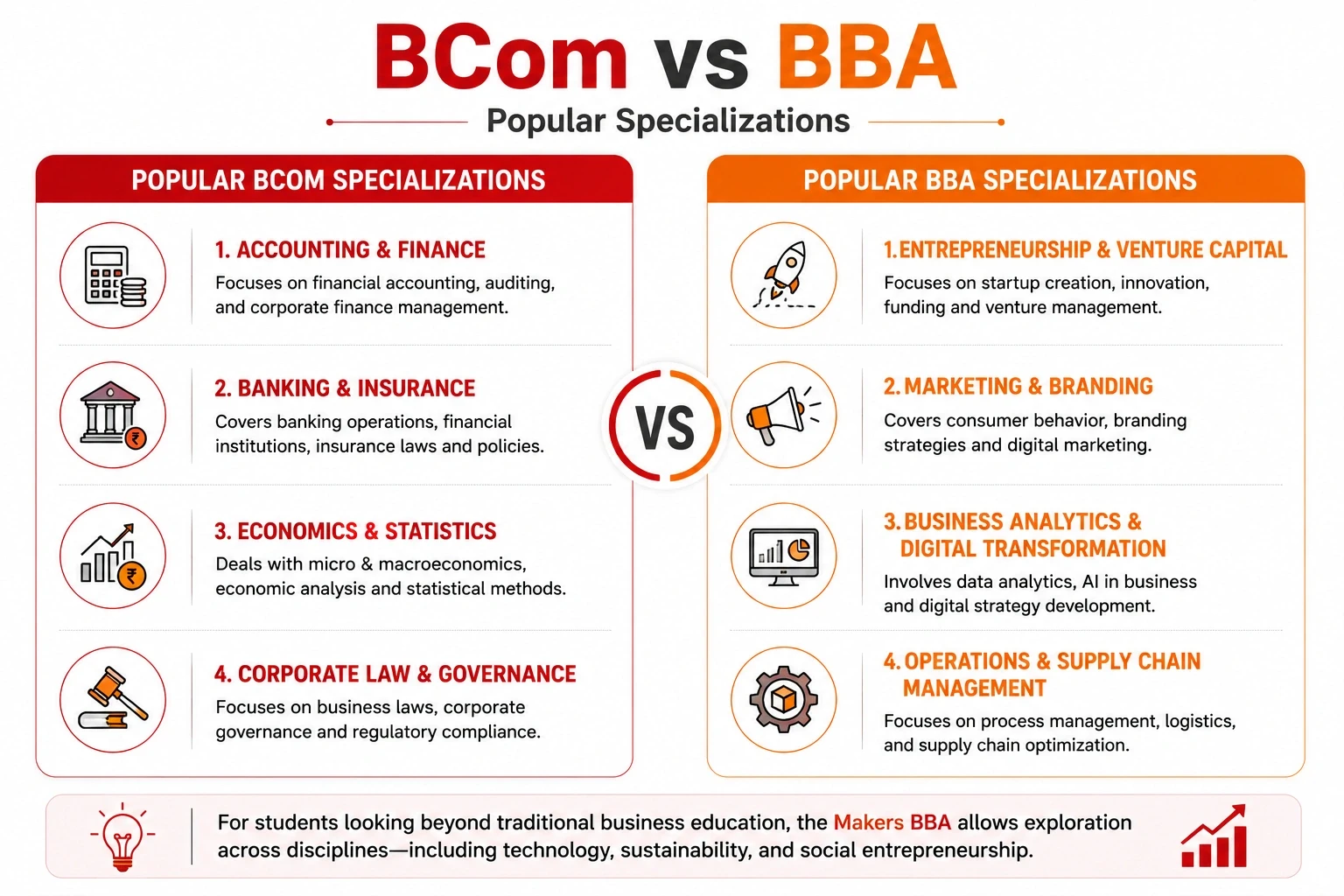
Popular BCom Specializations
Accounting & Finance
Banking & Insurance
Economics & Statistics
Corporate Law & Governance
Popular BBA Specializations
Entrepreneurship & Venture Capital
Marketing & Branding
Operations & Supply Chain Management
For students looking beyond traditional business education, the Makers BBA allows exploration across disciplines—including technology, sustainability, and social entrepreneurship.
BBA vs BCom Salary: What to Expect?
Both degrees offer strong career prospects, but BBA vs BCom salary comparisons reveal some differences based on industry and job roles.
Role | Average Salary After BCom | Average Salary After BBA |
Accountant | ₹3-5 LPA | ₹4-6 LPA |
Financial Analyst | ₹5-7 LPA | ₹5-8 LPA |
Marketing Manager | ₹5-8 LPA | ₹7-12 LPA |
Business Consultant | ₹6-10 LPA | ₹8-15 LPA |
Entrepreneur | Variable | Variable |
While BCom graduates often enter finance, auditing, and banking roles, BBA graduates have broader access to leadership positions in marketing, consulting, and startups. Those completing an Makers BBA can also explore tech-driven business roles, further increasing their market value.
Real Cost vs ROI: BBA vs BCom
Students obsess over fees but ignore return on investment.
BCom Cost in India
Government colleges: ₹20,000 – ₹1.5 lakh total
Private colleges: ₹2–5 lakh
BBA Cost in India
Mid-tier colleges: ₹3–8 lakh
Top private universities: ₹8–18 lakh
Now the reality:
Factor | BCom | BBA |
Cost | Lower | Higher |
Immediate ROI | Moderate | Depends on college quality |
Long-Term ROI | High (with CA/CFA) | High (with MBA/experience) |
Blunt truth:
Cheap BCom + strong certification = excellent ROI
Expensive BBA without internships = poor ROI
The degree itself doesn’t decide value. Execution does.
Career Opportunities: Where Do These Degrees Lead?
BCom Career Paths
Banking & Financial Services – Roles in investment banking, corporate finance, and financial analysis.
Accounting & Taxation – Chartered Accountancy (CA), Cost Accountancy (CMA), or Tax Consultant.
Government & Public Sector Jobs – SSC, UPSC, and RBI exams.
BBA Career Paths
Management & Consulting – Strategy roles in multinational companies.
Entrepreneurship & Startups – Building one’s own business.
Marketing & Digital Strategy – Careers in brand management and advertising.
The scope of BBA extends into innovation-driven roles, particularly for students who blend business acumen with technology. The Makers BBA offers an interdisciplinary approach, making graduates ready for business leadership, startups, or even tech-focused careers.
Skills Gap: Why Many Graduates Stay Unemployed
Here’s the uncomfortable truth most blogs ignore:
A large percentage of commerce graduates in India are not job-ready.
Why?
Over-reliance on theory
Lack of internships
Weak communication skills
No exposure to real business problems
What Companies Actually Want?
Excel & data handling
Communication & presentation
Problem-solving ability
Basic understanding of business operations
BBA programs should address this but many don’t.
That’s why practical exposure matters more than degree title.
BBA vs BCom: Which Has Better Future Scope?
Let’s remove the confusion.
BCom Future Scope:
Strong in traditional fields
Accounting
Taxation
Banking
Best paired with:
CA (Chartered Accountant)
CFA
CMA
BBA Future Scope:
Strong in dynamic fields
Marketing
Consulting
Startups
Business analytics
Best paired with:
MBA
Digital skills
Startup experience
Key Insight:
BCom = specialization-driven career
BBA = flexibility-driven career
If you don’t know your exact path yet, BBA gives more room to explore.
Higher Education: BBA or BCom – Which Is Better for MBA?
Many students consider their undergraduate degree as a stepping stone to an MBA. The question often arises: BBA or BCom which is better for MBA?
While both degrees provide a strong foundation, a BBA is more aligned with the MBA structure. It already covers management principles, strategy, and leadership—making the transition to an MBA smoother.
However, a BCom followed by an MBA in Finance is a powerful combination for those aiming for investment banking or financial management careers.
For students looking for an alternative to the traditional BBA-MBA path, the Makers BBA provides a head start. With entrepreneurial training, industry exposure, and tech integration, graduates already possess many of the skills that an MBA offers.
BBA vs B.Com: Which Is Better?
There is no one-size-fits-all answer to BBA vs B.Com which is better—it depends on individual goals:
If the aim is finance, accounting, or CA, a BCom is a better fit.
If the goal is entrepreneurship, leadership, or innovation, a BBA offers more opportunities.
Those looking for a flexible, multidisciplinary business education will find the Makers BBA to be a strong alternative.
A Bachelor of Business Administration (BBA) is an undergraduate degree which essentially focuses on business management and administration, self made entrepreneurship in the case of the Makers BBA here at Rishihood. There are three or four-year programs that develop perennially in high demand managerial and leadership abilities. Some BBA programs also focus on individual and self development, offering ample interdisciplinarity across psychology, design, Indic Knowledge, AI, tech, data, etc. Foundation programs also cover topics such as marketing, finance, human resources and operations management. BBA programs often include specialisations and focus on practical applications and experiential learning.
A Bachelor of Commerce (BCom) is also an undergraduate degree which focuses on commerce, economics and finance. The three-year course equips students with skills in accounting, financial analysis and business operations, alongside management and analytical skills. BCom provides a deeper understanding of theory, which can be useful if you wish to pursue further specialisations or professional certifications.
Both degrees have promising career prospects, including managerial positions. A BBA may be a better choice if you prefer a broad business education, while a BCom might be useful if you have a specific career path in mind, or wish to start your own business..
Finding the Right Fit: Best BBA Colleges in India
Choosing the right business program isn’t just about the degree—it’s about the experience, exposure, and skills gained. The best BBA colleges focus on experiential learning, industry collaborations, and interdisciplinary studies.
At Rishihood, the Makers BBA is structured to provide more than just business knowledge—it fosters entrepreneurial thinking, innovation, and tech-driven business models.
For students who don’t want to settle for conventional degrees, this is an opportunity to redefine business education.
Who Should NOT Choose BBA or BCom
This is where most students go wrong.
Don’t Choose BCom if:
You dislike numbers, accounting, or finance
You’re not planning any professional certification
You want fast career growth without specialization
Don’t Choose BBA if:
You think it’s an “easy” or low-effort degree
You’re not willing to do internships
You avoid practical work or communication-heavy roles
Both degrees fail if chosen for the wrong reasons.
2 B’s or Not 2B’s
When deciding between a BBA vs BCom, students must consider their interests and career aspirations. While BCom is ideal for commerce and finance enthusiasts, a BBA prepares students for leadership, strategy, and entrepreneurship.
The Makers BBA at Rishihood takes this one step further—bridging business, technology, and real-world impact.
Talk to our MAKERS BBA Department to learn more.
BBA or BCom? Reality Check
The BBA vs BCom debate is often misunderstood.
BCom builds depth in finance and commerce
BBA builds breadth in business and management
Neither guarantees success.
Your outcome depends on:
Skills you build
Internships you complete
Direction you choose early
Pick the one that matches how you want to work not what sounds more impressive.