Business
BBA vs Other Commerce Courses: Which One Matches Your Career Goals?
Compare BBA, B.Com, BMS, BFM, and BBM after Class 12 Commerce. Explore syllabus, careers, placements, salaries, and choose the right degree for your future.
07 July 2026

Table of Contents
Introduction
India's Gross Enrollment Ratio (GER) in higher education reached 28.4% in 2021–22, with total enrolment crossing 4.33 crore students, according to the Ministry of Education's AISHE report.
With higher education numbers going up, commerce and management remain popular choices after Class 12, while new promising options such as BBA, B.Com, BMS, BFM, and BBM offer new career avenues and growth opportunities.
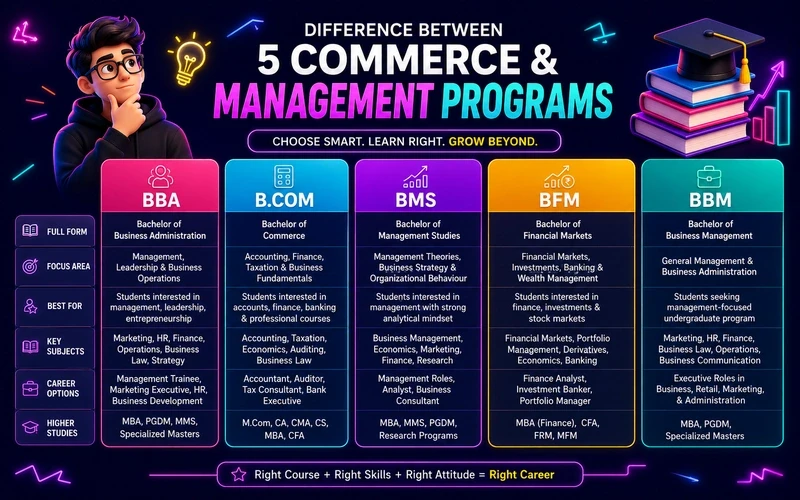
But with so many similar-sounding programs available, students often get confused about what to choose. This guide compares each degree across curriculum, career opportunities, industry relevance, MBA preparation, and future prospects to help you choose the one that best aligns with your goals.
BBA Course in India: Who Should Choose It?
The BBA course (Bachelor of Business Administration) is a three-year undergraduate management program designed to build business, leadership, and decision-making skills.
Unlike traditional commerce programs, BBA focuses on practical business management and industry-oriented learning. Most universities structure the program around management fundamentals, organizational behavior, communication, marketing, operations, and finance.
Key Features of a BBA Course
Duration: 3 years undergraduate degree program.
Primary Focus: Business administration, management principles, and organizational leadership.
Learning Style: Practical learning through case studies, presentations, projects, and business simulations.
Internship Exposure: Internships are commonly integrated into the curriculum to provide industry experience.
MBA Preparation: Strong foundation for MBA programs through early exposure to management, marketing, finance, and business strategy concepts.
Ideal Students
A BBA course suits students who want careers in:
Business management
Marketing
Human resources
Sales leadership
Entrepreneurship
Consulting
MBA programs
Students who prefer presentations, projects, internships, and business problem-solving often find BBA more aligned with their interests than theory-heavy commerce degrees.
Many companies also recruit BBA graduates for entry-level management trainee positions, customer success roles, business development, and operations functions.
Read about how this BBA graduate converted a consulting internship into a 7.5LPA placement. |
BBA Subjects in India and Career Link
The strength of a BBA program lies in its multidisciplinary structure. The curriculum introduces students to all major business functions.
Common BBA Subjects
Principles of Management
Marketing Management
Human Resource Management
Financial Management
Business Economics
Accounting
Business Statistics
Operations Management
Business Communication
Entrepreneurship
Subject-to-Career Mapping
BBA Subject | Career Path |
Marketing Management | Marketing Executive, Brand Associate |
Human Resource Management | HR Executive, Talent Acquisition |
Financial Management | Banking Associate, Finance Analyst |
Business Statistics | Business Analyst |
Operations Management | Operations Executive |
Entrepreneurship | Startup Founder, Business Owner |
The broad subject mix helps students explore multiple domains before choosing a specialization.
Internships also play an important role. Many universities now integrate summer internships, industry projects, and corporate training into their BBA curriculum, creating stronger workplace exposure before graduation.
Read this student’s story of how he cracked an internship in semester 1. |
BBA vs B.Com in India
The comparison between BBA vs B.Com remains one of the most common questions among commerce students.
Curriculum Comparison
Factor | BBA | B.Com |
Focus | Management | Commerce & Accounting |
Practical Exposure | High | Moderate |
Business Skills | Strong | Limited |
Accounting Depth | Moderate | High |
MBA Readiness | Strong | Moderate |
Learning Approach
B.Com focuses heavily on:
Accounting
Taxation
Economics
Auditing
Financial reporting
BBA focuses on:
Leadership
Management
Marketing
Business strategy
Organizational behavior
MBA Preparation
Students planning an MBA often choose BBA because management concepts begin during undergraduate education. However, B.Com graduates also successfully enter MBA programs. Most MBA entrance examinations in India accept graduates from all recognized disciplines.
Career Direction
B.Com Graduates
Accountant
Tax Consultant
Auditor
Banking Officer
BBA Graduates
Management Trainee
Marketing Executive
HR Executive
Business Development Associate
Students interested in CA, CMA, or accounting-heavy careers often prefer B.Com. Students targeting management roles generally lean toward BBA.
BBA vs BMS in India
While both programs focus on developing business knowledge and management skills, they differ in curriculum structure, specialisation opportunities, teaching approach, and career pathways.
What Is BMS?
BMS (Bachelor of Management Studies) emphasizes management theory and strategic business concepts. The program focuses on developing analytical thinking, decision-making, organizational planning, and leadership skills required in modern business environments. Compared to many general management programs, BMS often provides deeper exposure to subjects such as strategic management, business policy, and organizational behavior
Curriculum Depth
Factor | BBA | BMS |
Business Administration | Strong | Strong |
Strategic Management | Moderate | High |
Practical Projects | High | Moderate |
Industry Orientation | High | High |
Regional Availability
BMS remains particularly popular in Maharashtra and Mumbai-based institutions. Several colleges affiliated with major universities offer BMS as a specialized management degree.
Industry Orientation
BBA programs generally emphasize employability, internships, and business exposure while BMS programs often focus more deeply on management frameworks, organizational analysis, and business strategy.
BBA Admission Process
Many BBA programs admit students through university-specific entrance tests, merit-based admissions, or centralized systems and admissions vary by institution and state.
For students seeking broad management exposure with strong industry engagement, BBA often provides greater flexibility. Students seeking management specialization from the start may prefer BMS.
BBA vs BFM in India
While BBA provides a broad foundation in business disciplines such as marketing, human resources, operations, and entrepreneurship, BFM focuses more specifically on financial markets, investments, banking, and financial analysis. Understanding the differences between these programmes can help students choose the path that best matches their interests, strengths, and career aspirations.
What Is BFM?
BFM (Bachelor of Financial Markets) specializes in:
Financial markets
Investment analysis
Banking
Risk management
Portfolio management
Comparison
Factor | BBA | BFM |
Management Focus | High | Moderate |
Finance Focus | Moderate | High |
Quantitative Learning | Moderate | High |
Career Flexibility | High | Moderate |
India's banking and financial services sector continues to be one of the country's largest employment generators, while fintech expansion continues to create new finance-related opportunities. India's higher education and business ecosystem increasingly supports specialized finance careers.
Best Fit
Choose BFM if you specifically want the list below alongside broader career flexibility:
Investment banking
Equity research
Financial analysis
Wealth management
If you want to pursue a BBA program that gives you high career flexibility, explore this course! |
BBA vs BBM in India
Both courses focus on developing business knowledge, leadership abilities, and managerial skills, but they may differ in curriculum design, areas of emphasis, and learning outcomes depending on the institution. The comparison between BBA vs BBM often creates confusion because both degrees share similar foundations.
Similarities
Both programs teach:
Business management
Marketing
Human resources
Organizational behavior
Key Difference
BBM stands for Bachelor of Business Management.
Historically, many institutions used BBM as the preferred program name before transitioning toward BBA.
Current Availability
Today, BBA has become significantly more common across India. Many universities that previously offered BBM have shifted toward BBA due to stronger market recognition.
Recognition
Employers generally treat BBA and BBM as equivalent management qualifications when evaluating entry-level candidates. Students should focus more on curriculum quality, internships, and placement outcomes than the degree title itself.
Commerce Course Match by Career Goal in India
Choosing the right course becomes easier when viewed through career outcomes.
Career Goal Comparison Matrix
Career Goal | Best Course |
MBA Preparation | BBA / BMS |
Entrepreneurship | BBA |
Accounting | B.Com |
Banking & Finance | BFM / B.Com |
Corporate Management | BBA |
Financial Markets | BFM |
Government Exams | B.Com |
Business Consulting | BBA / BMS |
Entrepreneurship- BBA offers strong exposure to leadership, business planning, and organizational management.
Finance Careers- BFM and B.Com provide stronger finance specialization.
Corporate Management- BBA and BMS align closely with management trainee and business operations roles.
MBA Preparation- More than one undergraduate path can lead to MBA programs. Students from BBA, B.Com, BMS, BBM, and BFM regularly enter MBA admissions pipelines across India.
Government Examination Preparation- B.Com remains a preferred option for many students preparing for banking, SSC, and government recruitment examinations because of its accounting and economics focus.
If you want mentors and funding for your business idea, pursue your dream of being an entrepreneur. |
How to Select a BBA College in India
The quality of the institution often matters more than the course title.
Before selecting a BBA college in India or a BBA college in Haryana, evaluate:
Accreditation and university recognition
Placement records
Internship opportunities
Industry partnerships
Faculty credentials
Alumni outcomes
Fee versus placement ROI
Available specializations
Institutions such as Rishihood University have designed their BBA programs around industry immersion, entrepreneurship, interdisciplinary learning, and experiential projects rather than classroom instruction alone. Students gain exposure to real-world business challenges through internships, industry collaborations, startup ecosystems, and mentorship from practitioners, helping bridge the gap between academic learning and workplace expectations.
Students should compare placement reports, internship statistics, curriculum structure, industry partnerships, and experiential learning opportunities rather than relying solely on rankings. A strong BBA program should not only teach management concepts but also provide practical exposure that improves career readiness after graduation.
Apply now for BBA in Entrepreneurship!
FAQs
Which course is best after Class 12 commerce?
The best course depends on your career goal. BBA suits management careers, B.Com suits accounting and finance, while BFM specializes in financial markets.
Is BBA better than B.Com for MBA?
BBA provides earlier exposure to management concepts. However, both BBA and B.Com graduates successfully pursue MBA programs.
Is BFM difficult?
BFM includes more quantitative finance concepts than BBA. Students interested in investments and financial analysis generally adapt well to the curriculum.
Does BBM still exist in India?
Yes. However, many institutions have shifted from BBM to BBA because BBA has stronger national recognition.
Which course gives better placements?
Placement outcomes depend heavily on the institution, internships, skills, and specialization. Strong BBA, BMS, B.Com, and BFM programs can all produce competitive career outcomes.
Build Your Management Career with the Right Foundation
Choosing the right commerce degree requires a clear understanding of your long-term career goals, preferred learning style, and industry interests. While all five programs- BBA, B.Com, BMS, BFM, and BBM can lead to successful careers, each develops a different set of skills and opens different professional pathways.
A BBA course is best suited for students who want early exposure to business management, leadership, entrepreneurship, marketing, and corporate decision-making. Its practical approach, industry projects, and management-focused curriculum also make it a strong foundation for students planning to pursue an MBA. A B.Com degree remains a preferred choice for students interested in accounting, taxation, auditing, banking, and professional certifications such as CA, CMA, or CS. Students with a strong interest in financial markets, investments, portfolio management, and banking may find BFM more aligned with their career ambitions due to its specialized finance-oriented curriculum.
For those seeking deeper academic exposure to management theories and business strategy, BMS offers a focused management education that is particularly popular in certain regions of India, especially Maharashtra. Meanwhile, BBM continues to provide a management-focused undergraduate pathway in institutions where the program remains active, although many universities have transitioned to the more widely recognized BBA format.
Rather than selecting a course based on popularity or current market trends, students should compare curriculum structure, specialization options, internship opportunities, industry partnerships, placement outcomes, and postgraduate aspirations. The most suitable course is the one that aligns closely with your career objectives, strengths, and the type of professional role you aim to pursue after graduation.