Business
Best Entrepreneurship Courses for Undergraduate College Students
Explore the best entrepreneurship courses after 12th in India, including BBA Entrepreneurship, family business programs, startup courses in Sonipat, Delhi NCR
3 May 2026
TL;DR
Table of Contents
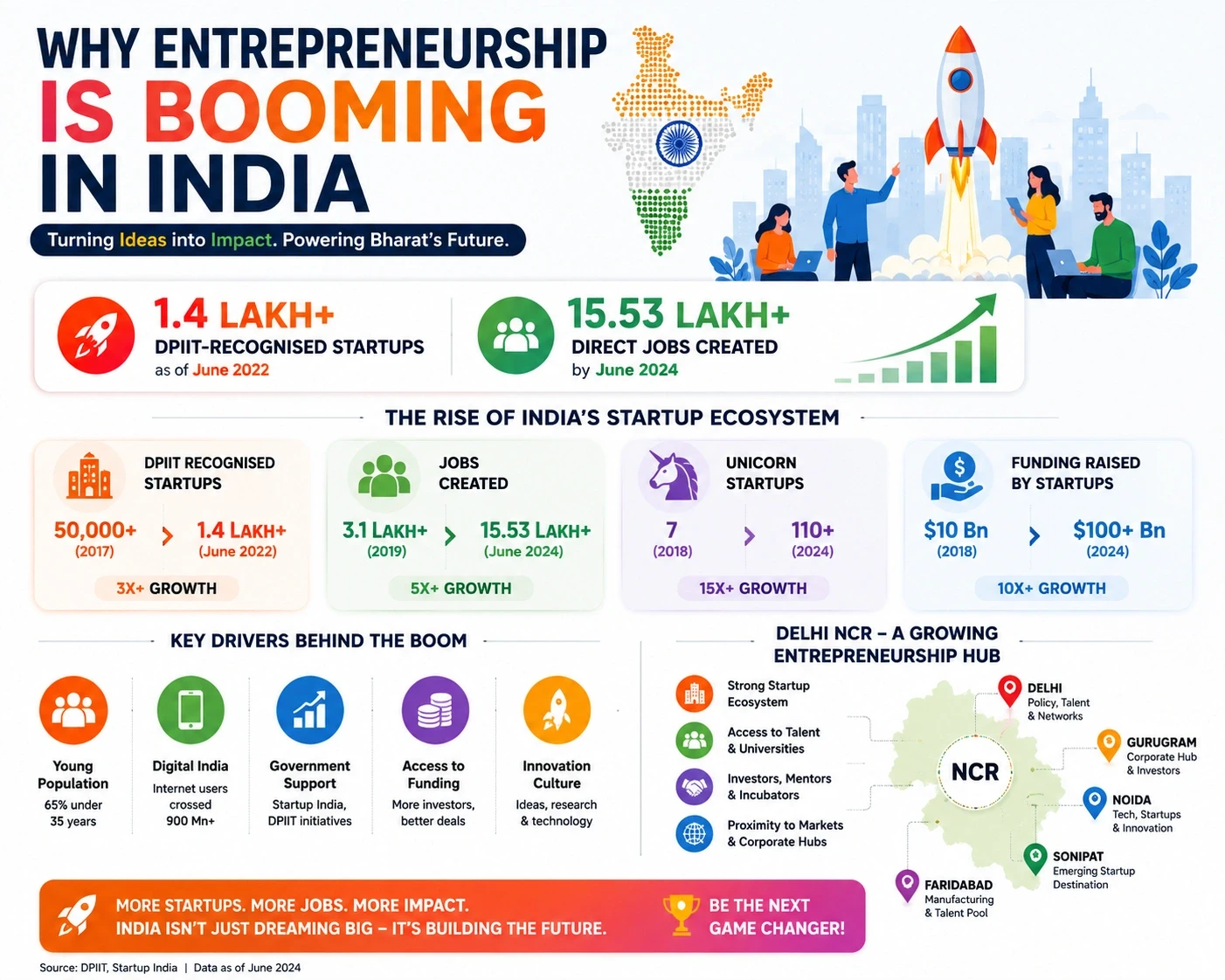
India crossed over 1.4 lakhs DPIIT-recognised startups in June 2022. These recognised startups have created over 15.53 lakh direct jobs by June 2024, showing how quickly entrepreneurship has moved from a risky career idea to a mainstream economic pathway.
Most entrepreneurship courses are either an undergraduate degree or a short-term program that teach students how to build, manage, fund, and scale businesses.
For students after Class 12, the main options include BBA in Entrepreneurship, BBA Family Business and Entrepreneurship, startup courses in India, and specialized bachelors degree in business programs. The demand is especially relevant in Delhi NCR and Haryana, where students have access to startups, family enterprises, investors, corporate offices, incubators, and emerging private universities.
This article explains entrepreneurship courses after 12th, course types, BBA entrepreneurship syllabus, family business programs, admission criteria, career paths, startup opportunities, and colleges near Sonipat, Haryana and Delhi NCR.
Entrepreneurship Courses After 12th in India
Entrepreneurship courses after 12th are designed for students who want to understand how businesses are created, managed, scaled, funded, and sustained. These courses are not only for students who already have a startup idea. They are also useful for students who want to join a startup, work in business development, enter consulting, scale a family business, become product managers, or build a venture later.
The most common entrepreneurship courses after 12th include:
BBA in Entrepreneurship
BBA Family Business and Entrepreneurship
Bachelors degree in business
BBA with innovation or startup specialization
Startup management programs
Venture-building programs
Short-term entrepreneurship certifications
Incubation-led student founder programs
A full-time degree is usually the strongest route for undergraduate students because entrepreneurship requires more than motivation. Students need to understand customers, cash flow, pricing, business law, marketing, operations, negotiation, team-building, digital tools, and fundraising.
Most undergraduate entrepreneurship courses require students to complete Class 12 from a recognized board. Many institutions ask for around 50% marks or an entrance process depending on the college. Entrepreneurship options after Class 12 can include BBA, B.Com, BMS, diploma, and certificate routes, with degree programs usually taking three years and short-term certificates taking a few months.
Types of Entrepreneurship Courses in India
Entrepreneurship courses in India can be divided into two major categories: degree programs and certification programs.
Degree-Based Entrepreneurship Courses
Degree programs are full-time undergraduate courses, usually lasting three or four years. These include:
BBA in Entrepreneurship
BBA Family Business and Entrepreneurship
Bachelor of Business Administration
Bachelor’s degree in business studies
BBA with startup, innovation, or venture-building specialization
These programs are useful for students who want a structured academic pathway after Class 12. They usually include management, finance, accounting, marketing, economics, communication, operations, digital business, leadership, and entrepreneurship subjects.
Certification and Short-Term Startup Courses
Certification courses are shorter and focus on specific business skills. These may include:
Startup fundamentals
Digital marketing
Financial modelling
Pitch deck creation
Product management
Fundraising basics
E-commerce
Business analytics
Social entrepreneurship
Certification courses can be useful for skill-building, but they usually work best as add-ons. A student can pursue a BBA course and add certifications in digital marketing, analytics, finance, or product management to strengthen employability.
For most students after 12th, a degree provides the broader base; certifications provide sharper skill upgrades.
Bachelors Degree in Business for Entrepreneurship in India

A bachelors degree in business gives students the foundation needed to understand how companies actually work. Entrepreneurship is not only about having an idea. It is about execution, revenue, people, systems, capital, product-market fit, customer behaviour, and long-term decision-making.
A business degree helps students learn:
How markets function
How customers make decisions
How companies manage money
How products are priced
How teams are built
How brands grow
How operations are managed
How legal and compliance systems affect business
How businesses scale sustainably
This matters because many startup ideas fail due to weak execution, unclear demand, poor financial planning, lack of customer understanding, or inability to scale.
A BBA course is one of the most common bachelors degree in business options for students after 12th. It gives students broad business exposure while allowing specialization in entrepreneurship, family business, marketing, finance, analytics, international business, or innovation.
A BBA also gives students flexibility. They can start a venture, join a startup, enter a family business, work in sales or marketing, move into product or growth roles, or pursue higher education later.
BBA Course Overview for Entrepreneurship Students in Delhi NCR
A BBA course is usually a three-year or four-year undergraduate business degree focused on management, finance, marketing, economics, operations, communication, leadership, and strategy.
For entrepreneurship students in Delhi NCR, BBA is a practical option because the region gives students access to:
Startup hubs
Corporate offices
Family businesses
Co-working spaces
Angel investors
Incubators
D2C brands
E-commerce companies
Consulting and growth teams
Policy and institutional networks
Delhi, Gurgaon, Noida, Faridabad, Ghaziabad, and Sonipat together form a strong business belt for undergraduate students. This location advantage matters because entrepreneurship cannot be learned only inside a classroom.
A BBA course for entrepreneurship students usually includes subjects like business communication, principles of management, accounting, marketing, economics, entrepreneurship development, business law, digital business, innovation, and internships.
Bennett University’s BBA page highlights industry-integrated learning, project-based learning, leadership, analytics, communication, decision-making, and entrepreneurship or corporate project innovation as key outcomes.
BBA in Entrepreneurship Programs in Colleges
BBA in Entrepreneurship is a specialized undergraduate program for students who want to understand how to create, validate, fund, and grow business ideas.
Unlike a general BBA course, a BBA in Entrepreneurship focuses more directly on venture-building. Students learn how to identify a market gap, test a problem, build a product or service, create a revenue model, pitch to investors, and manage early-stage business challenges.
A strong BBA in Entrepreneurship program should include:
Startup ideation
Business model development
Market research
Consumer behaviour
Entrepreneurial finance
Digital business
Product development
Pitching and fundraising
Legal basics for startups
Incubation exposure
Internships or live projects
Rishihood University’s BBA Entrepreneurship brochure positions the program for students who want to start a venture, scale high-impact businesses, or aim for roles in consulting, product, strategy, finance, and operations.
The same brochure highlights access to a $5 million Makers Fund, startup incubation through Venture Studio, a ₹10,000 Demat account, global exposure, 40+ electives, and 50+ alpha industry leaders as mentors.
Students should compare entrepreneurship programs by looking at actual venture-building support, not just the course title.
BBA Family Business and Entrepreneurship is designed for students who either come from business families or want to understand how owner-led businesses are built, modernized, and scaled.
This course is different from a regular BBA in Entrepreneurship.
BBA in Entrepreneurship usually focuses on starting a new venture from zero. It teaches students how to identify a problem, validate a market, build a business model, raise funds, and grow.
BBA Family Business and Entrepreneurship focuses on both new ventures and existing businesses. It is useful for students who may join a family enterprise in manufacturing, retail, trading, hospitality, exports, real estate, food, textiles, services, or local distribution.
Manav Rachna describes BBA in Entrepreneurship and Family Business as a program combining foundational business education with dedicated training in startup creation and family enterprise management, including areas such as venture innovation and family governance.
Course Type | Best For | Main Focus |
BBA in Entrepreneurship | Students who want to build new startups | Venture creation, funding, growth, innovation |
BBA Family Business and Entrepreneurship | Students who want to join or scale existing businesses | Succession, governance, expansion, modernization |
General BBA | Students who want broad business roles | Management, marketing, finance, HR, operations |
Students from business families should not automatically choose a general BBA. A family business and entrepreneurship course may be more useful if the goal is to digitize, expand, or professionalize an existing enterprise.
Entrepreneurship Subjects Covered in BBA Programs
Entrepreneurship subjects in BBA programs combine management fundamentals with startup-focused learning.
Common subjects include:
Principles of Management
Business Communication
Financial Accounting
Marketing Management
Business Economics
Organizational Behaviour
Entrepreneurship Development
Startup Strategy
Business Model Innovation
Entrepreneurial Finance
Digital Marketing
Operations Management
Business Law
Consumer Behaviour
Family Business Management
Pitching and Negotiation
Leadership and Team Building
Rishihood’s curriculum includes Applied Business Analytics for Decision Making, Principles of Management and Organisational Behaviour, Foundations of Finance, Introduction to Entrepreneurship and Business, Programming Fundamentals for Business, Marketing Management, Managerial Accounting, and Human Resource Management in Year 1.
This matters because entrepreneurship students need both startup thinking and business discipline. Ideas are important, but businesses survive through finance, customer understanding, operations, people, and execution.
BBA Entrepreneurship Syllabus: Year-Wise Breakdown
A BBA Entrepreneurship syllabus usually moves from business basics to venture-building and real-world application.
First Year
The first year builds the foundation. Students usually study:
Principles of Management
Business Communication
Financial Accounting
Business Mathematics
Marketing Basics
Business Economics
Organizational Behaviour
Introduction to Entrepreneurship
At Rishihood, Year 1 includes business analytics, management, finance, entrepreneurship, programming for business, marketing, accounting, HR, communication, Understanding India, Self and Society, and systems-thinking-oriented foundation courses.
Second Year
The second year becomes more applied. Students may study:
Corporate Finance
Microeconomics
Business Growth Strategy
Startup Governance
Fundraising
AI Tools for Business
Customer Relationship Management
Marketing and Communication Strategy
Rishihood’s Year 2 includes Corporate Governance and Ethics in Startups, Corporate Finance, Strategies for Business Growth, Raising Money: Seed, VC and Private Equity, AI Digital Tools for Business, and Entrepreneurial Enablers covering institutions, policy, and pitch proposals.
Third Year
The third year usually focuses on scaling and practical application. Subjects may include:
International Business Law
Project Management
International Finance
Python for Finance
Digital and Social Media Marketing
Product and Brand Management
Consumer Behaviour
Negotiation and Leadership
Rishihood’s Year 3 includes International Business Law, Python for Finance, Project Management, International Finance, Operations Management, Product and Brand Management, Consumer Behaviour, and leadership-related electives.
Fourth Year
In four-year programs, students often get deeper exposure to internships, venture-building, capstone work, or industry training. Rishihood’s Year 4 includes semester-long internships in both Semester 7 and Semester 8, with learning outcomes focused on building and leading a venture, making advanced strategic, financial and legal decisions, business modelling, investor-ready pitches, and responsible leadership.
Admission criteria for entrepreneurship courses vary by college, but most undergraduate programs follow a similar structure.
Common requirements include:
Class 12 from a recognized board
Minimum percentage requirement, often around 50%
Open to Science, Commerce, and Arts students in many colleges
Entrance test, interview, or merit-based selection
Personal statement, video response, or profile review in some institutions
Some universities accept CUET, SAT, JEE, or other recognized scores. Others conduct their own entrance process.
Rishihood’s BBA brochure lists a four-step admission process: checking eligibility, submitting the application through the digital admission portal, appearing for RSAT, and completing a personal interview. It also notes that students with a valid SAT or JEE score do not need RSAT. RSAT includes a video response, aptitude assessment, and psychometric evaluation.
Students should check each college separately because entrepreneurship admissions can differ across Delhi NCR, Haryana, Noida, Faridabad, and Sonipat.
Career Paths After BBA in Entrepreneurship in India
A BBA in Entrepreneurship does not mean every student must start a company immediately. It opens multiple career paths across startups, corporates, family businesses, and venture ecosystems.
Common career options include:
Startup Founder
Family Business Manager
Business Development Executive
Growth Associate
Product Associate
Marketing Executive
Sales Strategist
Operations Executive
Venture Analyst
Innovation Associate
E-commerce Manager
Startup Consultant
Founder’s Office Associate
Students can also work in early-stage startups because entrepreneurship programs often train them to handle multiple functions. They may support sales, marketing, operations, partnerships, product testing, investor research, or customer growth.
Students from family business backgrounds can use the degree to modernize existing businesses through branding, digital marketing, financial systems, new product lines, e-commerce, or professional management.
The degree becomes strongest when students graduate with live projects, pitch decks, internships, market research, business plans, revenue experiments, or actual startup experience.
Startup Opportunities for Students in Delhi NCR Ecosystem
Delhi NCR is one of India’s strongest startup and business regions. It includes Delhi, Gurgaon, Noida, Faridabad, Ghaziabad, and Sonipat, giving students access to both startup and traditional business ecosystems.
Delhi NCR is useful for entrepreneurship students because it offers:
Startup offices
Investor networks
Business families
Corporate headquarters
Co-working spaces
D2C brands
E-commerce companies
Tech startups
Policy access
Internship opportunities
Founder communities
For students in Sonipat and Haryana, Delhi NCR access is a major advantage. They can study near Haryana while still being close to Delhi, Gurgaon, and Noida’s business ecosystem.
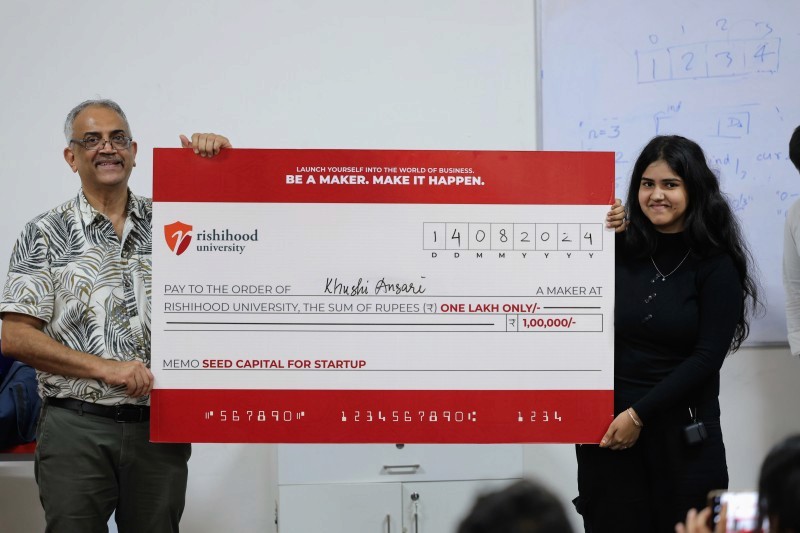
Rishihood’s Venture Studio model also fits into this ecosystem. Its brochure describes a five-step venture-building path: start with an idea, meet mentors, incubate the startup, receive initial funding of up to ₹100K, get help with market launch through industry connections, and access support up to $5 million from the Makers Fund.
This kind of structure is relevant because student founders usually need more than lectures. They need idea validation, mentorship, seed support, industry connects, and launch guidance.
Skills Required for Entrepreneurship Students in NCR Market
Entrepreneurship students in the NCR market need practical, fast-moving skills because the region is competitive and opportunity-rich.
Important skills include:
Sales and negotiation
Financial understanding
Market research
Communication
Digital marketing
Problem-solving
Data interpretation
Leadership
Team management
Customer empathy
Pitching
Adaptability
Project management
Tech comfort
Students should also learn how to use tools for presentations, spreadsheets, dashboards, customer research, analytics, social media, and project management.
Rishihood’s brochure lists tools such as Midjourney, LinkedIn, Hootsuite, Buffer, Figma, Canva, Notion, Slack, Instagram, YouTube, Asana, Miro, G Suite, and FlutterFlow as part of the learner toolkit.
This is relevant because modern entrepreneurship is not just about business theory. Students need to work with digital tools, AI tools, content platforms, productivity systems, and customer-facing technology.
Students looking for entrepreneurship courses near Sonipat, Haryana, and Delhi NCR can consider colleges based on location, curriculum, admission process, incubation support, fees, and industry exposure.
Rishihood University, Sonipat
Rishihood University offers a BBA Entrepreneurship program positioned as a 3-year/4-year residential undergraduate program in business studies and entrepreneurship. The brochure highlights $5 million Makers Fund access, Venture Studio incubation, 40+ electives across 5 minor degree programs, 50+ alpha industry leaders as mentors, 100+ workshops and masterclasses, 20+ classroom projects, and 2 semesters of hands-on industry training.
It is relevant for students from Sonipat, Panipat, Rohtak, Delhi, Gurgaon, and nearby NCR areas because of its location in Haryana and entrepreneurship-focused structure.
Bennett University, Greater Noida
Bennett University is another Delhi NCR option for students interested in business, entrepreneurship, and management. Its BBA program highlights industry-integrated learning, project-based learning, leadership, analytics, communication, decision-making, and entrepreneurship-oriented outcomes.
Manav Rachna University, Faridabad
Manav Rachna offers BBA in Entrepreneurship and Family Business, focused on foundational business education, startup creation, family enterprise management, venture innovation, and family governance.
Sharda University, Greater Noida
Sharda University offers BBA Entrepreneurship & Family Business as a three-year undergraduate programme. Its listed subject areas include Social Entrepreneurship, MSME and Family Business, Financing of New Ventures, Working Capital Management, and Innovation and Creativity.
Students should not choose only by brand name. They should compare curriculum, founder exposure, mentorship, internship structure, incubation support, funding access, fees, location, family business relevance, and career outcomes.
FAQs
What are the best entrepreneurship courses after 12th in India?
The best entrepreneurship courses after 12th include BBA in Entrepreneurship, BBA Family Business and Entrepreneurship, bachelors degree in business, startup management programs, innovation courses, and entrepreneurship certifications. For most students, a full-time BBA course with entrepreneurship specialization is the strongest undergraduate route.
Is BBA in entrepreneurship a good option after 12th?
Yes, BBA in entrepreneurship is a good option after 12th for students who want to start a business, join a startup, scale a family business, work in business development, enter product or growth roles, or build a venture after gaining experience.
What is BBA family business and entrepreneurship course?
BBA family business and entrepreneurship is an undergraduate business program that teaches students how to manage, modernize, and scale family-run businesses while also learning entrepreneurship principles. It is useful for students from business families and students interested in owner-led enterprises.
What are the subjects in BBA entrepreneurship?
Common subjects include principles of management, marketing, accounting, finance, business economics, entrepreneurship development, startup strategy, entrepreneurial finance, digital marketing, business law, consumer behaviour, family business management, innovation, and venture creation.
What is the duration of entrepreneurship courses in India?
Undergraduate entrepreneurship degree programs usually last three or four years. Certification courses may last from a few weeks to a few months. Rishihood’s BBA Entrepreneurship brochure describes it as a 3-year/4-year undergraduate residential program.
What is the average fee for BBA entrepreneurship in NCR?
There is no single average fee because NCR colleges vary widely by university type, residential format, facilities, and specialization. Private universities can range from a few lakhs in total tuition to several lakhs per year. Rishihood’s brochure lists a semester-wise fee structure including residential fee, tuition fee, and technology fee, with Sem 1 total payable shown as ₹4.2 lakh and later regular semesters shown at ₹3.3 lakh where applicable.
Which colleges offer entrepreneurship courses near Sonipat?
Students near Sonipat can consider Rishihood University in Sonipat, along with Delhi NCR options such as Bennett University in Greater Noida, Manav Rachna University in Faridabad, and Sharda University in Greater Noida.
What are career options after entrepreneurship degree?
Career options include startup founder, business development executive, growth associate, product associate, family business manager, marketing executive, sales strategist, operations executive, venture analyst, innovation associate, e-commerce manager, and founder’s office associate.