Technology
Best JEE Main Undergraduate Colleges for B.Tech Course
Explore the list of colleges for 70–80 percentile in JEE Mains. Compare top B.Tech colleges, cutoffs, and smart shortlisting strategies.
23 April 2026
TL;DR
Table of Contents
Every year, over 13 lakh students compete in JEE Main. At 70–80 percentile, you’re in the most crowded segment, where decisions matter more than marks.
At this percentile, your outcome depends on rank, branch, location, and counselling strategy, not just your score. So what defines a “best JEE college”? Not just IIT or NIT tags. It’s the right mix of realistic cutoff, desired branch (like CSE vs core), location advantages, and future opportunities.
This is where Delhi NCR and Sonipat stand out. With one of the highest concentrations of engineering colleges in India, the region offers more flexibility to choose based on career goals, not just rank.
This post will help you evaluate your options, shortlist the right colleges, and make a confident B.Tech college decision based on your score.
What can you actually get at 70–80 percentile?
Top NITs: Not realistic
Mid/lower NITs: Possible in lower-demand branches
IIITs/GFTIs: Limited options
State colleges: Strong opportunities (especially with domicile)
Private universities: Best access to CSE/IT
Best JEE Main colleges for B.Tech: What to check first
Before you open any college list, you need to understand what filters actually matter at the 70–80 percentile level. Students who skip this step apply to colleges that are either unrealistic or misaligned with their goals.
Key factors to evaluate before choosing a JEE Main college:
Parameter | Why it matters | What to check |
Percentile vs rank | Percentile is not your AIR, rank determines seat allocation | Convert your percentile to an expected rank range and compare it with last year’s cutoffs |
Home state quota | NITs and many state colleges reserve ~50% seats for home-state students | If you have a domicile (e.g., Haryana), check home-state cutoffs and prioritise those colleges first |
Branch preference | CSE and IT close much earlier than core branches like Civil or Mechanical | Review last year’s closing ranks branch-wise, not just college-wise |
Seat type (AI vs HS) | All India (AI) seats are more competitive than Home State (HS) seats | Compare AI vs HS cutoff ranks in JoSAA/CSAB data before shortlisting |
NIRF ranking | 100+ engineering colleges are ranked annually, reflecting quality indicators | Cross-check rank with NIRF score for placement and faculty quality |
India has 3,500+ AICTE-approved engineering colleges. Within that, the JoSAA counselling covers 110+ institutes, 31 NITs, 26 IIITs, and 33+ GFTIs. That leaves thousands of institutions outside JoSAA, all with their own cut-offs and timelines.
Delhi NCR is one of the highest-density college zones in India. Within a 60-km radius of Delhi, you have the state government and a cluster of well-established private universities, like Rishihood University, Sonipat. For students who want to stay close to home, this geography is a significant advantage.
JEE college predictor: How to use rank and percentile properly
A JEE college predictor is one of the most searched tools after results, and also one of the most misunderstood. Many students enter their percentile and expect a fixed list of colleges, which often leads to poor decisions.
Step 1: Understand what your percentile actually means
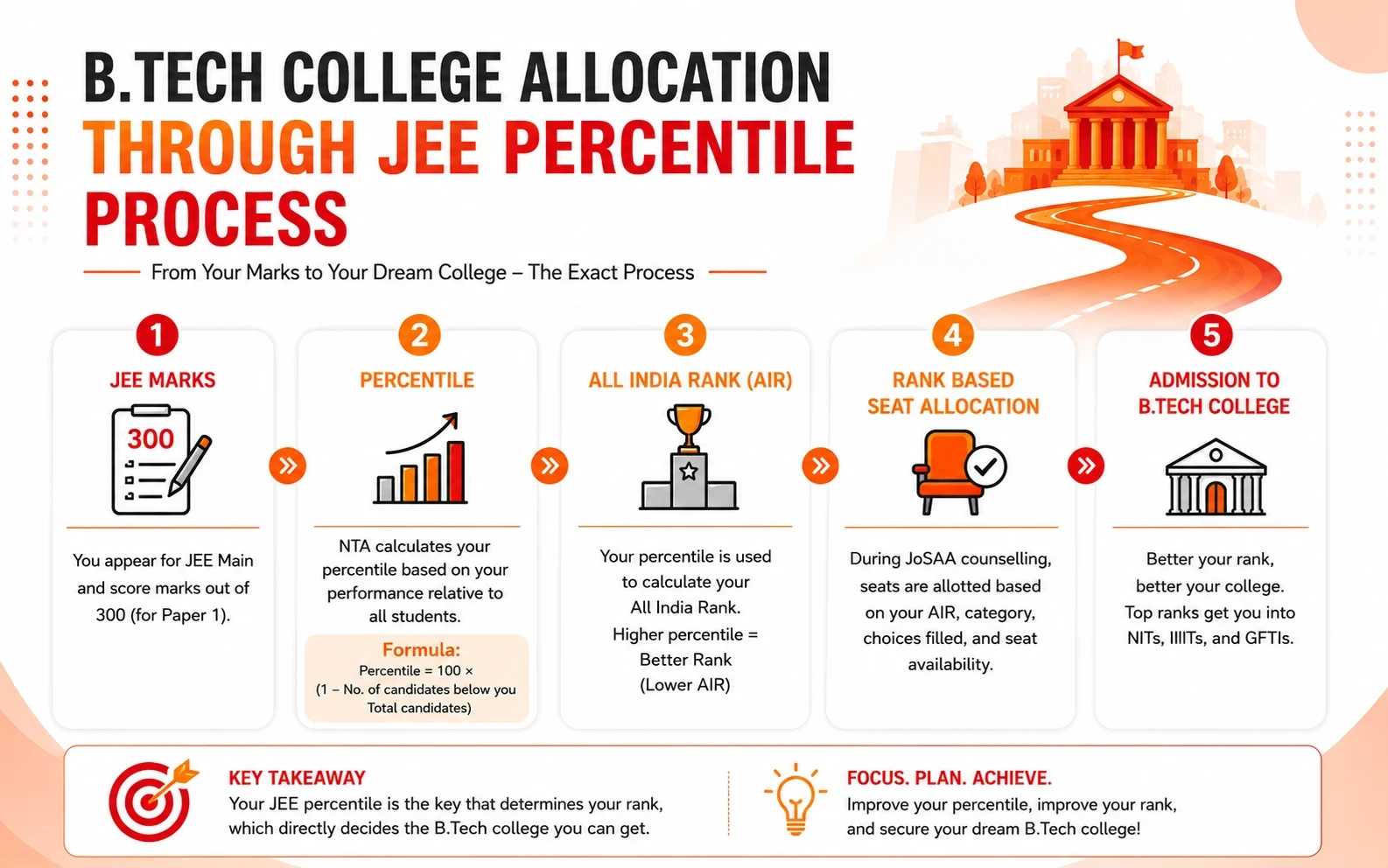
In JEE Main, percentile shows how many students you scored better than, not your rank.
75 percentile roughly translates to a 2.5–4 lakh rank range (varies yearly)
Counselling is based on rank, not percentile
Step 2: Convert percentile to a realistic rank range
JEE counselling is based on rank, not percentile.
Quick way to estimate:
If ~14 lakh students appear
And you’re at 75 percentile
→ Around 25% are ahead of you
→ Rank ≈ 3–3.5 lakh (approx.)
Step 3: Use predictors the right way
When using a predictor tool, apply filters:
Category (General / OBC / SC / ST)
Home state
Preferred branches (CSE, IT, etc.)
Most students skip this and end up with irrelevant colleges.
Step 4: Cross-check with previous year cutoffs
Use official data from JoSAA to check opening and closing ranks.
Compare across:
Round 1 vs final round
AI vs Home State quota
Predictors give you a starting point, while cutoff data gives you accuracy.
Step 5: Build a 3-tier college list
Don’t rely on a single “best option.” Build a strategy:
Tier A (Aspirational)
Slightly above your rank range (if luck + cutoffs shift)
Tier B (Realistic)
Matches your expected rank range
Tier C (Safe)
Colleges where your rank is comfortably higher than cutoff
Step 6: Factor in branch cutoffs
Most predictors fail because:
CSE closes early
IT and ECE follow
Core branches (Mechanical, Civil) remain open longer
So instead of asking, “Which college can I get?”, ask “Which branch + college combination can I realistically secure?”
Common mistakes to avoid
Trusting one predictor blindly
Ignoring home state quota
Not checking branch-wise cutoffs
Over-prioritising brand name over outcomes
Creating no backup list
JEE Main colleges in India: Government and private options
When exploring JEE Main colleges, most students default to a government-vs-private comparison. But the smarter approach is to understand what each category offers, and where you fit based on your rank and goals.
You can also use NIRF rankings as a starting point. The framework ranks the top 100 engineering colleges in India every year, based on parameters like teaching quality, placements, and research.
Government vs Private: What changes at 70–80 percentile?
Government colleges (NITs, IIITs, GFTIs): Lower fees and strong brand, but limited access to top branches at this percentile
Private colleges: Better access to CSE/IT, flexible admissions, improving placements
Thumb rule:
Branch priority → private
Cost + brand → government

B.Tech colleges admission: Steps and eligibility
Once your JEE Main result is out, the admission process moves quickly. Understanding the steps in advance helps you act without delays.
Step 1: Check basic eligibility
You must have passed Class 12 (PCM: Physics, Chemistry, Mathematics)
Most colleges require 50–75% aggregate (varies by institute)
You must have appeared for JEE Main (for most government and many private colleges)
If you meet these, you’re good to proceed.
Step 2: Get your JEE Main score and rank
After results, focus on your All India Rank (AIR).
Also account for:
Category rank (if applicable)
Home State eligibility (relevant for NITs and state colleges)
Step 3: Register for counselling
For central institutes (IITs, NITs, IIITs, GFTIs), register through JoSAA.
You’ll need to:
Fill personal and academic details
Select your category and home state
Pay the counselling fee
For state colleges, apply separately through state-level counselling portals.
Step 4: Choice filling and locking
This is one of the most critical stages. You’ll create a list of college + branch combinations, ranked in order of preference.
A common mistake is listing only “dream options.” Instead, build a balanced list:
List colleges and branches in order of preference
Balance between aspirational, realistic, and safe options
Step 5: Seat allotment and confirmation
Based on your rank and choices, you’ll be allotted a seat in rounds.
You can:
Accept and freeze
Float (wait for better option)
Slide (same college, better branch)
Once satisfied:
Pay the admission fee
Upload documents for verification
Step 6: Keep backup options ready
Apply to private colleges in parallel to avoid losing backup options. This ensures you don’t end up with no seat after multiple rounds.
Do not wait for JoSAA because many private universities start taking admissions from May onwards. Seats in popular branches (CSE, AI) fill before JoSAA rounds are complete.
List of colleges for 70–80 percentile in JEE Main in Haryana and Delhi NCR
If you fall in this percentile range, your options are more flexible than they may seem. The key is to focus on colleges where your rank aligns with past cutoffs.
If your priority is CSE/IT (higher ROI):
If you prefer government/state colleges:
If targeting IPU colleges (Delhi):
Important: Always verify branch-wise cutoffs before applying.
How to shortlist JEE Main colleges by branch, fees, and distance?
Once you have a broad list of JEE Main colleges, next is narrowing it down to options that actually work for you. The smartest way to do this is by filtering through three practical lenses:
1. Start with branch priority
Your branch directly impacts your career path, so this should be your first filter. For example, Computer Science and related fields (AI, Data Science) typically offer broader placement opportunities compared to some core branches.
Ask: “Where can I get my preferred branch at a realistic cutoff?”
Because in most cases, your branch impacts placements more than your college name.
2. Evaluate fees vs ROI
Fees vary significantly between government and private colleges. But lower fees don’t always mean better value. What matters is return on investment (ROI):
Average placement packages
Internship opportunities
Industry exposure
A college with higher fees but strong placement may offer better long-term returns than a low-cost option with limited opportunities.
3. Consider distance and location advantage
Distance isn’t just about comfort. It affects exposure, internships, and overall experience. Regions like Delhi NCR and nearby areas such as Sonipat offer:
Internships during college
Proximity to companies and startups
Stronger networking opportunities
A simple shortlisting rule
Branch first → aligns with career
Fees second → ensures value
Location third → improves exposure
If a college checks all three, it can be the best choice.
What to do after JEE main result: Counselling, choice filling, and backup options
Once your JEE Main result is declared, the next phase is all about decision-making and timely action.
Week 1: Assess and register
Download your JEE Main scorecard from jeemain.nta.nic.in and note your AIR, percentile, and category rank
Run your rank through JoSAA’s Opening and Closing Rank data from the previous year (available at josaa.nic.in)
Register on JoSAA portal (110+ institutes including NITs, IIITs, GFTIs participate here)
Simultaneously register on your state counselling portal (HSTES for Haryana, JAC Delhi for Delhi colleges)
Week 2–3: Choice filling
Choice filling is where most students go wrong. Instead of listing only top colleges, create a balanced preference list:
Dream options (slightly above your rank range)
Realistic colleges (based on past cutoffs)
Safe options (high probability of admission)
Week 4 onwards: Track seat allotment rounds
Seat allotment happens in multiple rounds.
Use float/slide options wisely
Upgrade if better options open
Don’t panic-drop a decent seat too early
Cutoffs shift. So stay flexible and adapt accordingly.
Keep backup options ready
Do not wait for JoSAA to finish before applying to private universities. Many private universities in the NCR region, including Rishihood University, run rolling admissions from May onwards. Seats in popular branches (CSE, AI) fill before JoSAA rounds are complete. Therefore, track direct admission deadlines as waiting only for counselling results can be risky.
Rishihood University for B.Tech aspirants in Sonipat, Haryana (Delhi NCR)
Rishihood University is an emerging private university in NCR with a focus on industry-aligned B.Tech programs. It offers flexibility in admissions through JEE Main and its own test (RSAT), making it accessible for students in the 70–80 percentile range. Recent placements show average packages around ₹7–7.5 LPA.
Choose smart, not just safe
At 70–80 percentile, your outcome depends less on score and more on decisions.
Focus on realistic cutoffs, prioritise the right branch, and build a balanced shortlist.
Shortlist your top options and start applying early. The best outcomes go to students who act strategically, not reactively.