Psychology
Can You Become a Clinical Psychologist After B.Sc Psychology in India? Step-by-Step Path, Eligibility, Salary & Colleges
Learn how to become a clinical psychologist after B.Sc Psychology in India, including eligibility, RCI pathway, salary, colleges & career roadmap.
13 June 2026
Table of Contents
Introduction
India’s Gross Enrolment Ratio (GER) in higher education reached 28.4% in 2021–22, and psychology has emerged as one of the fastest-growing academic choices among students as awareness around mental health awareness is rising in urban India, creating strong demand for trained professionals. Resulting in thousands of students choosing BSc Psychology and other psychology courses after Class 12.
As interest in psychology continues to grow, clinical psychology has become one of the most sought-after specializations. India produces thousands of psychology graduates annually, but only a small fraction qualify as licensed clinical psychologists. The reason is the structured academic and licensing pathway regulated by the Rehabilitation Council of India (RCI). Many students complete a BSc in Psychology but remain confused about the next steps, eligibility rules, licensing requirements, salary expectations, and specialization options.
A common misconception is that a BSc Psychology degree is enough to become a clinical psychologist. In India, it isn’t. Clinical practice requires advanced training, supervised clinical experience, and registration with the Rehabilitation Council of India (RCI).
The journey typically takes 7–8 years after Class 12, progressing from a bachelor’s degree to postgraduate specialization, clinical training, and professional licensure.
This guide breaks down every step of the process—from BSc Psychology subjects and eligibility requirements to career pathways, salary expectations, licensing rules, BA vs BSc Psychology, and the top psychology colleges in India, including options in Delhi and Haryana.
What Do You Learn in a BSc Psychology Degree?
A BSc Psychology degree builds the scientific and analytical foundation required for advanced psychology education in India. Most universities offering bsc psychology honours programs focus on behavioural science, research methods, cognitive processes, and psychological assessment basics.
The curriculum varies across universities, but common bsc psychology subjects include:
Cognitive psychology
Developmental psychology
Abnormal psychology
Biological psychology
Social psychology
Psychological statistics
Research methodology
Experimental psychology
Counselling psychology basics
Personality theories
Students also learn behavioural observation techniques, psychological testing fundamentals, communication skills, and introductory counselling frameworks.
One major advantage of a Bsc in Psychology is its scientific structure. Many universities like Rishihood University include statistics, biology-related psychology concepts, neuroscience foundations, and research-focused modules. These subjects help students prepare for evidence-based mental health practice.
Click here to know more about the curriculum at Rishihood University. |
Internships and practical exposure also play an important role during undergraduate study. Students may participate in NGO support programs, school counselling assistance, rehabilitation centre observation, or mental health awareness projects.
For aspiring clinical psychologists, a BSc Psychology degree is the first step in the journey. While it does not qualify graduates for independent clinical practice, it provides the knowledge and skills required for advanced study, specialised training, and future clinical psychology careers.
Can You Become a Clinical Psychologist After BSc Psychology?
The short answer is no, students cannot become clinical psychologists directly after completing a BSc Psychology degree in India. While an undergraduate degree provides a strong foundation in psychological theory and research, clinical psychology is a regulated profession that requires advanced education, supervised training, and professional registration.
The standard pathway in India usually follows this sequence:
BSc Psychology or BA Psychology
MSc Psychology or MA Psychology
Clinical specialization
MPhil Clinical Psychology or equivalent recognized training
RCI registration
Licensed clinical practice
The Rehabilitation Council of India regulates professional licensing standards for clinical psychologists. Without RCI registration, graduates cannot legally practice as licensed clinical psychologists in hospitals, rehabilitation centres, or independent clinical settings.
A BSc Psychology degree mainly provides foundational knowledge. Students learn theory, behavioural concepts, research skills, and introductory psychological frameworks. Clinical psychology requires much deeper expertise in:
Psychopathology
Psychological assessment
Clinical diagnosis
Psychotherapy techniques
Rehabilitation methods
Case management
Supervised patient handling
Students often confuse psychologist roles with clinical psychologist roles. A psychology graduate may work in counselling support, HR, education support, behavioural research, or social sector roles. However, clinical psychologists handle diagnosis, treatment planning, psychotherapy, and mental health assessment under regulated professional standards.
Choosing the right undergraduate program is an important first step for aspiring psychologists. Click here to watch a BSc Psychology student sharing what she looked for in a university and why she ultimately chose Rishihood University for her academic journey.
The postgraduate stage is therefore mandatory.
Many universities allow both BA Psychology and BSc Psychology graduates to pursue MSc Psychology programs. Students should carefully review eligibility criteria because some universities require minimum percentage thresholds or entrance examinations.
For students asking whether BSc Psychology is useful for becoming a clinical psychologist, the answer is yes. It is an important academic starting point, but not the final qualification.
Step-by-Step Clinical Psychologist Path in India
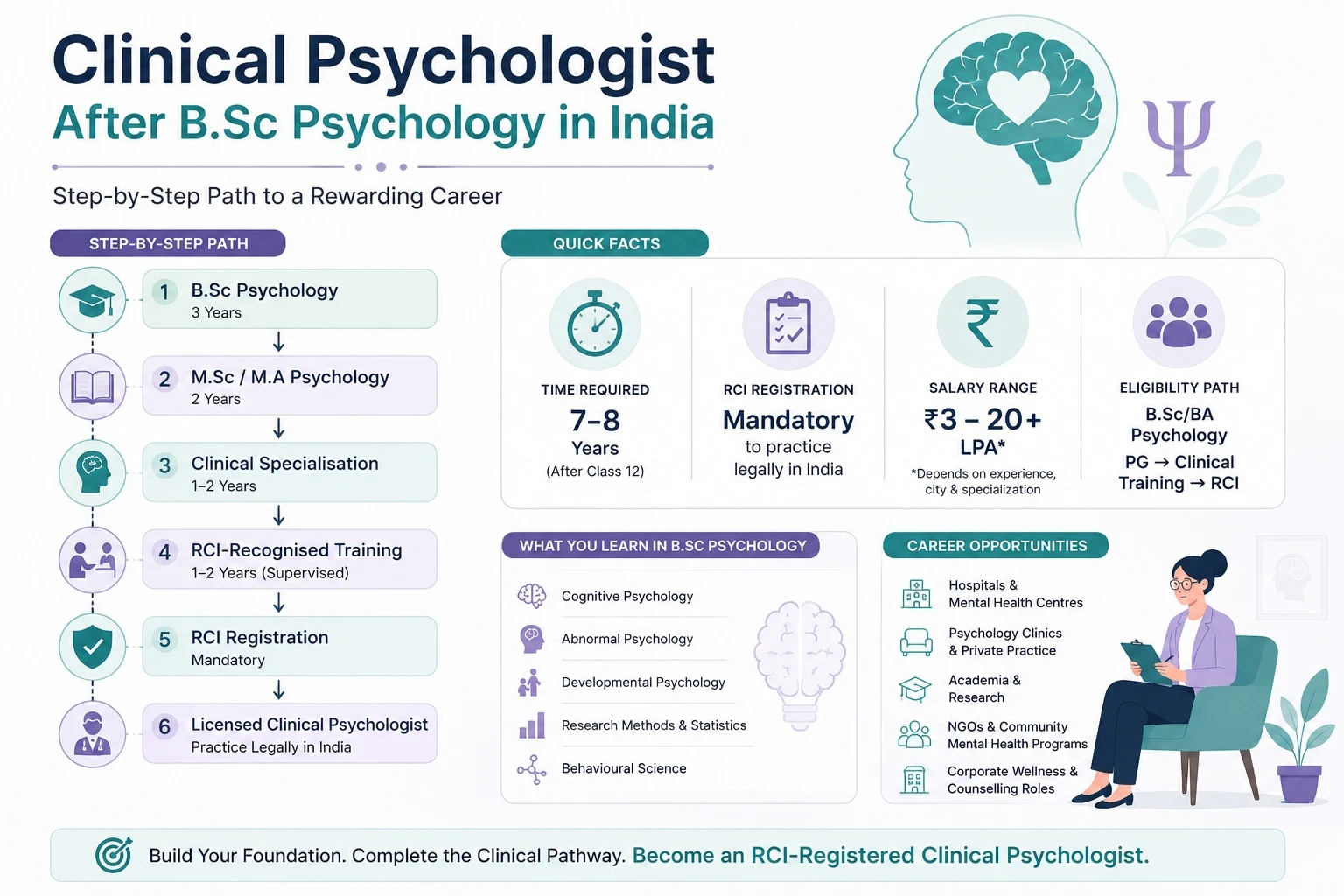
The pathway to becoming a licensed clinical psychologist in India involves multiple academic and professional stages.
Step 1: Complete your BSc Psychology degree
The first stage involves completing a 3-year undergraduate degree such as:
BSc Psychology
BSc Psychology Honours
BA Psychology
Applied psychology courses
Students learn foundational psychology theories, behavioural science principles, research methods, and introductory assessment concepts.
Step 2: Pursue MSc Psychology or MA Psychology
After graduation, students usually complete a 2-year postgraduate degree.
Common options include:
MSc Psychology
MA Psychology
MSc Clinical Psychology
Applied psychology courses
The postgraduate stage introduces advanced psychological theories, counselling frameworks, psychopathology, testing techniques, and research specialization.
Step 3: Choose Clinical Psychology Specialization
During postgraduate education, students interested in clinical practice should focus on:
Clinical psychology
Counselling psychology
Psychopathology
Psychological assessment
Mental health intervention
Students should focus on internships at hospitals, rehabilitation centres, and mental health clinics, as these provide valuable field exposure and help develop practical skills for future clinical training and professional practice.
Step 4: Complete MPhil Clinical Psychology or Equivalent Training
This stage is essential for professional licensing. Students must pursue an RCI-recognized MPhil Clinical Psychology program or equivalent recognized qualification. Training involves:
Supervised psychotherapy
Clinical case handling
Psychological assessment
Psychiatric observation
Rehabilitation work
Hospital-based practical training
Admission here is highly competitive because only limited seats exist across India.
Step 5: Complete Clinical Internship and Supervised Practice
Students undergo supervised clinical exposure under experienced professionals.
Training includes:
Patient interviews
Therapy observation
Diagnostic assessment
Behavioural testing
Case documentation
Clinical ethics
This stage develops practical competency for independent clinical work.
Step 6: Obtain RCI Registration
After completing recognized clinical training, graduates apply for Rehabilitation Council of India registration. RCI registration is mandatory for legal clinical psychology practice in India.
Step 7: Begin Clinical Practice
Registered professionals may work in:
Hospitals
Rehabilitation centres
Mental health clinics
Government institutions
Private practice
Academic institutions
Research organizations
Typical Timeline to Become a Clinical Psychologist in India
Undergraduate Degree (3 Years): BSc Psychology
Postgraduate Degree (2 Years): MSc Psychology or MA Psychology
Clinical Training & Licensing (2–3 Years): RCI-recognised professional training and registration
Total Duration: Approximately 7–8 years after Class 12.
What Are the RCI Licensing Requirements in India?
The Rehabilitation Council of India plays the central regulatory role in clinical psychology licensing.
RCI is a statutory body established by the Government of India to regulate rehabilitation and mental health professionals. The council defines educational standards, approves training programs, and maintains professional registration records.
In India, a major legal distinction exists between a “psychologist” and a “clinical psychologist.”
A general psychology graduate may work in education support, counselling assistance, HR, behavioural research, or social service sectors. However, a clinical psychologist requires recognized clinical training and official registration.
RCI registration is mandatory for clinical diagnosis, psychological assessment, psychotherapy practice, rehabilitation-based clinical services and independent clinical treatment.
Without registration, graduates cannot legally present themselves as licensed clinical psychologists. Many students mistakenly believe that an MSc Psychology degree alone permits clinical practice. That is incorrect in the Indian regulatory system.
The licensing pathway exists because clinical psychology involves direct patient care, diagnosis, and treatment responsibilities. Professional regulation ensures ethical practice and standardized clinical training. Students should therefore verify whether postgraduate programs are RCI-recognized before taking admission.
RCI-approved institutions usually provide:
Structured clinical exposure
Hospital-based training
Supervised therapy work
Standardized assessment training
Rehabilitation-focused practice
Graduates without proper registration may still work in counselling support, teaching, research, behavioural training, or organizational psychology roles. However, they cannot legally function as licensed clinical psychologists.
BSc Psychology Subjects and Their Career Relevance
The subjects taught during a BSc Psychology programme do more than build theoretical knowledge—they develop the foundations required for future careers in mental health, counselling, research, and clinical psychology.
Cognitive Psychology helps students understand memory, perception, attention, learning, and decision-making. These concepts later support areas such as behavioural assessment, emotional processing, and therapeutic approaches like Cognitive Behavioural Therapy (CBT).
Abnormal Psychology introduces students to psychopathology, emotional disturbances, and patterns of atypical behaviour. It provides an early understanding of mental health conditions and the frameworks used to study psychological disorders.
Developmental Psychology explores human growth across childhood, adolescence, adulthood, and aging, helping students understand how behaviour and mental processes evolve throughout life.
Research Methods and Statistics, which form the backbone of evidence-based psychology. Students learn how to design studies, analyse behavioural data, interpret findings, and evaluate psychological interventions. These skills are valuable not only for clinical practice but also for careers in research, policy, education, and organisational psychology.
At institutions such as Rishihood University, research exposure is integrated early into the undergraduate experience through projects, fieldwork, and interdisciplinary learning opportunities. This helps students move beyond textbook concepts and develop the analytical thinking required for advanced psychology training and professional practice. Watch a 3rd year student Sneha, talking about her research journey as an undergraduate.
Together, these subjects create a strong academic foundation while helping students discover which areas of psychology align most closely with their interests and career aspirations.
Internship Exposure
Internships strengthen practical understanding.
Students who participate in rehabilitation centres, NGOs, schools, or mental health projects often develop stronger professional clarity before postgraduate specialization.
These foundational subjects explain why bsc psychology eligibility and curriculum structure matter when students plan long-term clinical psychology careers.
Students exploring a modern BSc Psychology program in North India may also consider Rishihood University’s B.Sc (Hons.) Psychology Program located in Haryana. The 4-year residential program combines psychology, neuroscience, behavioural science, and interdisciplinary learning with practical exposure through psychology labs, internships, live projects, and counselling training.
The curriculum includes subjects such as biopsychology, developmental psychology, cross-cultural psychology, Indian psychology, research methods, and behavioural studies. The university also highlights practical exposure through neuroscience labs, cognitive science facilities, supervised projects, and industry-oriented learning modules.For students planning long-term clinical psychology careers, programs with research exposure, internship access, and strong psychology fundamentals can help strengthen postgraduate preparation
Apply now and explore internships at hospitals, clinics, NGOs etc |
BA Psychology vs BSc Psychology
Students often compare BA Psychology vs BSc Psychology before selecting undergraduate programs. Both degrees can lead to postgraduate psychology education, but important structural differences exist.
BSc Psychology
A BSc in Psychology usually emphasizes:
Scientific research
Statistics
Experimental psychology
Biological psychology
Neuroscience foundations
Data analysis
Many universities structure BSc Psychology as a science-oriented course with stronger analytical and research components.
Students interested in clinical psychology, neuropsychology, or research-heavy careers often prefer this route.
BA Psychology
A BA Psychology degree generally focuses more on:
Behavioural theories
Humanities integration
Social psychology
Counselling concepts
Communication frameworks
The arts-oriented structure may provide broader interdisciplinary exposure.
Which Is Better for Clinical Psychology?
Both pathways can eventually lead to clinical psychology specialization.
However, students pursuing:
Research careers
Neuroscience interests
Experimental psychology
Quantitative psychology
Clinical assessment
may benefit from the scientific training structure available in many BSc Psychology programs.
The final career outcome depends more on postgraduate specialization, RCI-recognized training, internships, and clinical exposure rather than only the undergraduate degree title.
Students should compare:
Curriculum depth
Faculty quality
Internship access
Research facilities
University accreditation
before choosing between BA and BSc programs.
Career Options After BSc Psychology
Students who complete a BSc Psychology degree have multiple career pathways even before clinical specialization.
Counselling Support Roles
Graduates may work as:
Counselling assistants
Student support coordinators
Wellness program associates
Mental health outreach staff
These roles usually involve supervised support work rather than independent therapy.
Human Resources and Organizational Psychology
Many psychology graduates enter corporate HR roles because behavioural understanding supports:
Recruitment
Employee engagement
Workplace communication
Training programs
Conflict management
NGO and Social Sector Roles
Mental health NGOs and rehabilitation organizations often hire psychology graduates for:
Community support programs
Child welfare initiatives
Rehabilitation assistance
Behavioural outreach projects
Research Assistant Positions
Universities and psychology institutes hire graduates for research support work and their responsibilities may include:
Data collection
Survey coordination
Literature review
Psychological testing assistance
Academic documentation
School Counselling Support
Some schools employ psychology graduates in supervised student wellness support roles.
Students interested in long-term psychology careers often use these early roles to gain practical exposure before postgraduate specialization.
Clinical Psychologist Salary in India
Clinical psychologist salaries in India vary based on experience, location, specialization, and work setting.
Entry-Level Salary
Fresh professionals with clinical training and RCI registration usually earn between ₹3–6 LPA.
Common entry-level workplaces include hospitals, rehabilitation centres, mental health clinics, NGO, Academic institutions
Mid-Level Salary
Professionals with 4–8 years of experience may earn ₹6–12 LPA.
Higher salaries often depend on specialized therapy expertise, urban location demand, patient volume, institutional reputation, clinical experience
Senior-Level Salary
Experienced clinical psychologists working in premium hospitals or private practice may earn ₹12–20+ LPA.
Senior professionals may also generate income through private consultations, teaching, research projects, teletherapy platforms
Sector-Wise Salary Differences
Hospitals: Large private hospitals generally offer structured salaries and multidisciplinary clinical exposure.
Government Role : Government institutions may provide stable income, pension benefits, and regulated work structures.
Private Practice: Private practice income varies significantly based on reputation, specialization, city location, and patient base.
Metro cities such as Delhi, Mumbai, Bengaluru, and Hyderabad usually offer stronger mental health demand and higher salary potential.
What are the Best Psychology Colleges in Delhi & Haryana
Students searching for psychology colleges in India often prioritize Delhi and Haryana because of their strong academic ecosystems, CUET-based admissions, and access to postgraduate opportunities.
Delhi-Based Psychology Institutions
Some of the most sought-after psychology programmes in India are offered by institutions in Delhi, including:
University of Delhi colleges
Ambedkar University Delhi
Jamia Millia Islamia
Indraprastha College for Women
Lady Shri Ram College
As many institutions now use CUET-based admissions, students should look beyond cut-offs and evaluate factors such as faculty expertise, research opportunities, internship exposure, clinical training partnerships, and postgraduate progression support.
Haryana-Based Universities
Haryana has also emerged as an important destination for psychology education, with universities increasingly focusing on interdisciplinary learning, research exposure, and practical training. Alongside established institutions, newer universities such as Rishihood University are expanding opportunities for students interested in behavioural sciences and psychology.
When evaluating psychology programmes in Haryana, students should consider accreditation, faculty quality, research facilities, internship support, clinical exposure opportunities, and pathways for postgraduate study.
Take the First Step Toward a Career in Psychology with Rishihood University
Career Decision Matrix After BSc Psychology
Students often face confusion after completing BSc Psychology because multiple specialization routes exist.
Clinical Psychologist
Duration: 7–8 years after Class 12
Difficulty Level: High
Requirement: RCI-recognized clinical training
This pathway suits students interested in diagnosis, psychotherapy, and mental health treatment.
Counselling Psychologist
Duration: Shorter than clinical psychology
Difficulty Level: Moderate
Salary Potential: Moderate to high
Focus: Emotional and behavioural support
This route may involve counselling specialization without intensive clinical diagnosis responsibilities.
HR and Organizational Psychology
Duration: Shorter academic pathway
Difficulty Level: Moderate
Salary Potential: Competitive in corporate sectors
This pathway focuses on workplace behaviour, employee engagement, and organizational development.
Research and Academia
Duration: Varies by higher education goals
Difficulty Level: High research commitment
Salary Potential: Variable
Students interested in behavioural science research, teaching, or academic psychology may pursue this route.
Choosing the right pathway depends on:
Academic commitment level
Interest in patient care
Long-term income goals
Research interest
Licensing willingness
Clinical training readiness
Students should evaluate these factors early before selecting postgraduate specialization paths.
FAQs
Can you become a clinical psychologist after BSc Psychology in India?
Yes, but not directly. Students must complete postgraduate psychology education, clinical specialization, supervised training, and RCI registration before practicing legally as clinical psychologists.
Is MSc mandatory after BSc Psychology?
In most cases, yes. Students generally pursue MSc Psychology or MA Psychology before entering advanced clinical psychology training pathways.
What is RCI registration?
RCI registration is the professional licensing process regulated by the Rehabilitation Council of India. It is mandatory for legal clinical psychology practice in India.
What is the salary of a clinical psychologist in India?
Clinical psychologist salaries usually range from ₹3–20+ LPA depending on experience, specialization, location, and work setting.
Which is better: BA Psychology or BSc Psychology?
Both degrees can lead to clinical psychology careers. BSc Psychology often provides stronger scientific and research-oriented training.
Which are the best psychology colleges in India?
Top psychology colleges are available in Delhi, Bengaluru, Mumbai, Pune, and other major cities. Students should evaluate factors such as accreditation, faculty quality, internship exposure, research opportunities, and postgraduate pathways. Emerging institutions like Rishihood University are also gaining attention for their interdisciplinary approach and emphasis on experiential learning alongside academic rigor.
Are psychology courses after 12th available through CUET?
Yes. Many universities now offer psychology admissions through CUET-based systems for undergraduate programs.
How long does it take to become a clinical psychologist in India?
The complete pathway usually takes 7–8 years after Class 12, including undergraduate education, postgraduate study, clinical training, and licensing.
BSc Psychology provides the academic foundation for long-term mental health careers, but it does not directly qualify students to become clinical psychologists in India. The clinical psychology pathway requires structured postgraduate education, clinical specialization, supervised training, and mandatory RCI registration.
Students planning this career should understand the timeline early. The process usually spans 7–8 years after Class 12 and involves significant academic commitment.
The demand for trained mental health professionals continues to grow across India, especially in urban healthcare systems, rehabilitation centres, educational institutions, and private mental health practice. Students who combine strong academic preparation, clinical exposure, and recognized licensing pathways can build stable long-term careers in the psychology sector.
Careful selection of undergraduate programs, postgraduate specialization, internships, and RCI-recognized institutions remains critical for students planning to enter clinical psychology in India with glorious opportunities guaranteed.