Technology
Coding vs Non-Coding Careers After B.Tech CS: Salary, Scope & Best Career Paths in India
Compare coding and non-coding careers after B.Tech CS in India with salary ranges, skills, workload, AI impact, Delhi NCR tech opportunities, and best career paths.
18 June 2026
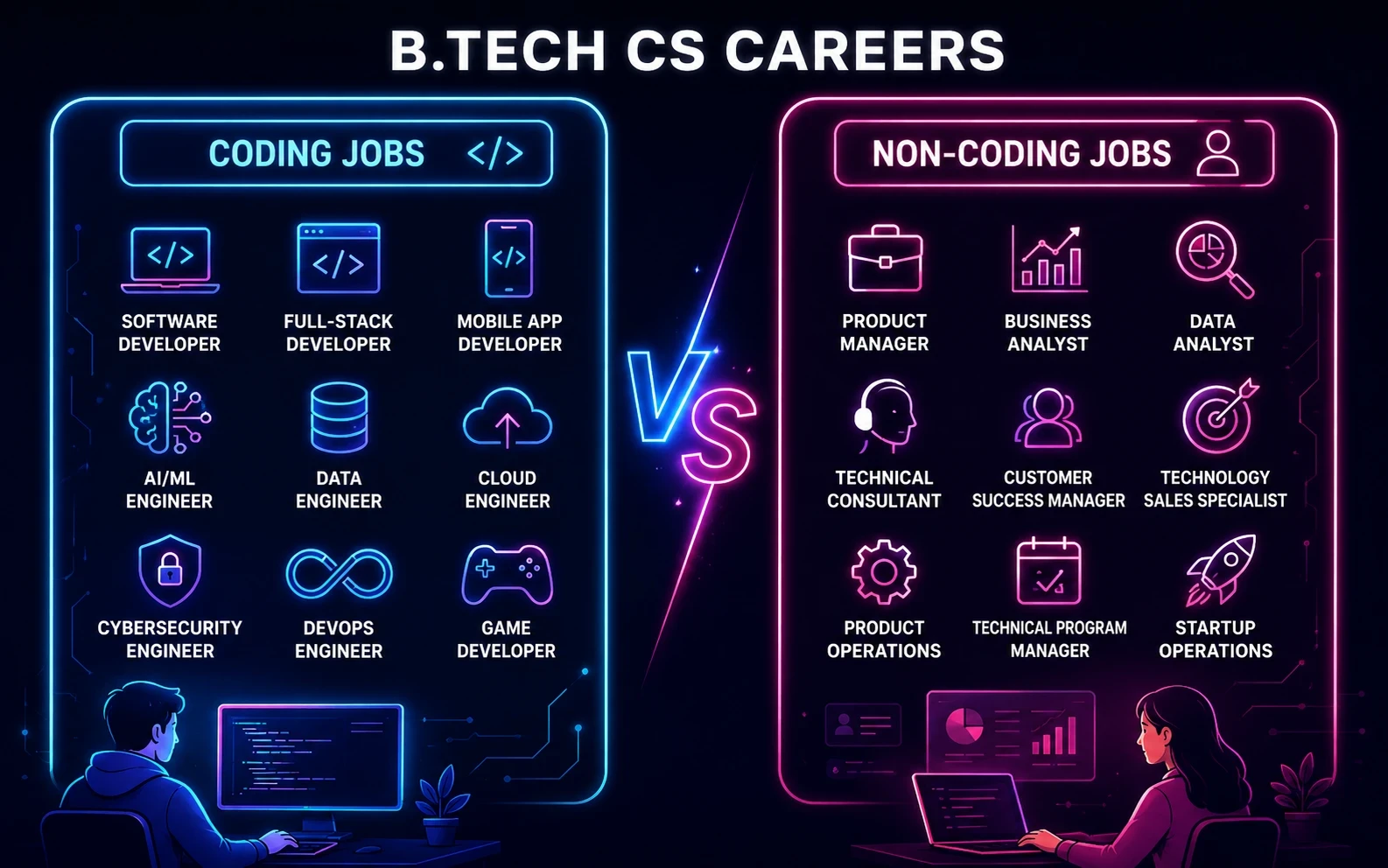
Table of Contents
Introduction
If you're considering a B.Tech Computer Science , one question will eventually come up: Do all computer science graduates need to become coders?
A decade ago, the answer might have been yes. Today, the technology industry looks very different. India's GenAI ecosystem alone crossed 890+ startups by H1 CY2025, according to NASSCOM, while the country's technology sector continues to move toward the $300 billion revenue milestone. As AI, cybersecurity, cloud computing, fintech, and digital products grow, so do the career options available to computer science graduates.
Some students enjoy coding, algorithms, AI models, and software development. Others are drawn to product management, business analysis, consulting, technical sales, UI/UX, startup operations, or customer success roles.
The good news? A B.Tech CS degree can open doors to both. This article explores coding and non-coding careers after Computer Science, comparing salary, growth, skills, AI impact, and which path may suit different students best.
What Are Coding Careers After B.Tech Computer Science?
When most students think of a Computer Science career, they think of software development. But coding careers today extend far beyond writing application code. From AI and cloud computing to cybersecurity and data engineering, technology companies are hiring professionals who can build, secure, scale, and improve digital systems.
Common coding careers after B.Tech CS include:
Software Developer
Frontend Developer
Backend Developer
Full-Stack Developer
Mobile App Developer
AI/ML Engineer
Data Engineer
DevOps Engineer
Cloud Engineer
Cybersecurity Engineer
Game Developer
Platform Engineer
Software Development Engineer in Test (SDET)
Success in these roles depends on more than classroom learning. Students need strong foundations in Data Structures and Algorithms, Operating Systems, Databases, Computer Networks, AI/ML, and Software Engineering, alongside hands-on project experience.
This is why many modern Computer Science programs are moving toward project-based learning. At Rishihood University's B.Tech Computer Science & Data Science program, students work on real-world projects, industry challenges, AI and data-focused applications, and experiential learning opportunities designed to build practical skills alongside technical fundamentals. These experiences have helped learners secure opportunities across technology, analytics, consulting, and emerging digital sectors.
Coding careers typically reward students who enjoy problem-solving, building systems, debugging, and continuously learning new technologies. The strongest candidates are often those who can demonstrate what they have built—not just what they have studied.
What Are Non-Coding Careers After B.Tech CS?
Not every Computer Science graduate ends up writing production code—and that’s no longer unusual. The modern tech industry runs on multiple layers of work where coding is just one part of the system. Many high-growth roles sit at the intersection of technology, business, users, and operations.
Product Management is one of the most important examples. Product managers translate user needs, business goals, and engineering constraints into product decisions. Alongside this, Business Analysts, Data Analysts, Customer Success Managers, Technical Consultants, Product Operations Associates, and Founder’s Office roles rely on technical understanding without requiring daily coding.
Common non-coding careers include:
Product Manager
Business Analyst
Data Analyst
Technical Consultant
Technology Sales Specialist
Customer Success Manager
Product Operations Associate
Technical Program Manager
Founder’s Office Associate
Startup Operations Associate
These roles are expanding quickly across SaaS, fintech, AI, enterprise software, and startup ecosystems.
At Rishihood University’s B.Tech Computer Science & Data Science program, students are trained beyond coding alone. The program integrates data thinking, product understanding, problem-solving, communication, entrepreneurship exposure, and real-world project experience. Through industry projects, mentorship sessions, startup exposure, and applied learning in AI and Data Science, students develop the ability to operate in both technical and non-technical environments.
Even in non-coding roles, technical understanding becomes a strong advantage. Graduates who can understand systems and also solve user, business, or operational problems often stand out in today’s technology-driven economy.
Coding vs Non-Coding Careers: Major Differences
Coding and non-coding careers can both be high-growth, but the daily work is very different. Coding roles are output-driven through code quality, features shipped, bugs fixed, systems scaled, and technical performance. Non-coding roles are output-driven through product decisions, user outcomes, customer satisfaction, revenue impact, stakeholder alignment, and operational efficiency.
Factor | Coding Careers | Non-Coding Tech Careers |
Daily Work | Writing code, debugging, building systems, testing features | Research, planning, analysis, coordination, client or product work |
Core Skill | Programming and technical problem-solving | Communication, product thinking, business logic, analytics |
Technical Depth | High | Medium to high, depending on role |
Work Style | Deep work, sprint cycles, technical reviews | Meetings, documentation, stakeholder management, market understanding |
Salary Direction | Strong in product, AI, cloud, cybersecurity, and backend roles | Strong in product, consulting, analytics, enterprise SaaS, and revenue-linked roles |
Remote Flexibility | High for many engineering roles | High for product, design, analytics, customer success, and consulting roles in tech firms |
Stress Type | Debugging, deadlines, production issues, code quality | Ambiguity, stakeholder pressure, metrics ownership, client expectations |
Upskilling Need | New languages, frameworks, architecture, AI tools, cloud platforms | Product tools, analytics, communication, domain knowledge, AI literacy |
Best Fit | Students who enjoy building systems | Students who understand tech but prefer people, product, and business problems |
Coding roles usually demand stronger technical depth. A backend engineer, for example, may spend the day working on APIs, databases, performance issues, testing, and deployment. A cloud engineer may work on infrastructure, automation, monitoring, and reliability.
Non-coding tech roles demand stronger coordination and ambiguity management. A product manager may spend the day understanding user problems, prioritising features, writing product requirement documents, aligning engineering teams, studying metrics, and talking to customers.
Neither path is easier by default. Coding can be mentally demanding because of deep technical problem-solving. Non-coding tech can be stressful because of communication pressure, unclear ownership, changing priorities, and cross-functional responsibility.
The best path depends on what kind of work gives the student energy.
Watch our learner Sourabh Pal, BTech CS DS talk about his journey of winning different competitions |
Best Coding Jobs After B.Tech CS in India
Coding careers remain one of the strongest and most in-demand paths after B.Tech Computer Science, especially for students who enjoy problem-solving, logic, and building systems from the ground up. These roles go far beyond “just writing code”—they involve designing, scaling, and maintaining the digital infrastructure of modern businesses.
1. Software Engineer
The most common entry point into tech. Includes frontend, backend, full-stack, mobile, and platform engineering. Requires DSA, programming languages, databases, APIs, testing, Git, and strong project-building ability.
2. Backend Developer
Focuses on servers, APIs, authentication, databases, performance, and system logic. Ideal for students who enjoy architecture, scalability, and deep technical problem-solving.
3. Full-Stack Developer
Works across frontend and backend. Startups especially prefer full-stack engineers because they can build end-to-end products quickly.
4. AI/ML Engineer
Builds and deploys machine learning models, AI systems, and data pipelines. One of the fastest-growing roles as companies integrate AI into products and operations.
5. Data Engineer
Builds data infrastructure, pipelines, and warehouses that power analytics and AI systems. Strong demand across tech-first organizations.
6. Cloud / DevOps Engineer
Works on deployment, automation, CI/CD pipelines, monitoring, and system reliability. Essential for SaaS, fintech, and cloud-native companies.
7. Cybersecurity Engineer
Protects systems from threats and vulnerabilities. Increasingly important due to rising digital transactions, cloud adoption, and AI-driven systems.
These roles typically offer the highest salaries in product companies, AI startups, GCCs, fintech firms, and cloud-first organizations. However, they are also highly competitive, requiring consistent practice, strong fundamentals, internships, and real-world project experience.
At Rishihood University’s B.Tech Computer Science & Data Science program, students build these capabilities through hands-on coding projects, AI and data labs, industry mentorship, startup exposure, and experiential learning. The program is designed to move students beyond theory into real-world engineering and problem-solving.
Watch our student talking about his achievements in national level competitions within 3 months of his B.Tech CS DS. |
Success in coding careers is ultimately defined by what you can build, not just what you study.
Best Non-Coding Jobs After B.Tech CS in India
Not every Computer Science graduate needs to become a developer. Many high-growth roles in tech today sit outside daily coding but still require strong technical understanding. These careers focus on products, users, business decisions, and execution across digital systems.
1. Product Manager
Owns product vision, roadmap, and execution. Works with engineering, design, and business teams to build user-focused products.
2. Business Analyst
Translates business problems into requirements, workflows, dashboards, and actionable insights for tech teams.
3. Data Analyst
Works with data to generate insights, build reports, and support decision-making across business functions.
4. Technical Consultant
Helps clients implement and adopt technology solutions in enterprise and SaaS environments.
5. Customer Success Manager
Ensures users get value from a product, improves retention, and acts as a bridge between customers and product teams.
6. Product Operations / Startup Ops
Supports product execution, internal processes, and coordination between teams in fast-moving startups.
7. Technical Program Manager
Manages timelines, dependencies, and execution across multiple technical teams and projects.
These roles are growing rapidly across SaaS, fintech, AI platforms, consulting firms, and startup ecosystems. While they may not require daily coding, they strongly benefit from understanding APIs, databases, system design basics, and how software products are built.
At Rishihood University’s B.Tech Computer Science & Data Science program, students are trained for both technical and non-technical tech careers. Through live projects, industry mentorship, startup exposure, product thinking modules, and experiential learning in AI and Data Science, students learn how technology connects with business and users in the real world.
Explore B.Tech Computer Science & Data Science at Rishihood University. |
Coding vs Non-Coding Salary in India
B.Tech Computer Science salary is not fixed—it varies based on college, skills, internships, city, company type, and how early a student builds real-world experience. Coding roles often start higher for students with strong DSA, projects, and product-company readiness, while non-coding roles may start slightly lower but can scale quickly in product, consulting, SaaS, and revenue-driven functions.
The salary ranges below are indicative and not guarantees.
Career Path | Indicative Fresher Salary | Mid-Level Potential |
Software Developer | ₹4 LPA – ₹10 LPA | ₹10 LPA – ₹25 LPA+ |
Backend / Full-Stack Developer | ₹5 LPA – ₹12 LPA | ₹12 LPA – ₹30 LPA+ |
AI/ML Engineer | ₹6 LPA – ₹12 LPA | ₹15 LPA – ₹35 LPA+ |
Cloud / DevOps Engineer | ₹5 LPA – ₹10 LPA | ₹12 LPA – ₹28 LPA+ |
Cybersecurity Engineer | ₹4.5 LPA – ₹10 LPA | ₹12 LPA – ₹30 LPA+ |
Data Engineer | ₹5 LPA – ₹11 LPA | ₹12 LPA – ₹30 LPA+ |
Business Analyst | ₹4 LPA – ₹8 LPA | ₹10 LPA – ₹20 LPA+ |
Associate Product Manager | ₹6 LPA – ₹12 LPA | ₹18 LPA – ₹35 LPA+ |
UI/UX or Product Design | ₹4 LPA – ₹8 LPA | ₹12 LPA – ₹25 LPA+ |
Tech Sales / Customer Success | ₹4 LPA – ₹9 LPA + incentives | ₹12 LPA – ₹30 LPA+ with revenue ownership |
Coding roles often show faster early salary growth in product companies, AI startups, fintech firms, GCCs, and cloud-native organizations. Non-coding roles can match or exceed them over time when professionals move into product ownership, consulting impact, enterprise accounts, or leadership roles.
Skills Required for Coding and Non-Coding Careers
Coding careers require strong depth in programming, Data Structures and Algorithms (DSA), databases, APIs, Git, debugging, testing, system design basics, and deployment. Students should be confident in at least one core language such as Python, Java, C++, or JavaScript depending on their chosen track.
AI-focused roles add additional requirements like statistics, machine learning, data preprocessing, model evaluation, prompt engineering basics, cloud deployment, and exposure to MLOps practices. Cybersecurity roles require understanding of networks, operating systems, encryption basics, vulnerability assessment, and security tools. Cloud and DevOps roles require Linux, containers, CI/CD pipelines, networking fundamentals, and platforms like AWS, Azure, or Google Cloud.
Non-coding tech careers require equally important but different skills: structured thinking, communication, documentation, product sense, user empathy, analytics, stakeholder management, and presentation skills. Product managers must understand metrics and trade-offs, business analysts must translate data into requirements, consultants must solve client problems using technology understanding, and UI/UX professionals must work with research, user flows, wireframes, and usability principles.
Across both paths, AI literacy has become essential. Students must understand how AI tools impact productivity, workflows, coding, research, and decision-making across roles.
At Rishihood University’s B.Tech Computer Science & Data Science program, students build these skills through industry-aligned learning experiences. The curriculum includes hands-on coding practice, AI and data labs, real-world projects, and exposure to modern development tools used in the industry. Students also participate in national-level hackathons, coding competitions, and innovation challenges, while receiving structured mentorship, project guidance, and opportunities to work on open-source contributions and applied problem-solving.
The goal is to develop a T-shaped professional—strong in one core area, with enough breadth to collaborate across technical and business teams.
Which Career Path Has Better Scope in India?
Neither path is universally better. Coding has stronger scope for students who want to build systems, work on AI, cloud, cybersecurity, data engineering, or core software development. Non-coding tech careers have strong scope for students who want to connect technology with users, business, design, consulting, revenue, and growth.
India’s startup ecosystem, SaaS expansion, fintech growth, AI adoption, and GCC presence support both tracks. GCCs in India are increasingly moving from cost-support centres to capability centres, which creates demand for software engineers, AI specialists, cybersecurity professionals, product thinkers, analysts, and program managers.
AI is changing both career paths. It may automate repetitive coding, documentation, testing, and analysis tasks. But it also increases demand for people who can build, evaluate, secure, manage, and apply AI systems responsibly.
For coding careers, AI increases the importance of architecture, system thinking, debugging, data quality, model evaluation, and security. For non-coding careers, AI increases the importance of product judgment, workflow design, analytics, customer insight, governance, and business use-case identification.
The future-proof graduate is not simply a coder or non-coder. The future-proof graduate is adaptable, AI-literate, tool-fluent, and able to solve real problems.
How to Choose Between Coding and Non-Coding Careers
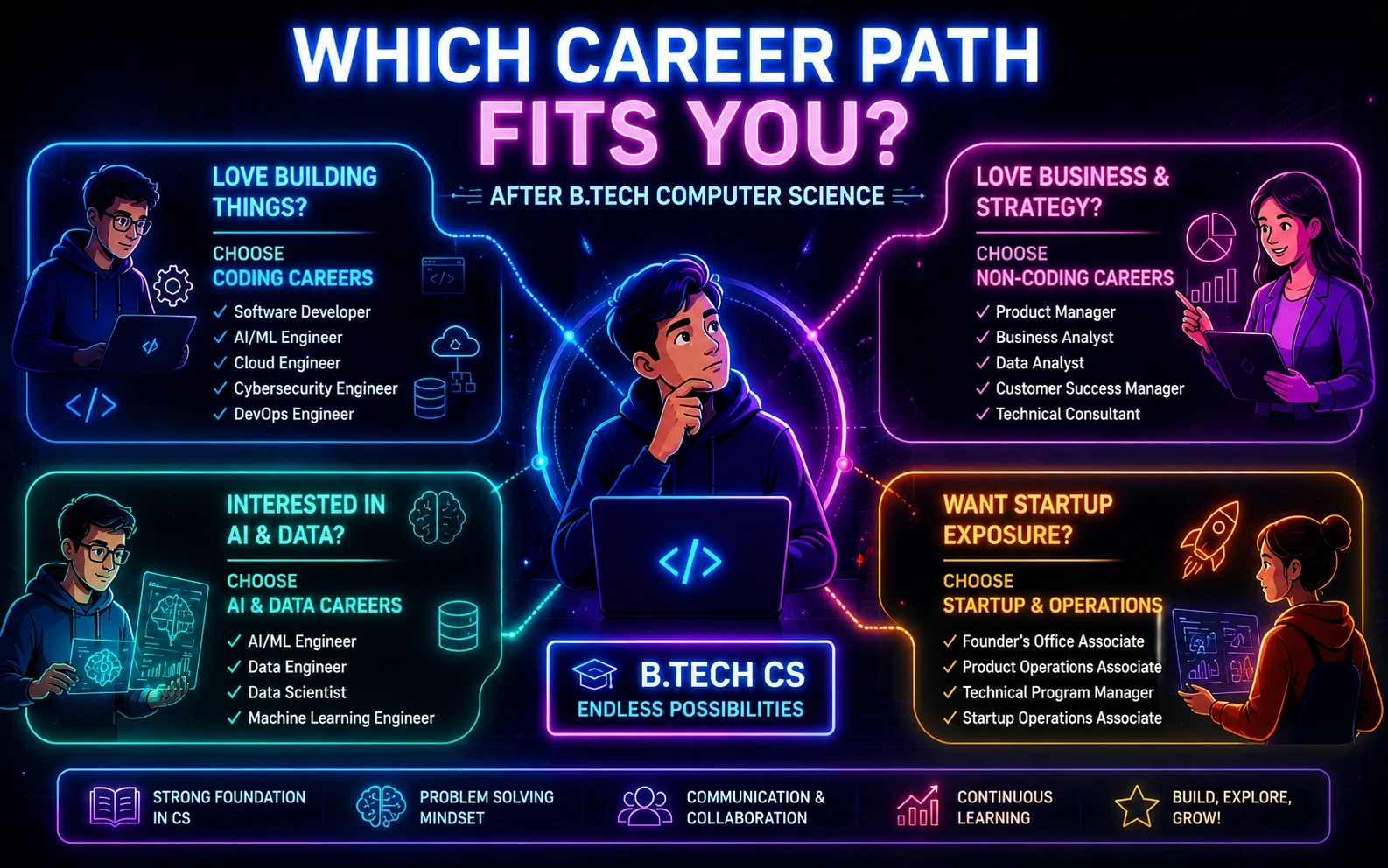
Choose coding if you enjoy building, debugging, logic, technical depth, and long periods of focused problem-solving. Choose non-coding tech if you enjoy understanding users, communicating with teams, solving business problems, presenting ideas, analysing markets, or managing execution.
Do not decide only based on salary. A high salary in a badly matched role can lead to burnout. Instead, ask:
Do I enjoy writing code for several hours?
Do I like debugging and technical problem-solving?
Do I prefer working with users, clients, and business teams?
Do I enjoy presentations, documentation, and coordination?
Am I more excited by systems or by product decisions?
Do I want deep technical expertise or cross-functional responsibility?
The best test is internships. Try one coding internship or project and one product, analyst, design, consulting, or operations project. Your energy after doing the work will tell you more than career advice videos.
Top B.Tech CS Colleges and Tech Ecosystem in India & Delhi NCR
Top B.Tech colleges in India matter because they provide recruiter access, peer networks, labs, hackathons, internships, alumni connections, research exposure, and placement support. But the best B.Tech CS outcomes do not come from the degree alone. They come from what students build during the degree.
Delhi NCR adds another advantage: proximity to startups, IT services firms, product teams, consulting offices, fintech companies, AI communities, founder networks, and global capability centres. Students can access internships, hackathons, startup events, tech meetups, product companies, and industry projects.
For students considering Rishihood University and similar Delhi NCR-linked campuses, the ecosystem advantage is practical. Rishihood’s B.Tech in Computer Science and Artificial Intelligence is positioned as a four-year full-time program focused on intelligent systems, machine learning, generative AI, coding from day one, paid internships, regularly updated curriculum, and startup and career support.
For B.Tech CSE with AI and ML, the real differentiator will be how early students work on live datasets, applied AI projects, cloud tools, startup problems, and cross-functional product challenges. A strong computer science education should prepare students not only for coding roles but also for the broader technology economy.
FAQs
1. Can B.Tech CS students get non-coding jobs?
Yes. B.Tech CS students can get non-coding jobs in product management, business analysis, UI/UX, consulting, customer success, technical sales, pre-sales, implementation, startup operations, and technical program management. These roles do not require full-time coding, but technical understanding helps.
2. Which pays more: coding or non-coding careers?
Coding roles often start higher in software engineering, AI/ML, cloud, cybersecurity, backend, and data engineering. However, non-coding roles such as product management, consulting, enterprise sales, and customer success can match or exceed coding salaries over time when they involve ownership, revenue, or leadership.
3. Is Product Management good after B.Tech CS?
Yes. Product Management can be a strong path after B.Tech CS because students understand technology and can work with engineering teams. It is best for students who also enjoy users, business, communication, metrics, decision-making, and cross-functional work.
4. Do non-coding jobs require programming knowledge?
Not always. Many non-coding jobs do not require daily programming. However, basic technical knowledge is valuable. Understanding APIs, databases, software workflows, data, and engineering constraints helps non-coding professionals work better with technical teams.
5. Which coding jobs have the highest salary in India?
AI/ML engineering, backend engineering, cloud engineering, cybersecurity, data engineering, full-stack development, and product-company software roles can pay strongly in India. Salaries depend on company type, college, skills, internships, projects, and interview performance.
6. Is AI replacing software developer jobs?
AI is changing software developer jobs, especially repetitive coding, documentation, and testing tasks. But AI is also increasing demand for engineers who can build, evaluate, deploy, secure, and manage AI systems. Students should learn how to use AI tools instead of ignoring them.
7. Is coding compulsory for B.Tech Computer Science?
Coding is a core part of B.Tech Computer Science and students should learn it seriously during the degree. However, a long-term career after B.Tech CS does not have to be coding-only. Students can move into product, consulting, analytics, design, customer success, technical sales, or startup roles if they build the right skills.