Technology
Complete Guide to B.Tech in Computer Science Admission 2026: Eligibility, Entrance Exams and Process
Complete guide to B.Tech admission 2026: eligibility, entrance exams, fees, admission process, best colleges, and Computer Science options in Haryana, Delhi NCR.
7 May 2026
TL;DR
Table of Contents
Over 11.7 lakh students appear for JEE Main every year, making it India’s largest gateway to B.Tech admissions. Yet, with only ~17,000 IIT seats, most aspirants are now exploring alternative pathways into B.Tech Computer Science and Engineering (CSE), which is the most in-demand branch in 2026.
From AI and software development to data science, Computer Science continues to lead hiring demand, making CSE the first choice for many engineering aspirants.
If you're planning your B.Tech admission in 2026, it’s essential to understand that entry into Computer Science programs is not limited to a single exam. Students today can enter through JEE Main, state counselling, or direct admission through private universities, depending on their goals and profile.
This is especially relevant for students in and around Delhi NCR and Sonipat (Haryana), where proximity to tech hubs like Gurgaon and Noida adds a clear career advantage.
This guide covers everything, from eligibility and entrance exams to fees, timelines, and high-ranked colleges, so you can choose the smartest path forward.
B.Tech Computer Science admission 2026 in India
Students seeking B.Tech Computer Science admission can choose from three primary pathways:
1. National-level entrance exams (JEE Main and JEE Advanced)
For students targeting institutions like IITs, NITs, and IIITs, JEE Main remains the most competitive pathway, with over 11.7 lakh candidates appearing annually. Those who qualify further can attempt JEE Advanced, where competition intensifies for a limited number of seats.
Ideal for: Students with solid academic preparation and a focus on highly ranked government institutes.
2. State-level counselling (Haryana and other states)
State counselling offers a more accessible pathway. For example, Haryana conducts 3 or more counselling rounds, allowing students multiple opportunities to secure seats based on merit and preferences.
These admissions typically consider JEE Main scores or state-level criteria and allocate seats across government and affiliated colleges. For students in Delhi NCR and Haryana, this channel provides a balanced mix of competition and availability.
Ideal for: Students looking for a balance between rank, affordability, and college options within a specific state or region.
3. Direct admission in private universities
Direct admission has become an increasingly high-demand option, especially in education hubs like Sonipat and Delhi NCR, where private universities offer flexible and faster admission processes.
These institutions evaluate students’ Class 12 performance (usually within the 45%–75% PCM eligibility range) and may conduct their own assessments or interviews.
Ideal for: Students who want quicker admission, flexible criteria, and industry-aligned Computer Science programs.
B.Tech Computer Science and engineering course details
B.Tech Computer Science and Engineering (CSE) is a four-year undergraduate program. Unlike generic engineering degrees, CSE focuses on problem-solving using software, data, and systems, making it one of the most industry-relevant B.Tech courses today. As a result, CSE graduates consistently secure some of the highest starting offers across engineering disciplines
The curriculum begins with core computing fundamentals and gradually progresses into advanced areas aligned with industry demand.
Many universities also offer specialisations in high-growth domains such as Artificial Intelligence, Data Science, Cybersecurity, and Cloud Computing.
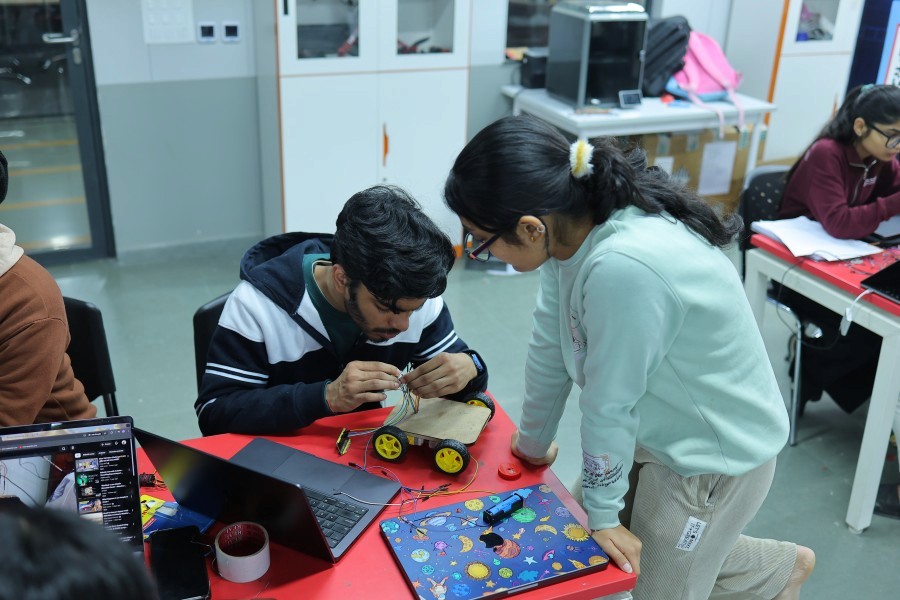
Alongside academics, the program emphasizes practical learning through projects, internships, and hands-on assignments, ensuring students build real-world skills before graduation.
In the final year, some universities, like Rishihood, enable students to work on real-world problem statements and applied projects, which strengthen their practical portfolio before placements.
Key insight: What makes B.Tech Computer Science distinct is its adaptability. The same degree can lead to roles across startups, multinational tech firms, government sectors, or even entrepreneurship, making it one of the most versatile engineering programs today.
B.Tech eligibility criteria for Computer Science admission
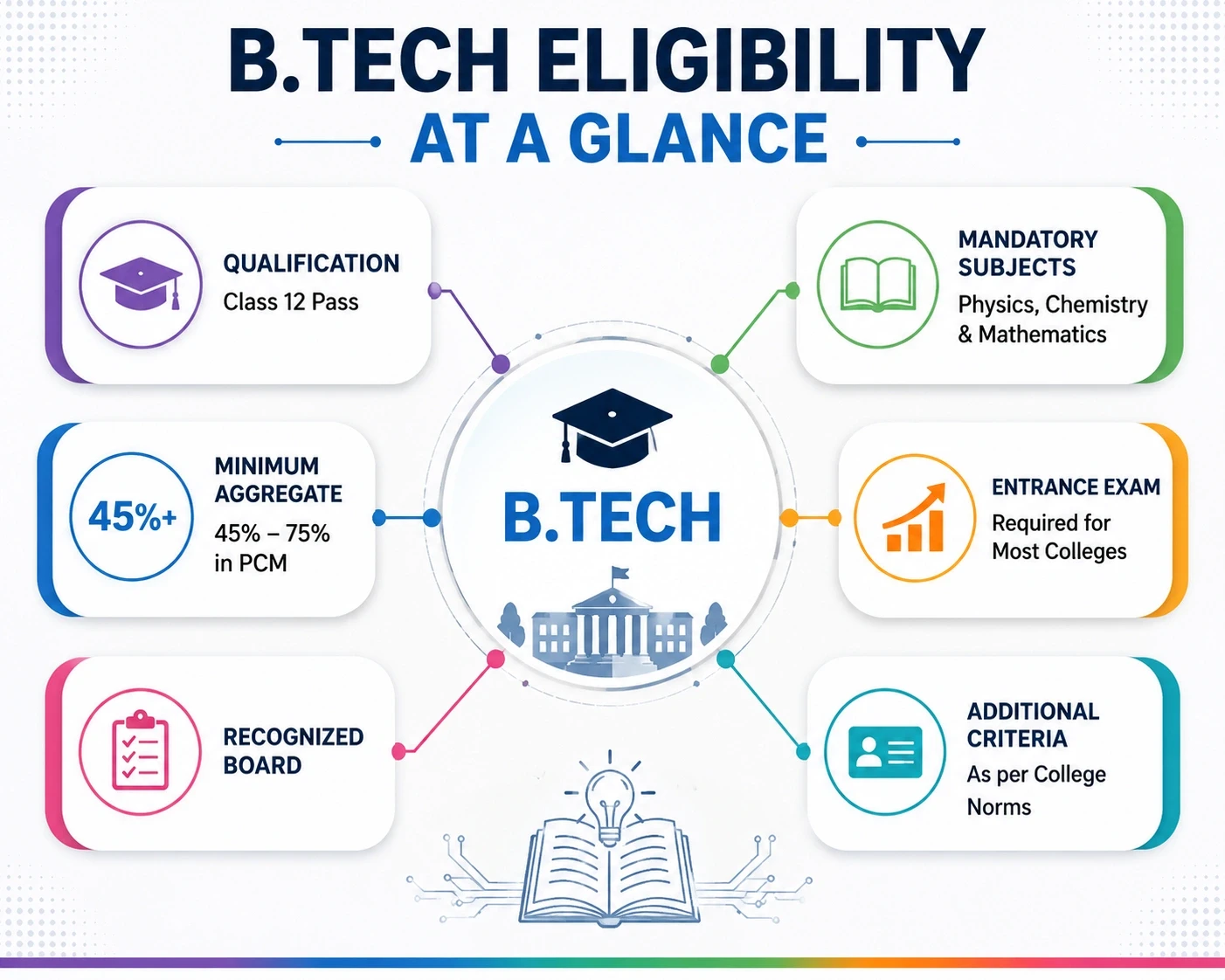
The primary eligibility criteria include:
Class 12 qualification from a recognized board
Mandatory subjects: Physics, Chemistry, and Mathematics (PCM)
Minimum aggregate marks: Typically 45%–75% in PCM, depending on the college and admission path
For government colleges, the cut-off is usually higher and is tied to entrance exam performance, especially JEE Main ranks.
For private universities and direct admission pathways, eligibility criteria are often more flexible within the approved range. Universities may also consider overall academic profile, entrance tests, or personal interviews.
Some institutions may also have additional requirements such as minimum marks in Mathematics specifically or eligibility conditions based on state domicile.
Students are advised to check individual college criteria carefully, as eligibility requirements can vary.
B.Tech entrance exam list 2026
Admission to B.Tech Computer Science and Engineering programs is primarily driven by entrance exams at national and state levels. Each exam differs in terms of competition, acceptance, and admission outcomes.
1. JEE Main (National-level exam)
JEE Main is conducted twice a year (January and April), giving students two opportunities to improve their scores.
JEE Main scores are used for admission into NITs, IIITs, and several well-regarded private engineering colleges, and also act as the qualifying exam for JEE Advanced.
2. JEE Advanced
Students who qualify in JEE Main can appear for JEE Advanced, required for admission into IITs.
This exam is ideal for students aiming for top-tier institutes with the highest academic rigor and placement outcomes.
3. State-level counselling and exams
In states like Haryana, admissions are conducted through centralized counselling processes. These typically consider JEE Main scores and include multiple rounds (3 or more), allowing students several chances to secure a seat.
4. University-level entrance tests and direct admission
Rishihood University, an emerging B.Tech institute, accepts admissions through its entrance test RSAT. |
Many private universities conduct their own entrance tests or offer direct admission based on Class 12 marks and/or JEE scores. This pathway is especially relevant in Sonipat and Delhi NCR, where institutions provide flexible admission cycles and faster seat allocation.
JEE Main vs state exams vs. Direct admission
Choosing the right admission route for B.Tech Computer Science in 2026 largely depends on your score, timeline, and college expectations.
Here’s a clear comparison to help you decide:
Factor | JEE Main | State counselling | Direct admission |
Best for | Government colleges | Balanced regional options | Flexible private university entry |
Competition | Very high | Moderate | Low to Moderate |
Typical required percentile / marks | Usually higher percentiles for leading colleges; varies by institute and category | Moderate merit ranks or qualifying scores; varies by state | Class 12 eligibility marks (commonly 45%–75%) + institute criteria |
Colleges covered | NITs, IIITs, many universities | State govt + private colleges | Private universities |
Based on | Entrance rank | Merit + counselling rank | Class 12 / mixed criteria |
Timeline | Fixed national schedule | Multiple counselling rounds | Often flexible |
Ideal student | Strong exam prep | Practical chooser | Time-sensitive / backup planner |
What If Your JEE Main Percentile Is Between 70 and 80?
Many students assume that scoring below 90 percentile in JEE Main ends their chances of pursuing Computer Science. The reality is very different.
In recent years, more than 11 lakh students have appeared for JEE Main annually. A percentile between 70 and 80 generally places students ahead of a significant portion of test-takers, but it may not be sufficient for highly competitive Computer Science seats at top NITs or IIITs in the General category.
This is why many students in the 70–80 percentile range explore alternative admission pathways instead of relying solely on JoSAA counselling.
What Colleges Can Students Consider at 70–80 Percentile?
While admission outcomes vary by category, state quota, and yearly cut-offs, students in this range often consider:
State engineering colleges through state counselling
Private universities with merit-based admissions
Universities accepting JEE Main scores without extremely high cut-offs
Institutions offering Computer Science specializations in AI, Data Science, and Cybersecurity
The key is not to focus only on brand names but on learning opportunities, industry exposure, and placement readiness.
Why Many Students Look Beyond JEE-Based Admissions
The competition for top government engineering institutes remains intense.
Over 11.7 lakh students appear for JEE Main annually.
IITs collectively offer roughly 18,000–19,000 seats.
NITs offer around 24,000+ undergraduate seats.
Computer Science remains one of the most competitive branches across nearly all leading institutions.
As a result, many capable students with moderate percentiles choose private universities that offer stronger industry integration, modern curricula, and project-based learning environments.
A Different Approach to Computer Science Education
For students exploring options in Delhi NCR and Haryana, universities such as Rishihood University provide an alternative pathway focused on outcomes rather than entrance exam rankings alone.
Instead of evaluating students solely through a single national exam, Rishihood considers academic potential, problem-solving ability, and overall learner profile through its admission process.
The university's B.Tech Computer Science and Artificial Intelligence program emphasizes:
AI-first curriculum aligned with emerging technologies
Industry projects from early semesters
Hackathons and innovation challenges
Startup incubation opportunities
Exposure to real-world product development
For students who may not secure their preferred branch through traditional counselling routes, this can provide a practical pathway toward the same technology careers that drive today's job market.
The Bigger Question: College or Career?
Students often spend months comparing cut-offs but overlook the factors employers actually evaluate.
Technology companies increasingly assess:
Coding ability
Project portfolios
Internship experience
Problem-solving skills
Communication and teamwork
A student graduating with strong technical skills, industry exposure, and a portfolio of real projects can often compete effectively regardless of whether admission came through JEE counselling, state counselling, or direct university admission.
That is why students should evaluate colleges based on curriculum quality, industry exposure, faculty support, internship opportunities, and placement ecosystem—not only on admission difficulty.
B.Tech admission process 2026: Step-by-step timeline
The B.Tech admission process follows a structured timeline. While exact dates may vary, the overall sequence remains almost consistent.
January to April: Entrance exam phase
JEE Main is conducted in two sessions, giving students multiple attempts. At the same time, many private universities begin their application cycles.
May to June: Results and shortlisting
Once JEE Main results are declared, start evaluating your ranks, cut-offs and college options. This is also the right time to explore backup options beyond national-level counselling.
June to August: Counselling and seat allotment
National and state-level counselling processes begin, including Haryana’s multi-round system. Students fill preferences and receive seat allotments across rounds.
August to September: Final admissions and late opportunities
Private universities continue admissions through rolling cycles. Students finalize their college, submit documents, and confirm admission.
Important: Students who rely on a single pathway often face last-minute uncertainty. A smarter approach is to combine entrance exams, counselling, and early applications.
B.Tech course duration and structure in Computer Science programs
The B.Tech course duration for Computer Science programs is typically four years, divided into eight semesters. Each semester follows a structured academic cycle.
In the first year, students focus on foundational engineering concepts and basic computing exposure, helping them transition from school-level learning to technical education.
Hear from Kavyansh, a student from Rishihood University, who went from the 100 Days Workshop to competing nationally at IIT Bombay in his very first semester.
The second and third years form the core of the program structure, where students engage in intensive coursework, lab work, and continuous assessments. This phase often includes mini-projects, coding assignments, and skill-based evaluations, which contribute significantly to overall academic performance.
By the final year, the focus shifts toward industry readiness. Students typically work on a major capstone project, and many institutions encourage or mandate internships before graduation.
B.Tech fees in Indian colleges (Government vs. Private)
The B.Tech fees in India vary significantly depending on the type of institution, location, and infrastructure offered.
Government Colleges
Fee range: ₹50,000 to ₹2 lakh per year
Includes institutions like NITs, IIITs, and state engineering colleges
Lower cost, but high competition and limited seats
Private Colleges and universities
Private institutions offer more flexibility but at a higher cost:
Fee range: ₹1.5 lakh to ₹5 lakh per year
Includes modern infrastructure, industry exposure, and updated curriculum
Easier access through direct admission and multiple intake cycles
Where Rishihood University fits
In the Delhi NCR and Sonipat region, Rishihood University positions itself differently from traditional private colleges.
Instead of focusing only on academics, Rishihood emphasizes:
Interdisciplinary learning + real-world projects
Greater exposure to competitions, hackathons, and industry collaboration
A learning environment that encourages experimentation, not just exams
This approach reflects in student outcomes as well.
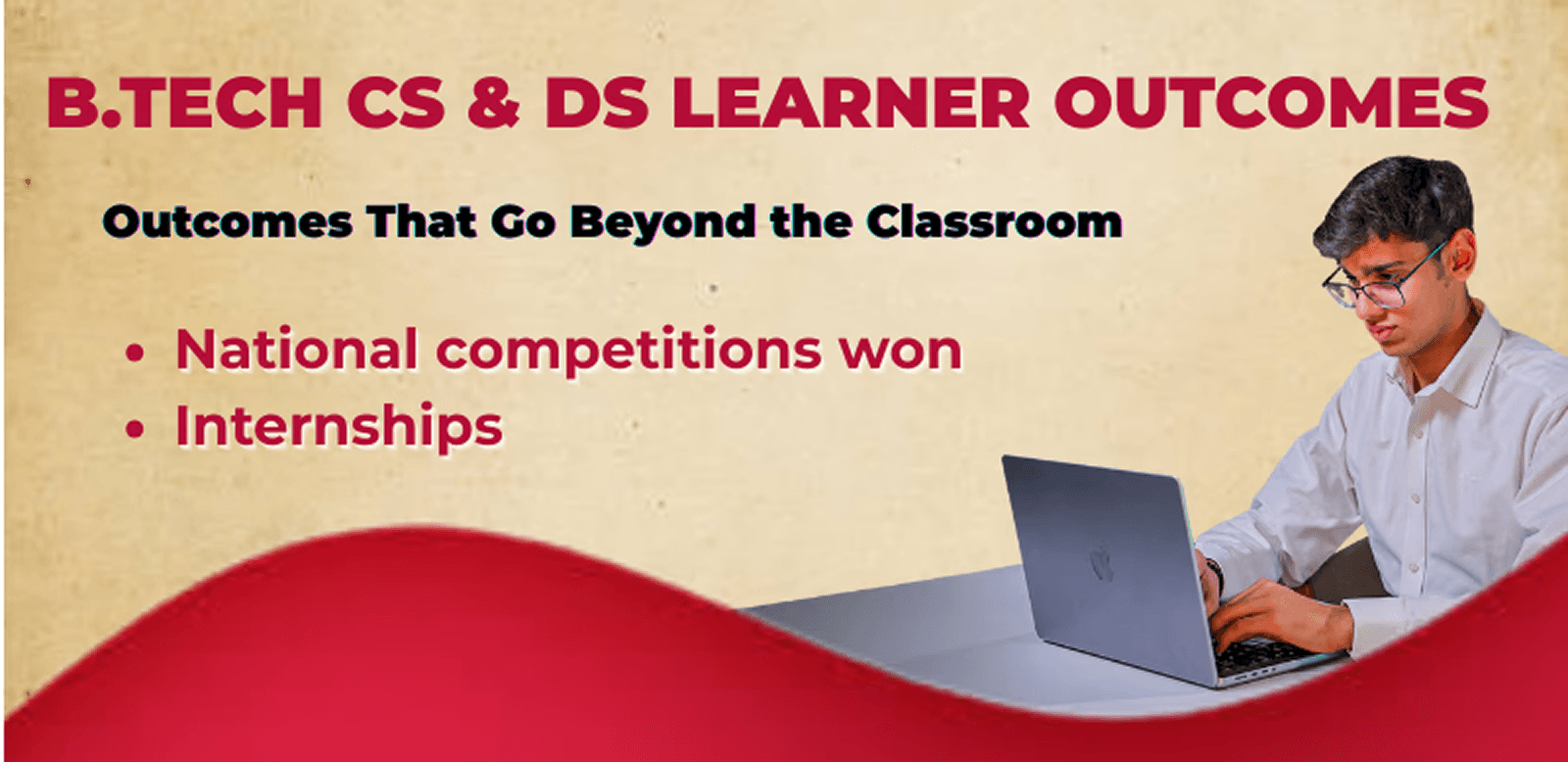
For example, a student team from Rishihood participated in multiple national-level competitions, including IIT Roorkee’s Cognizance, and secured wins, despite initially participating just for exposure. Over time, they went on to win and rank across competitions at institutions like NSUT, BITS Pilani, and other major universities.
Top B.Tech Computer Science colleges in India
India offers several options for B.Tech Computer Science.
At the top tier, institutions like IITs, NITs, IIITs, and BITS Pilani are known for their competitive admissions, high-level peer groups, and reliable recruiter interest.
In the Delhi NCR region, colleges such as DTU and NSUT remain popular choices for students seeking government institutions with high-level industry connections.
Alongside these, private universities like Rishihood University can be a relevant options for students looking for flexible admission pathways, interdisciplinary learning, and proximity to NCR’s tech ecosystem.
Instead of focusing only on rankings, students should evaluate colleges based on fit, exposure, and long-term career outcomes.
Meet Ayush Vishnoi, a first-year B.Tech CSDS learner at Rishihood University who is building his clean chocolate brand, Origine 1847 with a clear focus of combining taste and health. |
Documents required for B.Tech admission in 2026
While exact requirements may vary by college, most students need:
Mandatory documents
Class 10 mark sheet and certificate
Class 12 mark sheet and passing certificate
Entrance exam scorecard (JEE Main or other applicable exams)
Valid government-issued ID proof (Aadhaar card, passport, etc.)
Passport-size photographs
Additional Documents (if applicable)
Category certificate (SC/ST/OBC/EWS), if applicable
Domicile certificate (for state quota admissions)
Transfer certificate
Migration certificate (for boards other than state board)
Character certificate issued by the school
Important tip: Always carry both original documents and multiple photocopies, as verification is mandatory during counselling and final admission.
Career scope after B.Tech in Computer Science
A B.Tech in Computer Science opens up diverse career paths across high-growth domains.
Software Developer
Data Analyst / Data Scientist
AI / Machine Learning Engineer
Cybersecurity Specialist
Cloud Engineer
Salary outlook:
Entry-level salaries typically range between ₹4–8 LPA, while top-tier roles can reach ₹15–30+ LPA, depending on skills and experience.
Why NCR matters:
For Computer Science students, studying near major hiring clusters can improve internship access and job visibility after graduation.
Plan your B.Tech admission for 2026
B.Tech Computer Science admission is no longer about one exam. It’s about choosing the right admission path early.
If you’re exploring options in Delhi NCR and Sonipat, Rishihood University is worth considering for its future-focused curriculum, practical learning environment, and industry-linked approach.
There are limited Seats for 2026 Batch. Secure your seat early and stay ahead of the rush.
FAQs
What is the eligibility for B.Tech Computer Science in Haryana and Delhi?
Students must complete Class 12 with Physics, Chemistry, and Mathematics (PCM). Most colleges require 45%–75% aggregate marks, with higher cut-offs for government institutions.
Which entrance exam is required for B.Tech admission 2026?
The primary exam is JEE Main, conducted twice a year. Students can also apply through state counselling processes or opt for direct admission in private universities, depending on eligibility and preference.
Can I get B.Tech admission without JEE Main in Delhi NCR?
Yes. Many private universities in Delhi NCR and Sonipat, like Rishihood University, offer admission based on Class 12 marks, internal criteria, or alternative entrance options.
What is the average B.Tech fees in engineering colleges in India?
Government colleges may charge around ₹50,000 to ₹2 lakh per year, while private colleges often range from ₹1.5 lakh to ₹5 lakh+ per year, depending on the institution.
What is the duration of the B.Tech Computer Science course?
The standard B.Tech course duration is four years, divided into eight semesters.
Which are the top colleges for B.Tech CSE in Delhi NCR & Sonipat?
Popular options include DTU, NSUT, private universities in Delhi NCR, and institutions such as Rishihood University in Sonipat.