Business
Corporate vs Startup Career After BBA Course in India: Salary, Growth, Risks & Best Path for Students
Compare corporate vs startup careers after a BBA course in India. Know salary, growth, job security, risks, and career opportunities for students.
16 June 2026

Table of Contents
Introduction
India’s Gross Enrolment Ratio (GER) in higher education reached nearly 28.4% in 2021–22, while more than 4 lakh MBA aspirants compete annually for postgraduate management seats. This rising competition has increased pressure on students to make better career decisions immediately after completing a BBA course.
At the same time, India’s startup ecosystem expanded rapidly after 2020, while traditional corporate sectors such as banking, FMCG, consulting, retail, and IT services continued stable hiring across metro cities. Delhi NCR, Gurgaon, Bengaluru, Mumbai, and Noida emerged as major employment hubs for BBA graduates.
This shift has created a major career dilemma for students: should they choose the stability of a corporate job or the fast-growth environment of a startup?
The decision between corporate and startup careers now affects salary progression, skill development, MBA readiness, entrepreneurship exposure, and long-term income potential.
Delhi NCR has become one of India’s largest career ecosystems for both paths. Gurgaon and Noida host multinational corporations, fintech startups, edtech companies, SaaS firms, consulting organizations, and D2C brands that actively recruit BBA graduates.
This guide explains the real difference between corporate and startup careers after a BBA course in India using salary benchmarks, risk-adjusted comparisons, NCR hiring trends, career progression models, and decision-making frameworks built specifically for Indian students.
Corporate Career After BBA in India: Roles, Structure & Growth
Corporate careers remain one of the most common paths after a BBA course in India. Large companies generally provide structured job roles, defined reporting systems, fixed appraisal cycles, and long-term stability.
Common BBA Jobs in Corporate Companies
BBA graduates commonly enter roles such as:
HR Executive
Marketing Associate
Business Development Executive
Operations Executive
Financial Analyst Support
Customer Relationship Executive
Sales Coordinator
Major hiring sectors include:
Banking and BFSI
FMCG companies
Consulting firms
Retail organizations
IT services companies
Logistics and supply chain firms
Delhi NCR remains one of the largest corporate hiring ecosystems in India. Gurgaon and Noida host multinational companies, consulting firms, fintech companies, and enterprise service providers that recruit BBA graduates regularly.
Corporate Salary Structure
Corporate companies generally provide:
Fixed monthly salary
Annual appraisal cycle
Performance bonus
Employee benefits
Structured promotion pathways
Fresh BBA graduates in large corporate firms usually receive salaries between ₹3–6 LPA depending on company size, role, and college brand value.
Career Growth Timeline
0–3 Years
Employees usually work in execution-focused roles involving:
Reporting
Client coordination
Sales operations
HR support
Process management
3–5 Years
Professionals often move into:
Team leadership
Account management
Assistant managerial roles
Strategy support functions
Corporate careers generally reward consistency, specialization, and process management skills over time.
Startup Career After BBA in India: Roles, Risk & Exposure
Startup careers offer a completely different work environment after a BBA course. Startups usually operate with smaller teams, faster execution cycles, and less rigid organizational structures.
Common Startup Roles for Commerce Graduates
BBA graduates in startups commonly work in:
Growth marketing
Business operations
Sales and partnerships
Customer success
Product support
Founder’s office operations
Community management
Unlike corporate jobs, startup employees often handle multiple responsibilities simultaneously.
Early Responsibility Advantage
Startup companies frequently provide:
Faster learning exposure
Direct founder interaction
Cross-functional work
Decision-making participation
High ownership responsibilities
Many startup employees handle client communication, analytics, sales, and operations within the first year itself.
Startup Risk Factors
Startup careers also involve:
Higher job instability
Funding uncertainty
Variable salary structure
Long work hours
Rapid organizational changes
Early-stage startups may struggle with predictable salary increments and structured promotion systems.
Equity vs Salary Trade-Off
Some startups offer:
ESOPs (Employee Stock Ownership Plans)
Variable incentives
Revenue-linked bonuses
While startup fixed salaries may initially remain lower than corporate salaries, high-growth startups can create stronger long-term earning potential through equity appreciation.
NCR Startup Ecosystem
Gurgaon remains one of India’s largest startup clusters. Fintech, edtech, SaaS, healthtech, and D2C startups actively recruit BBA graduates for growth and operations roles.
Noida also expanded startup hiring across:
Digital marketing
E-commerce
Analytics support
Customer growth teams
Salary Comparison: Corporate vs Startup Jobs After BBA in India
BBA salary in India varies significantly based on:
Company type
City
Functional role
Skills
Internship exposure
College reputation
Fresher Salary Comparison
Corporate Companies
Typical fresher salary range:
₹3–6 LPA in MNCs and enterprise firms
₹2.5–4 LPA in mid-sized companies
Startup Companies
Typical fresher salary range:
₹3–7 LPA in funded startups
₹2.5–5 LPA in early-stage startups
Funded startups in Gurgaon and Bengaluru sometimes offer higher compensation for sales and growth-focused roles.
3-Year Earning Trajectory
Corporate Path
Approximate salary progression:
Year 1: ₹3–5 LPA
Year 3: ₹5–8 LPA
Year 5: ₹8–12 LPA
Growth generally remains stable but slower.
Startup Path
Approximate salary progression:
Year 1: ₹3–6 LPA
Year 3: ₹6–12 LPA
Year 5: ₹10–18 LPA
High-performing startup employees may experience faster salary jumps if the company scales successfully.
Fixed Pay vs Variable Pay
Corporate Compensation | Startup Compensation |
Fixed annual salary | Variable bonuses |
Structured incentives | ESOPs and stock options |
Insurance and healthcare benefits | Revenue-based incentives |
PF and retirement benefits | Equity-linked rewards |
Risk-Adjusted Income Comparison
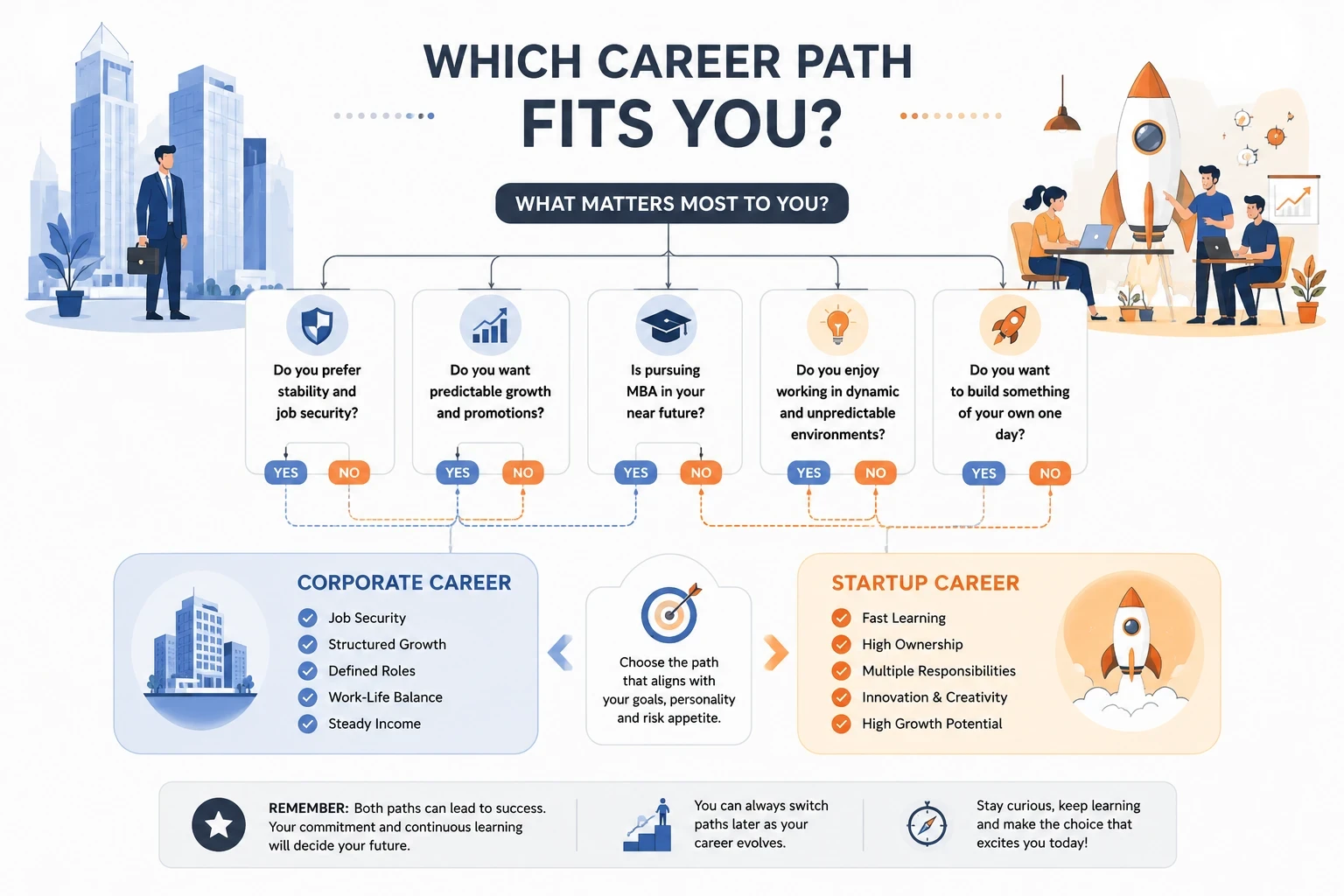
Corporate careers generally offer lower financial risk, consistent salary increments, and stronger long-term job stability within established organizational structures. In comparison, startup careers involve higher uncertainty and performance-based variability but often provide quicker income growth opportunities and faster professional learning. Students who value financial security, structured career progression, and predictable work environments usually prefer corporate roles. On the other hand, students seeking rapid skill development, broader business exposure, and accelerated career growth may find startup environments more beneficial.
Skills Required in Corporate vs Startup Careers After BBA
Different work environments require different professional skills.
Corporate Career Skills
Corporate companies value:
Reporting accuracy
Process discipline
Communication structure
Excel and analytics
Team coordination
Business presentation skills
Employees usually specialize in one functional area over time.
High-Demand Corporate Skills
Financial reporting
CRM management
HR operations
Data analysis
Sales coordination
Process optimization
Startup Career Skills
Startups prioritize:
Adaptability
Multitasking
Sales mindset
Problem-solving
Execution speed
Ownership mentality
Startup employees often work across departments simultaneously.
High-Demand Startup Skills
Performance marketing
Lead generation
Customer acquisition
Market research
Operations management
Business analytics
Skill Transferability Comparison
Corporate skills transfer well into:
MBA programs
Consulting
Large organizations
Specialized management careers
Startup skills transfer strongly into:
Entrepreneurship
Product management
Growth marketing
Business scaling roles
Students should align skill development with long-term career goals before selecting either ecosystem.
Entrepreneurship After BBA in India
Many students now explore entrepreneurship directly after completing a BBA course.
India’s startup ecosystem expanded rapidly across:
Fintech
Edtech
D2C brands
Healthtech
SaaS
Logistics
Startup Founding After BBA
BBA graduates increasingly launch:
E-commerce businesses
Digital marketing agencies
Consulting firms
D2C brands
Local service startups
Entrepreneurship offers:
Unlimited earning potential
Ownership control
Faster decision-making experience
However, startup founding also involves:
Capital risk
Revenue uncertainty
Operational pressure
Market competition
Business Incubators in India
India’s incubator ecosystem expanded significantly through:
IIT incubators
IIM entrepreneurship cells
Startup India initiatives
University incubation centres
Delhi NCR and Bengaluru remain strong entrepreneurship ecosystems due to investor networks and startup communities.
Family Business Integration
Many BBA graduates also join family businesses.
BBA knowledge supports:
Financial planning
Marketing systems
Operations management
Business expansion
Digital transformation
Students entering family businesses often gain faster leadership exposure than traditional corporate employees.
Job-First vs Startup-First Approach
Some graduates directly launch startups after BBA.
Others first gain:
Corporate exposure
Sales experience
Industry understanding
Professional networks
Job-first pathways generally reduce early entrepreneurship risk.
Corporate vs Startup Decision Matrix for BBA Students
Students should evaluate career choices using structured criteria instead of trend-based assumptions.
Risk Tolerance Model
Corporate Career
Best suited for students who prioritize:
Salary stability
Predictable growth
Structured work systems
Lower career risk
Startup Career
Best suited for students who prioritize:
Fast learning
Growth exposure
Innovation
Ownership responsibility
Salary vs Growth Priority
Corporate Path | Startup Path |
Stable income | Faster promotions |
Defined appraisal system | Broader skill exposure |
Employee benefits | Higher variable income potential |
Lower career volatility | Equity and ownership opportunities |
Stability vs Innovation Mapping
This table represents the comparative analysis of the variables that would help give clarity on the pros and cons of choosing a career in corporate vs startup endeavour
Career Factor | Corporate | Startup |
Salary Stability | High | Medium |
Learning Speed | Medium | High |
Work-Life Balance | Medium | Low |
Promotion Structure | Structured | Flexible |
Job Security | High | Lower |
Innovation Exposure | Medium | High |
Skill Diversification | Medium | High |
Student Career-Fit Framework
One can choose a career in Corporate if your priorities are:
You prefer structured growth
You plan to pursue MBA later
You want lower financial risk
You prefer specialization
Choose Startup Career If:
You enjoy multitasking
You prefer fast-paced work
You want entrepreneurial exposure
You can handle uncertainty
Career decisions should align with personality, financial priorities, and long-term professional goals.
Delhi NCR Job Market Impact on Career Choice as it remains one of India’s largest employment ecosystems for BBA graduates under ;
Corporate Hiring Hubs
Major corporate hiring zones include:
Gurgaon Cyber City
Noida IT parks
Delhi financial districts
These regions host:
MNCs
Consulting firms
BFSI companies
Enterprise service providers
Startup Clusters
Gurgaon developed into a major startup ecosystem with strong hiring across:
Fintech
Edtech
SaaS
D2C brands
Logistics startups
Bengaluru still leads India’s startup ecosystem overall, but Gurgaon remains highly competitive for business operations and growth hiring.
Hiring Trends for BBA Graduates
Current hiring trends favor:
Sales and revenue generation skills
Data-driven decision-making
Digital marketing knowledge
CRM tools
Business analytics exposure
Students with internships and practical project exposure generally achieve stronger placement outcomes.
FAQs
Is corporate better than startup after BBA?
Corporate careers offer greater stability and structured growth. Startup careers offer faster learning and broader exposure. The better option depends on risk tolerance and long-term career goals.
Which pays more after BBA in India?
Corporate companies usually provide more stable salaries initially. High-growth startups may generate faster long-term income growth through promotions and equity upside.
Can BBA graduates join startups directly?
Yes. Many startups actively recruit BBA graduates for sales, operations, growth marketing, and business development roles.
Is entrepreneurship risky after BBA?
Entrepreneurship involves financial and operational risk. However, practical exposure, market research, and business experience can reduce startup failure risk.
So then the scope of BBA in India remains in promising industries ;
Banking Sector: BBA graduates can work in retail banking, financial services, loan processing, relationship management, and fintech operations across private banks and NBFCs.
Marketing Careers: Companies hire BBA graduates for digital marketing, sales, advertising, brand management, market research, and customer acquisition roles.
Operations Management: Industries such as e-commerce, logistics, manufacturing, and retail recruit graduates for supply chain coordination, inventory control, and process management.
Human Resource Management: HR departments offer opportunities in recruitment, employee engagement, payroll support, training coordination, and HR operations.
Business Analytics: Growing demand for data-driven decision-making has increased opportunities in reporting, CRM analysis, business intelligence, and analytics support roles.
Consulting Industry: Consulting firms hire BBA graduates for client servicing, business development, research assistance, and operational support functions.
Startup Ecosystem: India’s expanding startup market provides faster career growth, cross-functional exposure, and practical business experience in technology-driven companies.
Entrepreneurship Opportunities: Many students use BBA knowledge to start family businesses, online ventures, service agencies, or independent startups.
Higher Education Pathways: Graduates can also pursue MBA, PGDM, digital marketing, finance, analytics, or international business specialization for advanced career growth.
Strong Demand Across Cities: Delhi NCR, Bengaluru, Mumbai, Pune, and Hyderabad continue offering large-scale employment opportunities for BBA graduates across multiple industries.
Choosing between a corporate career and a startup career after completing a BBA course depends on multiple factors, including salary expectations, career growth priorities, personality traits, work preferences, and risk tolerance. Corporate careers usually offer structured growth paths, stable salary progression, defined job roles, professional training systems, and long-term organizational stability. Many multinational companies and established firms also provide employee benefits, performance-based promotions, and predictable career advancement opportunities.
In contrast, startup careers focus on faster learning, cross-functional responsibilities, innovation-driven work environments, and quicker exposure to business operations. Startup roles often allow BBA graduates to work closely with founders, contribute to decision-making processes, and develop practical skills across marketing, operations, sales, and business strategy within a shorter period.
Delhi NCR continues to provide strong career opportunities in both sectors because of its growing startup ecosystem, expanding technology hubs, and the presence of multinational corporations across industries such as finance, consulting, e-commerce, healthcare, and education. Students should prioritize skill-building, internship exposure, industry-specific knowledge, networking, and long-term career planning before selecting a career path. Career clarity after a BBA course requires structured evaluation of professional goals, work culture preferences, growth expectations, and future stability instead of relying on market trends or peer-driven assumptions.