Psychology
Highest Paying Careers in Psychology in India (2026): Salary, Courses After 12th, Job Roles & Career Scope
In this guide, we explore highest-paying psychology careers in India, salary trends, top courses after Class 12, emerging opportunities, and academic pathways
Table of Contents
Introduction
India's higher education Gross Enrolment Ratio (GER) reached 28.4% in 2021–22, reflecting growing interest in specialised and future-ready careers. Among them, psychology has emerged as one of the most dynamic fields, extending far beyond traditional counselling and mental health practice.
Today, psychology graduates work across healthcare, education, corporate consulting, research, startups, and technology. As awareness of mental health, behavioural science, workplace wellbeing, and user experience continues to grow, so does the demand for skilled psychology professionals.
From clinical and organisational psychology to neuropsychology, forensic psychology, and UX research, the field offers diverse career paths with strong growth potential. However, long-term success depends on the right combination of specialisation, postgraduate education, practical experience, and research exposure.
In this guide, we explore the highest-paying psychology careers in India, salary trends, top courses after Class 12, emerging opportunities, and the academic pathways that can help you build a rewarding career in psychology.
Psychology Career in India
Mental health awareness in India expanded significantly after 2020. Schools, hospitals, startups, rehabilitation centres, NGOs, and corporations increased hiring for psychologists, counselors, and behavioral specialists. The National Mental Health Programme and rising workplace wellness initiatives also contributed to demand growth.
Psychology jobs in India now extend across multiple industries:
Hospitals and mental health clinics
Corporate HR and employee wellness
Educational institutions
Legal and forensic systems
Rehabilitation centres
Child development clinics
UX research and behavioral design
Startup mental wellness platforms
Sports psychology and performance coaching
For students in North India, Delhi NCR remains one of the country's most active psychology employment hubs. The region offers access to hospitals, mental health clinics, schools, NGOs, research centres, consulting firms, and large corporate employers across Gurgaon and Noida. This diverse ecosystem allows students to explore multiple career pathways while gaining practical exposure through internships, projects, and industry engagement.
Recognising the importance of experiential learning, institutions such as Rishihood University provide internship and placement support to psychology students. Learners have secured internships with organisations including the Kailash Satyarthi Foundation, while B.Sc. (Hons.) Psychology student Niharica gained hands-on experience through an internship at Sewasathi Sahayog Foundation.
As psychology continues to intersect with healthcare, technology, education, and business, students entering the field today have more career choices than ever before. The key lies in understanding which specialization aligns best with their interests, strengths, and long-term professional goals.
Explore a Psychology Program that combines academic learning with real-world internships and career support |
Highest Paying Psychology Careers in India
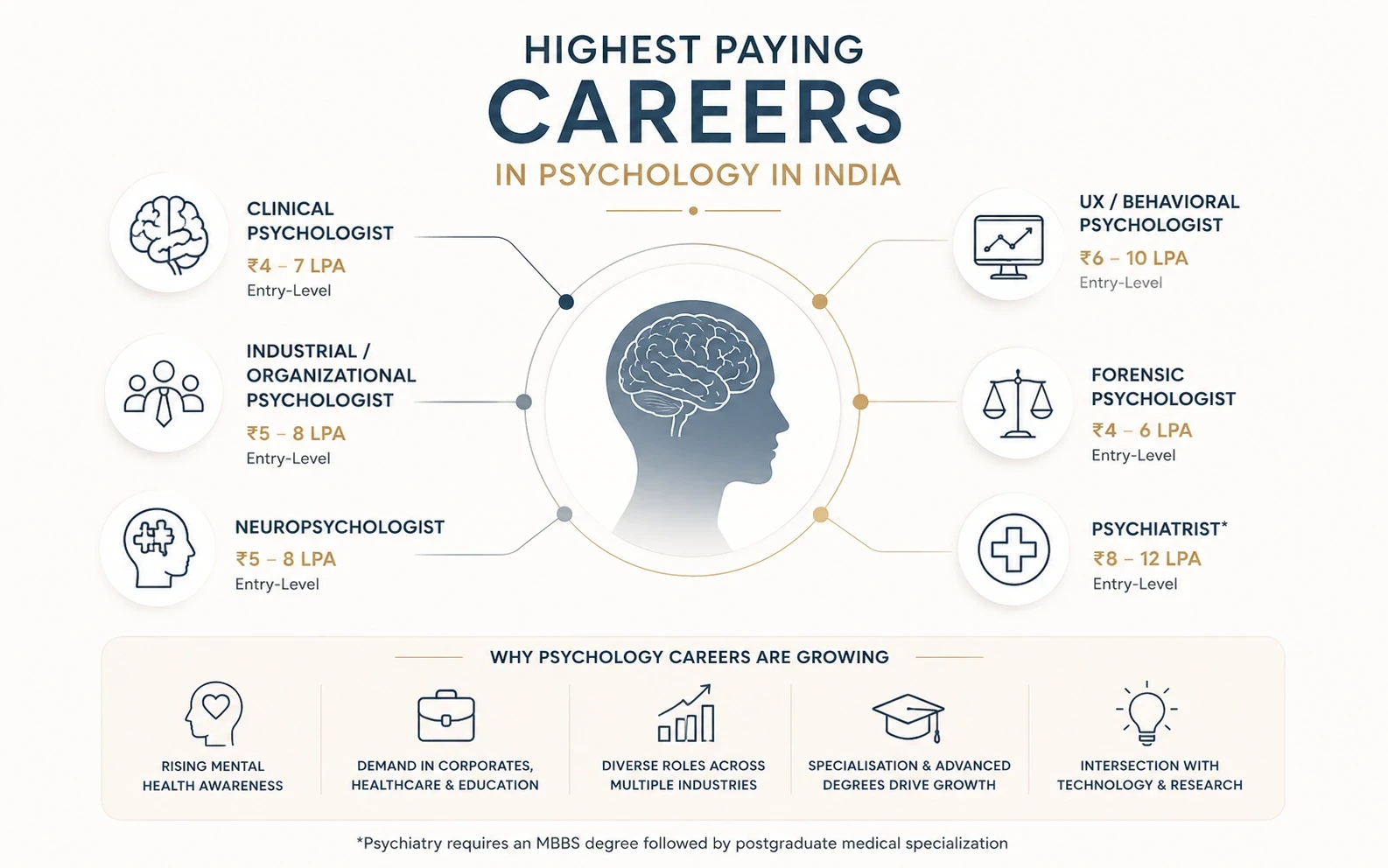
Psychology careers in India have expanded significantly over the past decade, creating opportunities across healthcare, education, technology, research, and corporate sectors. While salary growth depends on factors such as specialization, experience, location, and qualifications, certain roles consistently rank among the highest-paying psychology careers in India.
Career | Entry-Level Salary | Mid-Level Salary | Senior-Level Salary |
Psychiatrist* | ₹8–12 LPA | ₹15–25 LPA | ₹30 LPA+ |
UX / Behavioral Psychologist | ₹6–10 LPA | ₹12–20 LPA | ₹30 LPA+ |
Industrial / Organizational Psychologist | ₹5–8 LPA | ₹10–18 LPA | ₹25 LPA+ |
Neuropsychologist | ₹5–8 LPA | ₹10–18 LPA | ₹22 LPA+ |
Clinical Psychologist | ₹4–7 LPA | ₹8–15 LPA | ₹20 LPA+ |
Forensic Psychologist | ₹4–6 LPA | ₹7–12 LPA | ₹15 LPA+ |
*Psychiatry requires an MBBS degree followed by postgraduate medical specialization and is not a psychology degree pathway.
Among psychology-specific careers, Clinical Psychology remains one of the most sought-after specializations due to the growing demand for mental health services across hospitals, rehabilitation centres, clinics, schools, and private practice. Licensed professionals with advanced training and experience often see significant salary growth over time.
Industrial and Organizational Psychology has emerged as a strong career option as companies invest in employee wellbeing, leadership development, workplace culture, and talent assessment. Demand is particularly strong in Delhi NCR, Bengaluru, and Mumbai, where multinational corporations and consulting firms actively recruit psychology graduates.
For students interested in the intersection of psychology and healthcare, Neuropsychology offers opportunities in cognitive assessment, rehabilitation, and neurological care. Meanwhile, Forensic Psychology continues to grow through its applications in criminal investigations, legal consulting, and rehabilitation services.
One of the fastest-growing areas is UX and Behavioral Psychology, where professionals use psychological principles to understand consumer behaviour, improve digital experiences, and support product design decisions. As technology companies increasingly prioritise user-centred design, these roles are becoming some of the highest-paying opportunities available to psychology graduates.
While salary is an important consideration, students should focus equally on choosing a specialization that aligns with their interests, strengths, and long-term career goals. The most successful psychology professionals combine subject expertise with practical experience, research skills, and continuous learning. This is why institutions such as Rishihood University emphasize experiential learning through research, internships, mentorship, and interdisciplinary exposure, helping students build strong foundations for diverse psychology careers.
Psychology Salary in India
Psychology salary in India varies widely depending on specialization, qualifications, experience, and location. While graduates often begin with modest salaries, income typically increases after postgraduate study, specialization, professional licensing, and practical experience.
Career Stage | Typical Salary Range |
Entry-Level (0–3 Years) | ₹2.5–8 LPA |
Mid-Level (3–7 Years) | ₹8–20 LPA |
Senior-Level (7+ Years) | ₹20–30 LPA+ |
At the entry level, psychology graduates commonly find opportunities in counselling support, HR, employee wellness, research assistance, and behavioural analysis roles. Students who complete internships, research projects, or industry placements during their undergraduate studies often secure stronger starting positions.
Salary growth becomes more noticeable after postgraduate specialization. Professionals working in clinical psychology, organizational psychology, behavioural science, and UX research can earn between ₹8–20 LPA within a few years of gaining experience, particularly in metro cities.
At senior levels, experienced psychologists may move into leadership positions, private practice, consulting, behavioural science roles, or organisational advisory positions. These pathways often offer the highest earning potential, especially when combined with niche expertise and professional credentials.
Location also plays an important role. Delhi NCR, Bengaluru, and Mumbai generally offer higher salaries due to stronger demand from hospitals, corporate employers, consulting firms, and startups. While Tier-2 cities may offer fewer opportunities, they often provide lower living costs and less competition.
Students should remember that long-term salary growth in psychology is influenced less by their undergraduate degree alone and more by specialization, practical experience, research exposure, and continuous professional development.
Psychology Courses After 12th
Students interested in psychology can begin their journey immediately after Class 12 through undergraduate degree programmes. The right choice often depends on long-term career goals, academic interests, and preferred learning style.
The most common psychology courses after 12th include BA Psychology, BSc Psychology, Applied Psychology programmes, and integrated psychology degrees. While all of these pathways introduce students to the study of human behaviour, they differ in focus and career outcomes.
Course | Primary Focus | Suitable For |
BA Psychology | Human behaviour, counselling, social psychology | Counselling, education, social work, therapy support |
BSc Psychology | Research, neuroscience, statistics, behavioural science | Clinical psychology, neuropsychology, behavioural science, research |
Applied Psychology | Practical applications of psychology | Organisational, educational, clinical, and community settings |
Integrated Programmes | Long-term specialised study | Students seeking an accelerated academic pathway |
Students choosing a BA Psychology programme are typically introduced to subjects such as counselling psychology, developmental psychology, social psychology, personality theories, and human behaviour. The degree is often preferred by students interested in counselling, education, and people-centric professions.
A BSc Psychology degree takes a more scientific approach, combining psychology with research methods, statistics, cognitive psychology, biological psychology, and neuroscience foundations. As psychology becomes increasingly data-driven and interdisciplinary, many students interested in clinical psychology, behavioural science, and research choose this route.
Universities are also beginning to move beyond traditional classroom teaching. For example, programmes such as the B.Sc. (Hons.) Psychology at Rishihood University combines psychology with research, neuroscience, behavioural science, internships, and experiential learning opportunities, helping students connect theory with real-world application from an early stage.
Most psychology programmes are open to students from Arts, Science, and Commerce backgrounds, with admission based on merit, entrance examinations, or university-specific criteria.
Hear from Divya - B.Sc Hons student at Rishihood University on why she chose B.Sc Psychology instead of BA
BA Psychology vs BSc Psychology
One of the most common questions students ask after Class 12 is whether to choose a BA Psychology or BSc Psychology degree. While both programmes provide a strong foundation in psychology, they differ in academic approach and career orientation.
BA Psychology | BSc Psychology |
Focuses on human behaviour, counselling, and social psychology | Focuses on research, neuroscience, statistics, and behavioural science |
Greater emphasis on theoretical and applied concepts | Greater emphasis on scientific and analytical methods |
Popular among students interested in counselling, education, and social services | Popular among students interested in clinical psychology, research, neuropsychology, and behavioural science |
Typically includes social and developmental psychology | Typically includes research methods, cognitive psychology, and biological psychology |
At the undergraduate level, salary differences between BA and BSc Psychology graduates are usually minimal. Long-term career outcomes depend far more on postgraduate specialization, practical experience, internships, and professional qualifications.
Students interested in research-intensive fields such as neuropsychology, behavioural science, UX research, and clinical psychology often benefit from the scientific foundation offered by a BSc Psychology degree. Many modern BSc Psychology programmes also integrate research projects, neuroscience, data analysis, internships, and experiential learning to prepare students for emerging careers in psychology.
For example, the B.Sc. (Hons.) Psychology programme at Rishihood University combines psychology with behavioural science, neuroscience, research methodology, internships, counselling exposure, and interdisciplinary learning. Such programmes are designed to help students develop both academic depth and practical skills from the undergraduate stage.
Those interested in counselling, education, and community-focused careers may find a BA Psychology programme better aligned with their goals.
Ultimately, the best choice depends not on salary alone, but on the type of psychology career a student hopes to pursue.
Emerging Psychology Careers in India
As psychology increasingly intersects with technology, business, and healthcare, several new career pathways are emerging beyond traditional counselling and clinical roles. These fields combine behavioural insights with real-world problem-solving and are creating exciting opportunities for psychology graduates.
Career Path | What Professionals Do | Key Industries |
Corporate Behavioral Science | Apply behavioural insights to improve employee engagement, leadership development, consumer behaviour, and organisational performance | Consulting, HR, Corporate Strategy |
UX Psychology | Study user behaviour, decision-making, and digital experiences to improve products and services | Technology, Product Design, Startups |
HR Analytics Psychology | Use behavioural data to support hiring, retention, leadership assessment, and workplace culture initiatives | Human Resources, People Analytics |
Mental Health Startups | Deliver mental health support through digital platforms, wellness applications, and teletherapy services | HealthTech, Wellness, Digital Healthcare |
These emerging fields demonstrate how psychology is expanding beyond traditional settings and creating opportunities across industries. Students who develop strong research, analytical, and communication skills are increasingly finding roles at the intersection of psychology, technology, and business.
Watch Sneha - B.Sc Psychology student talk about exploring research as a career during her undergraduate journey. |
Career Pathway to High Salary in Psychology
Psychology career growth is typically driven by a combination of education, specialization, practical experience, and professional development.
Career Stage | Timeline | Focus Area |
Undergraduate Education | Years 0–3 | Build foundations through BA Psychology, BSc Psychology, or Applied Psychology programmes |
Postgraduate Specialization | Years 3–5 | Pursue MA/MSc Psychology and specialize in Clinical, Counselling, Organizational Psychology, Neuropsychology, or Behavioural Science |
Professional Training & Licensing | Years 5–7 | Complete advanced training, supervised practice, and licensing requirements where applicable |
Advanced Expertise & Leadership | Years 7–10+ | Move into consulting, private practice, behavioural science, research, leadership, or specialist roles |
While specialization and experience drive long-term salary growth, the foundation often begins at the undergraduate level. Students increasingly seek programmes that combine psychology with research, behavioural science, neuroscience, and practical learning opportunities. Programmes such as the B.Sc. (Hons.) Psychology at Rishihood University are designed to support this journey through research exposure, internships, psychology labs, counselling practice, and interdisciplinary learning.
As psychology continues to evolve, professionals who combine psychological expertise with skills in technology, healthcare, business, or analytics are likely to access some of the strongest career opportunities in the coming decade.
FAQs
Which is the highest paying psychology career in India?
Psychiatry remains among the highest paying mental health careers in India. Among psychology-specific careers, clinical psychology, industrial psychology, neuropsychology, and UX psychology offer strong long-term salary growth.
What is the difference between BA Psychology and BSc Psychology?
BA Psychology focuses more on social behavior, counseling, and theoretical concepts. BSc Psychology focuses more on scientific research, statistics, and biological psychology.
What is the psychology scope in Delhi NCR?
Delhi NCR offers strong psychology career opportunities in hospitals, schools, NGOs, startups, corporate organizations, and wellness consulting firms.
Can psychology graduates work in corporate companies?
Yes. Many psychology graduates work in HR, employee wellness, behavioral science, organizational development, leadership consulting, and UX research.
Which psychology specialization has the best salary growth?
Clinical psychology, organizational psychology, neuropsychology, behavioral science, and UX psychology currently show strong salary growth in India.
Is psychology a good career in India in 2026?
Psychology continues expanding across healthcare, education, technology, and corporate sectors. Specialized professionals with postgraduate qualifications and practical experience usually achieve stronger career growth.
Psychology careers in India expanded far beyond traditional counseling roles. Students now access opportunities across healthcare, corporate consulting, behavioral science, UX research, neuroscience, and startup ecosystems.
Delhi NCR, Bengaluru, Mumbai, and Hyderabad continue leading psychology hiring growth due to increasing demand from hospitals, multinational companies, educational institutions, and mental health startups.
Students planning long-term income growth should focus on:
Strong undergraduate foundations
Postgraduate specialization
Practical internships
Licensing and certifications
Emerging psychology domains
Metro-city exposure
Clinical psychology, industrial psychology, neuropsychology, forensic psychology, and behavioral science remain among the highest paying careers in psychology in India in 2026.
Students who combine psychology expertise with technology, analytics, organizational behavior, or healthcare specialization will likely access stronger salary growth and broader career opportunities over the next decade.