Design
Is B.Des a Good Career Option in India in 2026? Salary, Scope & Future Trends
Wondering if B.Des is a good career option in 2026-27? Explore salaries, career scope, specializations, AI impact, industry demand, and future trends in India.
26 June 2026

Table of Contents
Introduction
For years, engineering, medicine, and management dominated conversations about successful careers in India. Design was often viewed as a niche creative field with limited opportunities outside fashion, advertising, or the arts.
That perception has changed dramatically.
Fast-growing companies across fintech, ecommerce, SaaS, healthcare, and gaming rely on designers to build products that are intuitive, engaging, and user-friendly. As digital experiences become a competitive advantage, demand for skilled designers continues to rise.
This post explains why a B.Des degree can be stable and future-proof, with a focus on salary trends, industry demand, AI's impact, and the future of design careers in India in 2026.
Is B.Des Still a Strong Career Option in India in 2026?
The short answer is yes, but not for the reasons many people assume.
The strongest argument for pursuing a B.Des today is not that design is "creative." It is that design has become deeply integrated with how modern businesses operate.
Consider how consumers interact with brands. A customer may discover a product through Instagram, browse it through a mobile app, compare options on a website, and complete a purchase digitally. Every step of that journey is influenced by design decisions.
This is why companies increasingly view design as a strategic function rather than a support function.
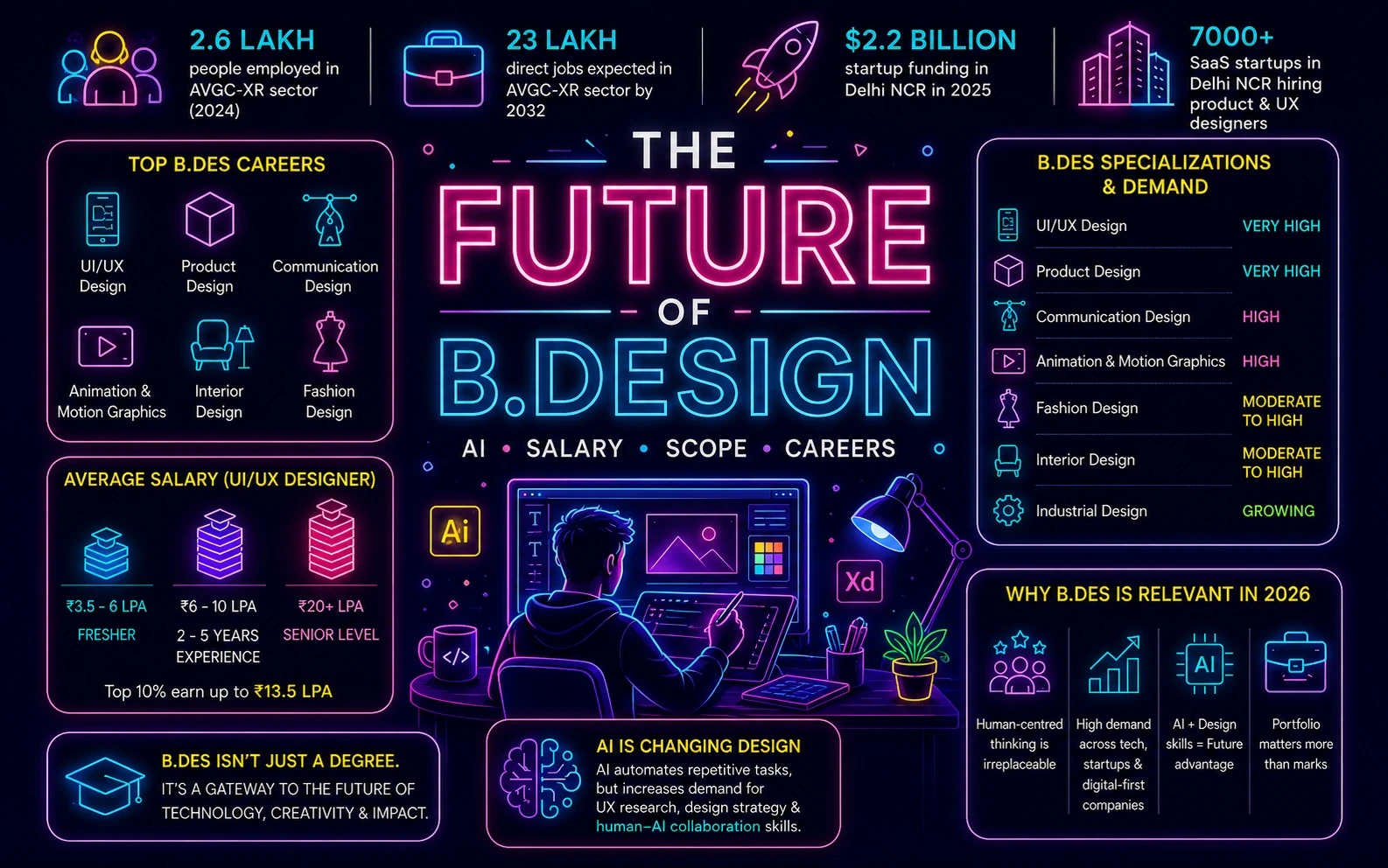
Delhi NCR startups raised $2.2 billion in 2025, cementing the region's position as India's second-largest startup hub. This funding activity directly translates into design hiring, as funded startups invest heavily in product and UX teams.
A decade ago, many organizations hired designers primarily for branding or marketing purposes. Across industries, design professionals are involved in product development, customer experience, business strategy, and innovation. Product teams depend on UX designers to improve adoption rates. Startups hire product designers early because usability often determines whether a digital product succeeds or fails.
For students who enjoy combining creativity, problem-solving, technology, and human-centred thinking, B.Des remains one of the most relevant undergraduate degrees available in 2026.
Bachelor of Design Course Details in India
Understanding B.Des course details, including curriculum, specializations, and industry exposure, can help students evaluate whether the degree aligns with their long-term career goals.
B.Des (Bachelor of Design) is a four-year undergraduate degree programme available across more than 450 colleges in India, including 64 government institutions. It is designed around portfolio-based learning, meaning students are evaluated primarily through projects, presentations, and design work rather than rote examinations.
Eligibility: Students who have passed Class 12 or an equivalent examination with a minimum of 50% marks are eligible to apply for B.Des programs. Most top design colleges, like Rishihood University, do not require JEE scores. Admission is instead based on design-specific aptitude tests.
Key Entrance Exams for B.Design:
- UCEED (Undergraduate Common Entrance Exam for Design) for IITs
- NID DAT (National Institute of Design, Design Aptitude Test)
- NIFT Entrance Exam
- University-specific design aptitude tests such as RSAT and other institutional entrance exams
Course Structure: The four-year programme is divided into 8 semesters. Early semesters cover design fundamentals, including colour theory, form, materials, typography, and sketching. Later semesters introduce specialization-specific subjects, studio projects, internships, and a final thesis project.
Whether you search for B.Des, BDES, or Bachelor of Design programs, employers ultimately evaluate the skills and portfolio you develop during the degree.
B.Des Specializations With Highest Demand in India
Here is a breakdown of the major B.Des specializations and their current demand in India's job market.
Specialization | Demand Level | Key Industries |
UI/UX Design | Very High | SaaS, Fintech, Ecommerce |
Product Design | Very High | Startups, Tech Companies |
Communication Design | High | Branding, Marketing |
Animation & Motion Graphics | High | Media, Gaming |
Fashion Design | Moderate to High | Retail, Luxury Brands |
Interior Design | Moderate to High | Real Estate |
Industrial Design | Growing | Manufacturing |
UI/UX Design Careers in Delhi NCR and India
Most startups today are digital-first businesses.
They need designers who can:
Conduct user research
Design interfaces
Improve customer journeys
Build product experiences
As a result, UI/UX and Product Design currently offer some of the strongest career growth opportunities among all B.Des specializations. According to Glassdoor data from May 2026, the average salary for a UI/UX Designer in India is approximately ₹6.42 LPA, with top earners reaching ₹13.5 LPA at the 90th percentile.
The Delhi NCR Ecosystem
Delhi NCR has quietly become one of India's most active hiring corridors for UX talent. The SaaS sectors in Delhi NCR include established names such as Shiprocket, Innovaccer, and PeopleStrong. These companies build digital-first products that require continuous UX investment across web, mobile, and enterprise interfaces.
Gurgaon concentrates fintech, HR tech, and logistics SaaS companies. Noida hosts a dense cluster of IT services firms, gaming studios, and digital agencies. Both cities have active UX hiring pipelines for freshers and mid-level designers with strong portfolios.
In Delhi NCR, demand is quite strong. Gurugram alone offers 500+ active UI/UX jobs, reflecting the volume of hiring in different companies.
Rishihood University's location in Sonipat places B.Des graduates within direct commuting range of both Gurgaon and Noida hiring markets, without the cost burden of living inside either city.
Remote and Hybrid Opportunities
Remote work is another advantage in this specialization. UX design is one of the few creative-technical roles where remote and hybrid arrangements are normalized, opening up global client opportunities for India-based designers.
Product Design Careers in India's Startup Economy
Product design has evolved from an engineering-adjacent function to a strategic role within Indian startups. Product designers in 2026 are expected to own the end-to-end user experience of a digital product, from research and wireframing through to delivery and iteration.
India's fintech sector, projected to cross $150 billion in value, is a significant employer of product designers. Platforms like PhonePe, Groww, CRED, and Zepto have built dedicated product design teams where designers hold real decision-making authority over product direction. The same pattern is visible in EdTech, healthtech, and logistics tech.
UX/UI design continues to be the highest-growth area, with a projected 20% surge in demand and corresponding salaries, driven by the booming app economy. For product designers, this means that those who complete strong internships during college years have a measurable hiring advantage.
Rishihood University provides an added advantage for the students pursuing their B.Des degree. The university offers 20+ high-intensity workshops, 6 months paid industry experience, and five or more live projects, helping students build stronger portfolios before graduation.
Communication Design Careers in India
Communication design graduates work at the intersection of visual identity, messaging, and media. In 2026, this role has expanded well beyond traditional print or advertising.
Key hiring areas include branding agencies (Dentsu, Ogilvy, McCann), in-house creative teams at consumer brands, social media design roles, OTT platform content teams, and the rapidly expanding D2C brands. India's creator economy runs on communication design talent across YouTube, Instagram, podcast networks, and newsletter platforms.
Motion graphics and video design are especially high-demand subsets of this specialization. Short-form video content on Instagram Reels and YouTube Shorts has created sustained demand for animators and motion designers who can produce content at scale.
B.Des Salary Trends in India for 2026
Salary depends heavily on specialization, city, portfolio quality, and internship experience.
B.Des Salary Summary Table
Experience Level | Salary Range (LPA) | Top Paying Specializations |
Fresher (0-1 years) | Rs 3 to Rs 6 | UI/UX, Product Design |
Mid-level (2-4 years) | Rs 6 to Rs 12 | UI/UX, Product, Communication |
Senior (5-10 years) | Rs 12 to Rs 25 | Product Design, Art Direction |
Freelance (3+ years) | Rs 6 to Rs 24 | UI/UX, Communication Design |
Metro cities, including Delhi NCR, consistently offer 15–25% higher salaries than Tier-2 cities for comparable roles.
Industries Hiring B.Des Graduates in India
The breadth of industries hiring B.Des graduates has expanded significantly. It is no longer limited to fashion or advertising.
SaaS and Tech Companies: Product and UI/UX designers are embedded in engineering teams at companies like Zoho, Freshworks, Chargebee, and hundreds of smaller SaaS firms. Design is a product differentiator in subscription software — making this one of the most stable employment categories.
Ecommerce and D2C: Meesho, Myntra, Flipkart, and emerging D2C brands need communication designers, UX designers, and visual designers across digital and packaging touchpoints.
Gaming and AVGC: The AVGC-XR sector currently employs around 260,000 people, with projections reaching 2.3 million across gaming, animation, VFX, and extended reality by 2032. Game artists, UI designers, and motion graphics professionals are in active demand.
Advertising and Branding Agencies: McCann, Leo Burnett, Dentsu, and homegrown agencies like Lowe Lintas recruit communication designers for brand identity, campaign, and digital work.
EdTech and Fintech: Both sectors saw design hiring accelerate post-2024 as user experience became central to retention and conversion metrics.
Will AI Replace Designers?
The honest answer: AI will not eliminate design career opportunities, but it will eliminate designers who refuse to engage with it.
So far, the evidence suggests that AI is transforming design workflows rather than eliminating design roles.
What AI Is Actually Doing to Design Work
AI tools are automating repetitive production tasks like resizing ads and formatting posts, accelerating personalization for different audience segments, and optimizing campaign performances. The key shift is that automation in the creative industry is not about removing people from the process. It is about giving creatives more space to think, strategize, and craft human experiences that machines still cannot replicate.
Tools like Figma AI, Adobe Firefly, Midjourney, and Galileo AI are already embedded in professional design workflows. Designers who use them produce faster, iterate more, and handle larger project volumes.
Which Design Roles Are Most Resilient
Specializations such as Design Strategist, UX Designer, Service Designer, and Inclusive Design Specialist are among those that AI cannot fully replace. Designers who combine creativity, judgment, context, and leadership with AI as a tool will most likely always remain ahead of the curve.
UX research, design thinking facilitation, design systems architecture, and brand strategy all require human judgment, empathy, and contextual reasoning that current AI tools cannot replicate. These are precisely the skills that strong B.Des programs build.
The risk in design is not replacement. It is irrelevant through stagnation. Students who graduate with AI tool fluency alongside strong design fundamentals enter the job market with a measurable advantage.
Explore Rishihood University’s B.Design programs in UX Design, Product Design, and Communication Design. |
Skills Required for High-Paying Design Careers
A B.Des degree provides the foundation, but high-paying roles require specific skill development beyond the classroom:
Core Design Skills:
Design thinking and user-centred research
Wireframing and prototyping (Figma, Adobe XD)
Visual design and typography
Information architecture and interaction design
High-Value Additions in 2026:
AI tool fluency (Midjourney, Firefly, Figma AI)
Design systems development (component libraries, style guides)
Basic front-end understanding (HTML, CSS) for developer collaboration
UX writing and content design
Motion design (After Effects, Lottie)
Portfolio quality is the single most decisive factor at hiring. A strong, real-world project portfolio, especially with documented design process and problem-solving, consistently outperforms a degree from a lower-tier institution in competitive hiring scenarios.
This is where Rishihood University stands out. Located near Delhi, it combines a focused learning environment with access to the opportunities of the NCR region. Its B.Design program emphasizes hands-on learning, mentorship, and portfolio development, the factors that have the greatest impact on a designer's career prospects.
B.Des vs B.Tech vs BBA Creative Career Comparison
Students often compare design degrees with engineering and management programs when evaluating future career prospects.
The reality is that these degrees serve different goals.
B.Tech focuses primarily on technical problem-solving and engineering systems. BBA emphasizes business management, operations, and organizational leadership. A B.Des, on the other hand, centres on creativity, innovation, human behaviour, and experience design.
Parameter | B.Des | B.Tech (CS/AI) | BBA |
Core Learning | Design thinking, visual communication, user research | Engineering, programming, systems design | Business, management, marketing |
Admission Route | UCEED, NID DAT, NIFT, CUET, aptitude tests | JEE Main, JEE Advanced, state CETs | CUET, university entrance tests |
Fresher Salary | Rs 3 to Rs 6 LPA | Rs 4 to Rs 8 LPA | Rs 3 to Rs 5 LPA |
Peak Salary (10 yrs) | Rs 20 to Rs 25 LPA | Rs 30 to Rs 50+ LPA | Rs 15 to Rs 25 LPA |
Creative Autonomy | High | Low to moderate | Low |
Startup Demand | High (product, UX roles) | Very high (engineering roles) | Moderate (operations, growth roles) |
Entrepreneurship Fit | Strong | Strong | Strong |
AI Disruption Risk | Moderate | Moderate to high | Moderate |
Important: B.Tech and B.Des career paths are increasingly overlapping. Roles such as product manager, design engineer, and creative technologist combine technical and design expertise. Students who pair design skills with technical knowledge are well-positioned for these hybrid roles, which are among the fastest-growing and highest-paying in India's startup ecosystem.
Who Should Choose B.Des After Class 12 in India
B.Des is a strong fit for students who:
Demonstrate consistent interest in visual thinking, aesthetics, or problem-solving through design
Enjoy project-based work more than examination-based assessment
Want to work in tech, startups, media, gaming, or fashion industries
Are comfortable with iteration, feedback, and building a portfolio over time
Have interest in entrepreneurship. Design thinking is foundational to building
products and brands
It requires careful reconsideration for students who:
Are choosing design as a backup because engineering didn't work out, without genuine interest
Expect quick results without sustained creative effort
Are not open to developing digital tool skills alongside creative skills
A Note on Realism
B.Des from a strong program with industry connections, internship pipelines, and portfolio mentorship produces meaningfully different outcomes than B.Des from an institution with weak industry linkages. Students should evaluate placement records, faculty backgrounds, and internship access as rigorously as they evaluate fees and campus aesthetics.
Rishihood University's B.Des program, ranked 26th in Design by IIRF 2025, offers 60 seats, accepts UCEED, NID DAT, NIFT, CUET, and RCAT scores, and brings industry exposure through its partnership with Limkokwing University, Malaysia, and association with designer Rina Dhaka.
Future Trends in India's Design Industry
The design industry in India over the next five years will be shaped by several converging forces:
AR/VR and Spatial Design: As extended reality platforms mature, demand for spatial UX designers, professionals who design for 3D and immersive environments, will grow sharply. This is an early-mover specialization with limited supply.
AI-Human Design Collaboration: Portfolios should highlight both technical adaptability and creative originality. Designers increasingly showcase projects involving human-AI collaboration, demonstrating how they effectively leverage AI while maintaining personal artistic vision.
Gaming and AVGC Expansion: The Indian gaming market is expected to be worth $9.2 billion USD by 2029, growing at a compounded annual growth rate of 20%. Recent government initiatives supporting India's AVGC-XR ecosystem are expected to strengthen opportunities in game art, UI/UX, animation, and immersive media.
Sustainable and Inclusive Design: Global and Indian brands are incorporating sustainability mandates into design processes. Designers with expertise in sustainable packaging, circular design, and accessible interfaces will command a premium.
Creator Economy Roles: Brand designers, motion designers, and visual strategists who can work with independent creators and content-first companies represent a fast-emerging career category outside traditional agency or corporate structures.
India's design industry is moving from being execution-focused to being strategy-integrated. B.Des graduates who develop both aesthetic and analytical capabilities, and who stay current with AI tools, are positioned for strong, long-term career trajectories in 2026 and beyond.
Students do not need to limit their choices to highly competitive government institutes. Universities such as Rishihood University provide a strong pathway into the design profession.
Explore the School of Design at Rishihood University and take a virtual campus tour
Ready to Start Your Design Career?
If you are evaluating B.Des after Class 12, the most important step is honest self-assessment.
Genuinely answer the following:
Do you think in images?
Enjoy solving user problems?
Have the patience to build a strong portfolio over four years?
If yes, the industry demand, salary potential, and career flexibility in 2026 make B.Des a genuinely excellent choice.
The students who get the most from B.Des are those who choose programs with real industry pipelines, portfolio mentorship, and internship access, not just strong brand names.
Rishihood University's B.Des program is ranked 26th in Design by IIRF 2025 and offers 60 seats across specializations. Admissions are open to students who have cleared UCEED, NID DAT, NIFT, CUET, or RCAT. JEE scores are not required. The program brings global design exposure through its partnership with Limkokwing University, Malaysia, and industry connections through designer Rina Dhaka.
Located in Sonipat within the Delhi NCR corridor, Rishihood places graduates within direct reach of Gurgaon and Noida's active design hiring markets.
Explore the B.Des program at Rishihood University and discover how industry projects, portfolio-driven learning, and hands-on experience can prepare you for the future of design.
FAQs
Is B.Des a good career option in India in 2026?
Yes. B.Des offers strong career opportunities in UI/UX design, product design, branding, gaming, and digital media. Growing demand from startups, SaaS companies, fintech firms, and ecommerce brands makes it a promising career choice in 2026.
What is the average salary after a B.Des course in India?
Fresh B.Des graduates typically earn between ₹3 LPA and ₹10 LPA, depending on their specialization, portfolio, location, and employer. Product Design and UI/UX Design often offer the highest starting salaries.
Which B.Des specialization has the highest scope?
UI/UX Design and Product Design currently offer the highest demand and salary potential. Communication Design, Animation, and Motion Design are also growing due to the expansion of digital products and content creation.
Will AI replace design jobs in the future?
No. AI can automate repetitive design tasks, but human skills such as user research, creativity, problem-solving, and design strategy remain difficult to replace. Designers who use AI effectively are likely to stay in demand.
Can students from any stream pursue a B.Des after Class 12?
Yes. Students from Science, Commerce, and Humanities streams can pursue a B.Des degree after Class 12, subject to the eligibility criteria of the institution they apply to.
Is B.Des better than B.Tech or BBA for creative students?
For students interested in design, innovation, branding, and user experience, B.Des offers a more specialized and creative career path than B.Tech or BBA.