Design
NID Exam and Best NID Undergraduate Colleges for B.Design in India
Explore NID exam eligibility, B.Des course details, NID entrance exam pattern, selection criteria, top NID colleges, private design colleges, and career scope after Bachelor of Design in India.
13 May 2026
TL;DR
The NID entrance exam is one of India’s most competitive design entrance pathways, with around 20,000 applicants competing for fewer than 500 B.Des seats.
The approximate NID selection rate is around 1.5%–2%, making it tougher than many other undergraduate entrance routes in India.
NID B.Des admission is conducted through the Design Aptitude Test, commonly known as NID DAT.
NID DAT has two stages: DAT Prelims and DAT Mains. DAT Prelims is used for shortlisting, while DAT Mains carries the final evaluation weightage.
B.Des is open to students from Science, Commerce, and Arts after Class 12, provided they meet the eligibility and entrance requirements.
NID Ahmedabad is the flagship NID campus, while NID Andhra Pradesh, Haryana, Madhya Pradesh, and Assam also offer B.Des seats.
Haryana and Delhi NCR students can apply for NID without location restrictions and may also consider private bachelor of design colleges near Sonipat and Delhi NCR as backup options.
Rishihood University’s B.Design program offers specializations in UX and Interaction Design, Product Design, and Communication Design, making it relevant for students exploring private design colleges near Delhi NCR.
Table of Contents
Introduction
Every year, around 20,000 students appear for the NID entrance exam across India, competing for approximately 425–450 B.Des seats across National Institute of Design campuses. This puts the estimated selection rate at only around 1.5%–2%, making NID one of the most competitive undergraduate design admission routes in the country.
The competition is high because NID is considered one of India’s strongest design institutions. For students interested in product design, communication design, UI/UX, textile design, fashion, animation, branding, and digital experiences, NID is often seen as the dream college.
At the same time, the demand for B.Des courses in India has grown because design is now central to technology, consumer products, advertising, fashion, e-commerce, media, and startups. A Bachelor of Design is no longer limited to “creative arts”; it is a professional degree linked to problem-solving, user experience, business, and innovation.
This article explains B.Des course details, B.Des course eligibility, NID exam eligibility, NID entrance exam pattern, selection criteria, top NID colleges, private design college alternatives, and career paths after B.Des in India.
B.Des Course Details in India for Students
B.Des, or Bachelor of Design, is a four-year undergraduate degree focused on creative thinking, problem-solving, visual communication, product development, and practical design execution.
Unlike traditional theory-heavy degrees, B.Des is built around studio learning. Students work on projects, sketches, models, prototypes, presentations, research exercises, and real-world design problems. The course helps students understand how people interact with objects, spaces, products, interfaces, brands, and services.
A B.Des course typically trains students in:
Design fundamentals
Drawing and visualization
Form, colour, and composition
Product design basics
Communication design
User research
Material study
Digital tools
Prototyping
Portfolio development
The course is ideal for students who enjoy observing people, solving everyday problems, creating visual ideas, working with materials, or improving how products and services function.
Industries are now hiring designers not just for aesthetics but for business impact. A good app interface, a useful product, attractive packaging, clear signage, or a strong brand identity can directly affect how consumers behave. This is why B.Des graduates are increasingly needed across technology companies, startups, product companies, advertising agencies, design studios, fashion brands, lifestyle businesses, and e-commerce platforms.
For students after Class 12, B.Des offers a structured pathway into professional design careers.
B.Des Course Eligibility After 12th India
B.Des course eligibility is broad compared to many technical degrees. Students from Science, Commerce, and Arts streams can apply after completing Class 12 from a recognized board.
General B.Des course eligibility usually includes:
Completion of 10+2 from a recognized board
Minimum marks requirement, depending on the institution
Entrance exam score, where applicable
Portfolio, studio test, or interview in some colleges
For NID specifically, students must meet both educational and age criteria. For B.Des 2026–27, candidates applying in the General and GEN-EWS category must be born on or after 1 July 2005. OBC-NCL, SC, and ST candidates must be born on or after 1 July 2002, while PwD reserved category candidates must be born on or after 1 July 2000.
Students appearing for Class 12 can also apply, provided they meet the final admission and document verification requirements later.
The important point is that NID admission is not based only on Class 12 marks. The NID exam selection criteria focus on design aptitude, creativity, observation, visualization, and practical design ability. This is why students must prepare differently from regular academic entrance exams.
For private bachelor of design colleges in India, eligibility may be more flexible. Some colleges accept national test scores such as NID, UCEED, NIFT, or SAT, while others conduct their own design aptitude test and interview. For example, Rishihood University evaluates students through RSAT or recognized standard tests such as NIFT, NID, UCEED, SAT, academic and extracurricular achievements, and a personal interview.
B.Des Course Structure and Specializations in India
A B.Des course usually begins with a foundation year. This stage focuses on design fundamentals, drawing, visual thinking, material behaviour, user studies, form, colour, and communication.
After the foundation stage, students move into specializations. Common B.Des specializations in India include:
Product Design
Communication Design
UI/UX Design
Interaction Design
Textile Design
Fashion Design
Animation Design
Graphic Design
Rishihood’s B.Design brochure also follows a similar structure, with Year 1 focused on observational drawing, material and fabrication fundamentals, visual representation, user research, and problem framing. From Year 2 onwards, students specialize in UX and Interaction Design, Communication Design, or Product Design.
NID Entrance Exam Overview for Aspirants
The NID entrance exam is officially called the Design Aptitude Test, or DAT. It is conducted for admission to B.Des programs at NID campuses.
Unlike conventional entrance exams, NID DAT does not test only memory or textbook knowledge. It evaluates how students think, observe, imagine, draw, solve problems, and communicate ideas.
The exam has two stages:
DAT Prelims
DAT Mains
DAT Prelims is the first stage and is used to shortlist candidates. DAT Mains is the second stage and is conducted for students who clear Prelims. According to the official NID admission process, admission is based on performance in the two-stage Design Aptitude Tests: DAT Prelims and DAT Mains.
For students, the biggest difference is that NID rewards originality, observation, visual thinking, and practical problem-solving instead of rote learning. A student preparing for NID must therefore build both creative and analytical ability.
NID Exam Eligibility Criteria for Students in India: Haryana and Delhi NCR Focus
Students from Haryana, Delhi NCR, Sonipat, Gurgaon, Faridabad, Noida, Ghaziabad, Panipat, Rohtak, and other regions can apply for the NID entrance exam. There is no location-based restriction for applying to NID B.Des.
This matters because NID Haryana is one of the NID campuses offering B.Des, making it especially relevant for North Indian students. NID Haryana offers B.Des in Communication Design, Industrial Design, and Textile & Apparel Design, with 25 seats in each discipline.
For Delhi NCR students, test centre access is also relatively practical because New Delhi is generally included among the DAT Prelims test cities in the official NID admissions process.
Students from Haryana and Delhi NCR should plan their applications in two layers. First, they should aim for NID if they meet eligibility and are prepared for the competition. Second, because the selection rate is low, they should also shortlist private bachelor of design colleges in India, especially those within accessible travel distance from Delhi NCR and Sonipat.
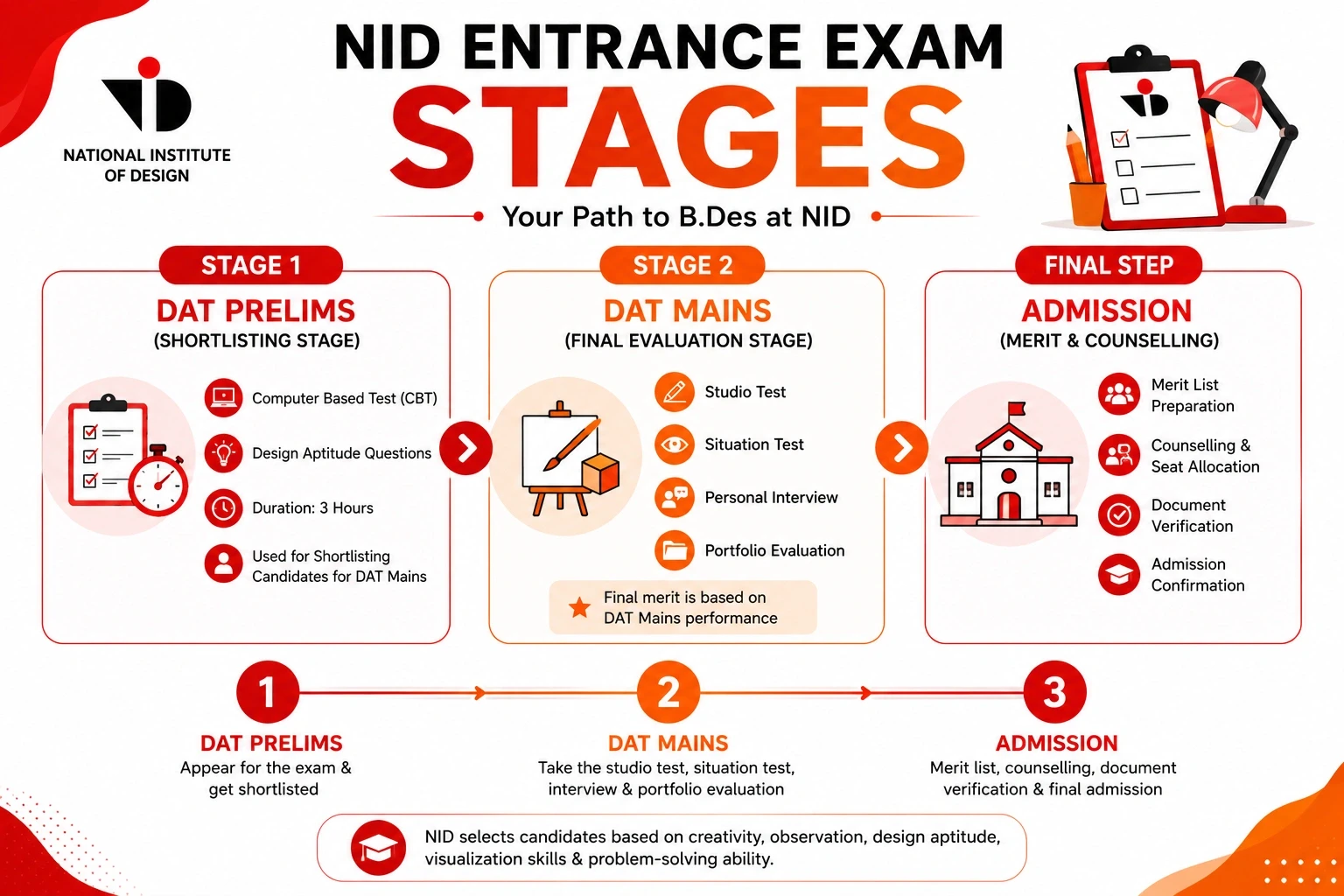
NID Entrance Exam Pattern and Selection Process in India
The NID exam selection criteria are built around a two-stage process.
Stage 1: DAT Prelims
DAT Prelims is the first screening round. For B.Des, it is conducted as a paper-and-pencil/pen test across test centres. The questions may include both text and visuals.
DAT Prelims usually tests:
Observation
Creativity
Visual interpretation
Drawing ability
Problem-solving
Logical thinking
Design awareness
Communication of ideas
This is the large-scale elimination stage. With thousands of applicants and limited seats, only shortlisted students move to DAT Mains.
Stage 2: DAT Mains
DAT Mains is conducted for shortlisted candidates. This round is more practical and may involve studio-based evaluation, sensitivity tests, hands-on exercises, and personal evaluation.
For B.Des 2026–27, the official final result weightage is based on DAT Mains components: Studio Sensitivity Test at 60% and In-Person Sensitivity Test at 40%.
This means DAT Prelims is important because it gets students shortlisted, but the final admission depends on performance in DAT Mains.
The selection reality remains very competitive:
Around 20,000 applicants
Around 425–450 B.Des seats
Around 1.5%–2% selection rate
Roughly 1 selection for every 50–60 applicants
This is why students should not treat NID as a last-minute exam. It requires consistent creative development and serious preparation.
NID Exam Dates and Application Process
NID exam dates vary slightly every year, but the broad admission cycle usually follows a predictable timeline.
A typical NID B.Des timeline looks like this:
September–December: Application window
December/January: DAT Prelims
March/April: DAT Prelims result and DAT Mains process
May/June: Final result, counselling, fee payment, and document verification
For the 2026–27 cycle, the official NID B.Des handbook listed DAT Prelims for 21 December 2025.
The application process is conducted online through the official NID admission portal. Students usually need to complete:
Online registration
Personal details
Academic details
Category details, if applicable
Document upload
Application fee payment
Form submission
Students should read the official admission handbook carefully because eligibility, age criteria, seat intake, test cities, documents, and counselling rules are updated every year.
Top Design Colleges for B.Des in India with Campus Details: Government and Private
For government design education, NID remains one of the most respected names in India.
NID Ahmedabad
NID Ahmedabad is the flagship campus and has 128 B.Des seats for Indian nationals. It offers specializations across communication, industrial, and textile/apparel/lifestyle-related design areas.
NID Andhra Pradesh
NID Andhra Pradesh offers 75 B.Des seats across Communication Design, Industrial Design, and Textile & Apparel Design.
NID Haryana
NID Haryana offers 75 B.Des seats, divided across Communication Design, Industrial Design, and Textile & Apparel Design. This campus is especially relevant for students from Haryana, Delhi NCR, Sonipat, and nearby regions.
NID Madhya Pradesh
NID Madhya Pradesh offers B.Des programs across Communication Design, Industrial Design, and Textile & Apparel Design.
NID Assam
NID Assam offers a four-year B.Des program with specialization streams in Industrial Design, Communication Design, and Textile & Apparel Design.
Private bachelor of design colleges in India are important because NID seats are extremely limited. Private colleges often offer more accessible admission routes, modern specializations, and industry-linked programs in UX, product, communication, fashion, animation, and digital design.
Rishihood University for Design Course Near Delhi NCR and Travel Access from Sonipat
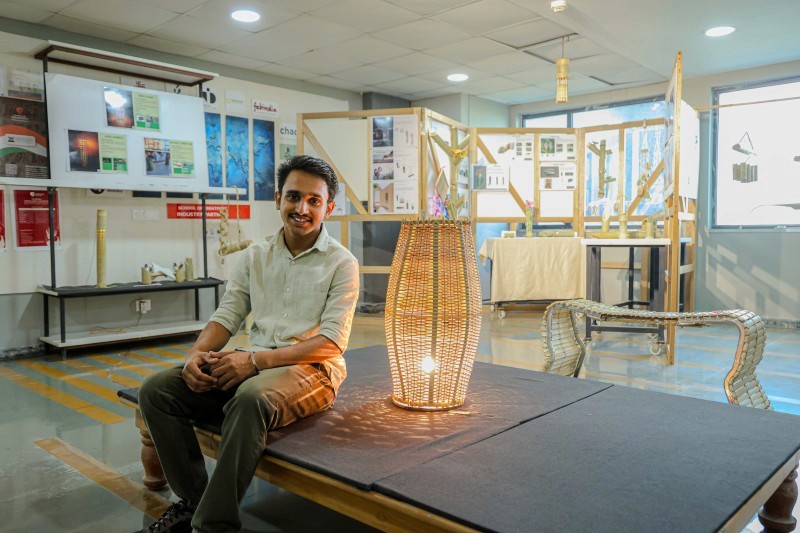
For students exploring NID exam private colleges or bachelor of design colleges near Delhi NCR, Rishihood University in Sonipat can be considered as one regional option.
Rishihood’s B.Design brochure describes the program as a four-year residential undergraduate program and lists three specializations: UX and Interaction Design, Product Design, and Communication Design.
Program highlights include:
₹1 lakh creative grant
13+ advanced labs for all specializations
Semester-long paid internship
40+ electives across 6 minor degree programs
50+ alpha design leaders as mentors
6+ subscriptions including Adobe, Behance Pro, MS Office, and Autodesk
These are listed in the Rishihood B.Design brochure.
For students from Sonipat, Delhi, Gurgaon, Panipat, Rohtak, and nearby NCR areas, the location advantage makes it a practical option for students who miss out on NID admissions.
Admission after 12th to NID B.Des for Students
The journey from Class 12 to NID B.Des should be planned step by step.
A student should follow this path:
Understand B.Des course details
Check B.Des course eligibility
Review NID exam eligibility
Apply for NID DAT
Appear for DAT Prelims
Qualify for DAT Mains
Complete studio and in-person evaluation
Wait for final merit list
Complete counselling and document verification
Because NID has a very low selection rate, students should also keep backup options ready. This does not mean lowering ambition. It means applying strategically.
A practical shortlist should include:
NID campuses
Other government design colleges
Private bachelor of design colleges in India
Regionally accessible colleges near Delhi NCR or Sonipat
For students who want a private design option near Delhi NCR, Rishihood can fit into the backup list, especially for those interested in UX and Interaction Design, Product Design, or Communication Design.
Career Paths After B.Des in India with Industry Scope
A Bachelor of Design degree opens career opportunities across creative, digital, product, and business industries.
Common roles after B.Des include:
Product Designer
UI/UX Designer
Communication Designer
Graphic Designer
Interaction Designer
Textile Designer
Fashion Designer
Packaging Designer
Brand Designer
Design Researcher
The industry scope has grown because design is now tied to business performance. Technology companies need UX designers to improve apps and websites. Consumer brands need product and packaging designers. Fashion and lifestyle companies need textile, apparel, and visual designers. Advertising agencies need communication designers. Startups need designers who can work across product, branding, and user experience.
Rishihood’s curriculum also reflects this shift, with UX courses covering AI for UX, interface design, behavioural interfaces, conversational UI, service design, systems design, and strategy design.
Salary after B.Des depends on college, portfolio, specialization, internships, city, and skill level. Entry-level roles may begin around ₹4–8 LPA, while mid-level designers can move into ₹8–15 LPA roles. Senior designers, design leads, UX managers, and strategy roles can move higher depending on experience and portfolio strength.
For design students, the portfolio is often as important as the degree. Employers want to see the thinking process behind the final work.
FAQs
What is the NID entrance exam and who can apply?
The NID entrance exam is called the Design Aptitude Test, or DAT. Students who have completed or are appearing for Class 12 can apply for B.Des, provided they meet NID’s age and eligibility criteria.
What is B.Des course eligibility after 12th in India?
Students from Science, Commerce, and Arts can apply for B.Des after Class 12. For NID, students must meet age criteria and clear the NID DAT selection process.
Which is the best NID college for B.Des in India?
NID Ahmedabad is widely considered the flagship NID campus. It has 128 B.Des seats for Indian nationals and offers multiple design disciplines.
How many NID colleges are there in India?
For B.Des, the main NID campuses include NID Ahmedabad, NID Andhra Pradesh, NID Haryana, NID Madhya Pradesh, and NID Assam.
What is the selection process for NID exam?
The NID selection process has two stages: DAT Prelims and DAT Mains. DAT Prelims is used for shortlisting, while DAT Mains is used for final evaluation.
Can Haryana students apply for NID entrance exam?
Yes. Haryana students can apply for NID. NID Haryana also offers B.Des programs, making it especially relevant for students from Haryana, Delhi NCR, and nearby regions.
Is NID better than other bachelor of design colleges in India?
NID is one of India’s strongest government design institutions because of its reputation, limited seats, competitive selection process, and design-focused curriculum. However, private bachelor of design colleges can be good alternatives for students who want more accessible admission options, newer specializations, or location advantages.