Business
Top BBA Entrance Exams in India
Explore top BBA course entrance exams, syllabus, fees, and best BBA college options with a focus on startups, internships, and scholarships
18 June 2025
Table of Contents
Introduction
If you’re reading this, chances are you’re coquetting with the idea of doing a BBA i.e Bachelor of Business Administration. And honestly? Good call. It’s one of the most versatile degrees out there. But also one of the most confusing to get into.
So let’s make sense of the BBA course, entrance exams, college fees, what to expect in the syllabus, and what happens after you finally get that degree.
What Is a BBA?
A BBA degree doesn’t just train you to be an accountant or a manager,it gives you a taste of everything: marketing, HR, finance, entrepreneurship, analytics, and in some newer programs, even design thinking and tech.It’s the go-to for students who are business-curious but not yet ready to pick a narrow path like CA, CFA, or MBA. Plus, if you eventually want to do an MBA, a BBA makes for a smooth ride.
Top BBA Entrance Exams in India
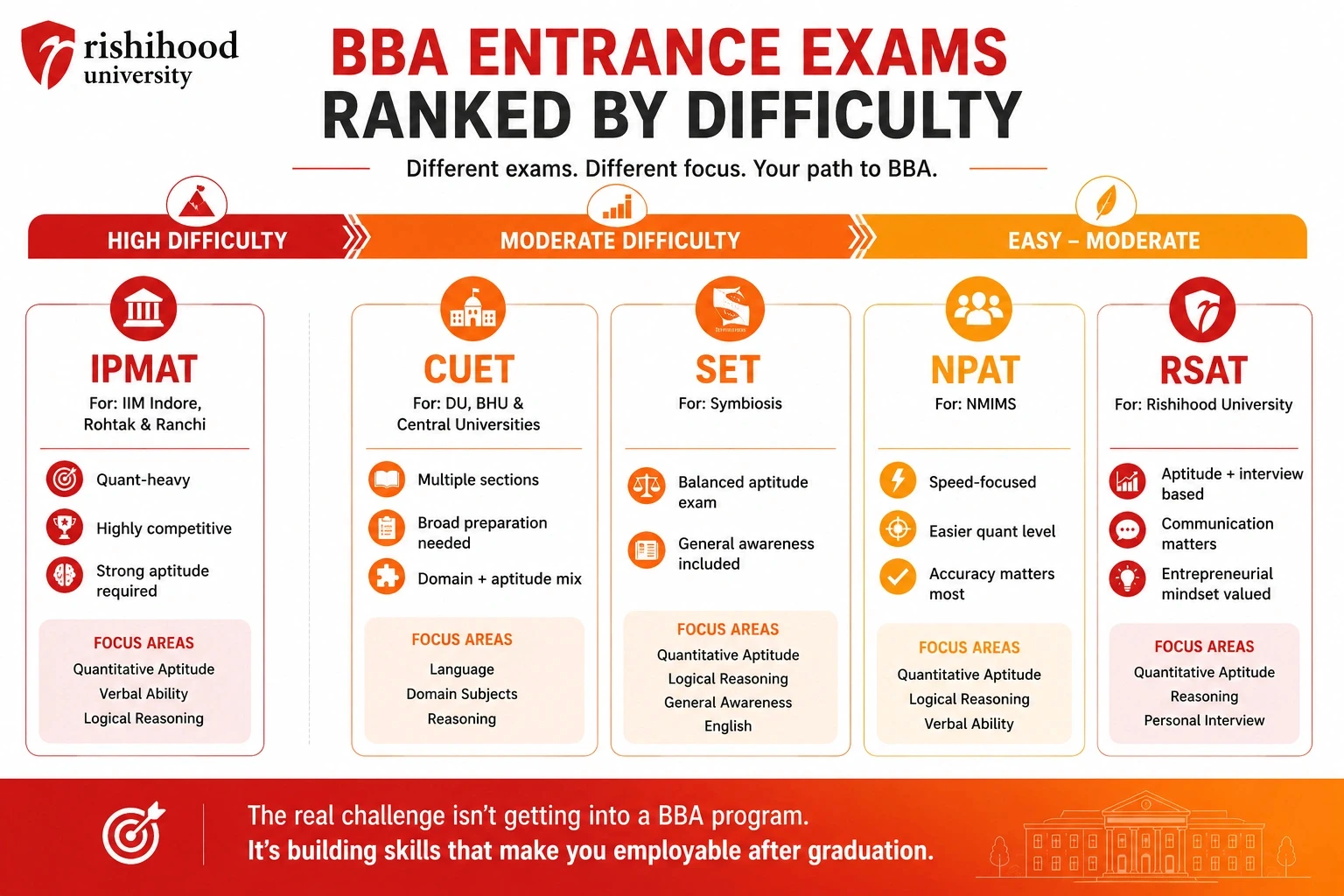
1. IPMAT (IIM Indore, Rohtak, Ranchi)
The Integrated Programme in Management Aptitude Test (IPMAT) is one of the most competitive BBA entrance exams, especially for students targeting IIMs.
Sections: Quantitative Aptitude, Verbal Ability, and Logical Reasoning (varies slightly by IIM).
Difficulty:
Preparation Tip: The Quant section is considered tricky and requires strong fundamentals. Focus on algebra, arithmetic, and functions. RS Aggarwal is a good book for practice. Use YouTube channels like Ashish Sansanwal for concept clarity and past paper analysis.
2. CUET (Common University Entrance Test)
CUET is conducted for admission into central and many state universities including DU and BHU.
Sections: Language, Domain-specific subjects (like Business Studies or Economics), and General Test (including Quant and Reasoning).
Difficulty:
Preparation Tip: Go through NCERT books for domain subjects. Practice reasoning and quant basics regularly.
3. NPAT (NMIMS)
Conducted by Narsee Monjee Institute of Management Studies.
Sections: Quantitative Aptitude, Logical Reasoning, and Verbal Ability.
Difficulty: Easy to Moderate.
Preparation Tip: Focus on speed and accuracy. Basic understanding of math and English grammar is essential.
4. Rishihood Scholarship Aptitude Test
Sections: Personal Interview Round,Reasoning, Quantitative Aptitude
Difficulty: Easy to Moderate
Preparation Tip: Strong communication skills help during the interview.Know your 12th Maths and Some basics of Entrepreneurship
5. SET (Symbiosis Entrance Test)
For admission to BBA at Symbiosis International (Pune and other campuses).
Sections: General English, Quantitative Aptitude, Logical Reasoning, and General Awareness.
Difficulty: Easy to Moderate.
Preparation Tip: Stay updated with current affairs. Brush up on school-level math and reasoning.
6. Christ University Entrance Test
Sections: English, x, Quant, GK, and sometimes a personal interview round.
Difficulty:Moderate
Preparation Tip: Keep up with general knowledge and revise 10th–12th standard Math and English.
TLDR; Practice a lot after boards.If you’re aspiring for IPMAT, work hard. You should mainly focus on quants, logical reasoning and general knowledge. Private universities are fairly easy to get into.
But its always better to know what your getting into. So what exactly is BBA?
Nobody picks BBA thinking they’ll have to study a lot. But the BBA syllabus does come with surprises ,some good, some bad and some ugly.
Here’s what it usually includes:
Principles of Management – Basically, how to not be a terrible boss.
Marketing – Selling stuff with strategy and not just standing outside counters screaming others to buy
Financial Accounting
Human Resource Management – Hiring, firing, and sometimes understanding people but nowadays it’s mostly firing.
Business Law & Ethics – So you don’t accidentally do a scam(to not be the next Harshad Mehta).
Business Analytics / Data Science – In newer programs like the one at Rishihood.
Most good BBA colleges also include internships. If your future plan involves building a startup, internships help incredibly much. Internships are crucial for building a strong resume and securing jobs easily, especially in product-based companies.They provide practical experience which helps avoid common mistakes .
One major reason to do internship is to know if the field of work is for you or not. You can’t know for sure unless you yourself set into the puddle of internship.
This is also the reason why our BBA program has a mandatory 6 months internship in their 5th semester.
At one point, no matter what college, you start to feel the rebel boiling inside you, telling you what are you even doing in a place that does not even value practicality and the reality of running a business . That’s a reason why most dropouts even exist. We didn’t want our students to go through this mental trauma. That’s why we have this mandatory 6 months internship in our 5th Semester. It’s to make our students well versed with the practicalities of the companies. So that they get used to the nuances and problems it takes to run a company beforehand.
But not everyone wants to start a startup. Some just want to relax . In that case we have other university exams.
Exam | Institutes | Mode | Key Subjects |
IPMAT | IIM Indore, IIM Rohtak, IIM Ranchi | Online | Quant, Verbal, Logical |
CUET | Central & state unis (DU, BHU, etc.) | Online | Domain + Language + Reasoning |
NPAT | NMIMS | Online | Reasoning, English, Quant |
SET | Symbiosis | Online | Quant, Logic, English, GK |
RSAT | Rishihood University | Online | Aptitude + Personal Statement |
Even though we accept scores from CUET and SAT, We also have our own bba entrance exam. Its called RSAT. Its final round is 30th June. You can refer to our website for more details .
But one of the most important to refer to is the fees of the bba program.
BBA Course Fees in India: What You Actually Pay
The cost of a BBA degree in India varies massively depending on the type of college:
Government Colleges (DU, BHU, etc.)
₹20,000 to ₹1.5 lakh total (3 years)
Lowest cost, but highly competitive entry through exams like CUET
Semi-Private / State Universities
₹1.5 lakh to ₹10 lakh total
Moderate infrastructure, decent ROI
Top Private Universities
₹12 lakh to ₹35 lakh total
Better exposure, internships, industry tie-ups
Premium/New-Age Universities
₹15 lakh to ₹50 lakh total
Focus on global curriculum, entrepreneurship, and practical learning
High fees don’t automatically mean better outcomes. What matters is:
Internship exposure
Industry connections
Skill development (not just theory)
A ₹10 lakh degree without internships is worse than a ₹3 lakh degree with real experience.
BBA vs Other Commerce Courses: What’s Actually Better?
Students often confuse BBA with other paths like B.Com, CA, or even early MBA prep.
Here’s a blunt comparison:
Course | Focus | Difficulty | Career Speed | Risk |
BBA | Broad business exposure | Moderate | Medium | Low |
B.Com | Theoretical commerce | Easy–Moderate | Slow | Low |
CA | Accounting & taxation | Very High | Slow (high drop rate) | High |
CFA | Finance specialization | High | Medium | Medium |
MBA (after grad) | Advanced management | High | Fast (if from top college) | Medium |
Reality check:
If you want flexibility: BBA
If you want a high-paying niche: CA/CFA (but with serious risk)
If you’re unsure: BBA is the safest starting point
Most students choosing BBA are buying optionality, not just a degree.
Career Options After BBA
Here’s what actually happens after BBA in India:
Entry-Level Roles:
Marketing Executive: ₹3–6 LPA
Business Development Executive: ₹3–5 LPA
HR Executive: ₹2.5–4.5 LPA
Operations Executive: ₹3–5 LPA
With 2–3 Years Experience:
Product/Marketing roles: ₹6–12 LPA
Analyst roles: ₹8–15 LPA
After MBA (Top Colleges):
₹15–35 LPA (top 20 B-schools)
Important reality:
BBA alone rarely leads to high salaries.
It works best when combined with:
MBA
Certifications (Digital Marketing, Data Analytics, Finance)
Strong internships
Industry Demand: Why BBA Still Works in 2026
India’s business ecosystem is expanding fast:
India has over 63 million MSMEs (as per government data)
Startup ecosystem crossed 100,000+ registered startups
Service sector contributes ~55% of India’s GDP
What does this mean?
Companies don’t just need specialists. They need people who understand multiple functions marketing, operations, finance.
That’s exactly what BBA trains you for.
New-age roles growing fast:
Business Analyst
Growth Marketer
Startup Operations Manager
Product Associate
This is why BBA is still relevant it adapts faster than rigid degrees.
What Top BBA Colleges Do Differently
This is where you separate average colleges from serious ones.
Top programs focus on:
1. Mandatory Internships
Students graduate with real experience, not just theory.
2. Industry Projects
Working on live business problems instead of textbook case studies.
3. Skill-Based Learning
Excel & data tools
Presentation skills
Communication training
4. Exposure to Startups
India’s startup ecosystem is a massive opportunity but only if colleges connect you to it.
Most average colleges fail here. They:
Over-focus on theory
Ignore practical exposure
Produce graduates who are not job-ready
How to Choose the Right BBA College
Ignore marketing brochures. Use this instead:
Does the college guarantee internships?
What companies recruit from campus?
Are there industry mentors or just professors?
What percentage of students actually get placed?
Is the curriculum updated (analytics, digital, entrepreneurship)?
If a college cannot answer these clearly, it’s not worth your time.