Technology
What is B.Design (B.Des)? Courses, Specialisations and Career Opportunities Explained
Learn what is B.Design (B.Des), course details, fees, eligibility, specialisations, and career opportunities in India specially in Haryana and Delhi NCR.
13 April 2026
TL;DR
Table of Contents
Design is becoming a core business function across digital products, brands, and physical experiences, expecting to become a $1 trillion digital economy by 2030. India has also recorded over 4.14 crore (41.4 million) student enrollments in higher education, reflecting the growing scale of education for future-ready careers.
So, what is B.Design? A B.Des or B.Design degree prepares students to solve real-world problems using design thinking, practical skills, and portfolio-based learning.
If you're considering B.Des, the key decision isn’t just what course you want to pursue, but which specialisation, college, and career path align with your goals.
What is B.Design (B.Des Course)
B.Des (Bachelor of Design) is a four-year undergraduate program that develops the ability to solve problems using creativity, visual thinking, and human-centered design principles.
It’s not about drawing. It’s about learning how to think and solve problems differently.
The degree spans fields like UI/UX design, product design, communication design, fashion design, and animation, making it one of the most versatile career paths.
Why is B.Des a growing field?
Everything needs design now. Apps, websites, products, branding, even government systems. This is reflected in a 112% increase in UX job postings in India between 2019 and 2020.
The best part is that not enough students are pursuing formal design education. So trained design graduates are still lower than industry demand.
Role of Design Education in NCR
Delhi NCR has emerged as a strong design ecosystem. Cities like Gurugram and Noida offer access to startups, agencies, and tech firms, giving students exposure to internships, live projects, and job opportunities early in their careers.
B.Des course details for students in Haryana and Delhi
A B.Des program combines creative thinking with practical skills through studio-based learning.
Course overview and structure
The course runs across 8 semesters and blends classroom learning with real-world application:
Year 1: Fundamentals
Year 2–3: Skill development + specialisation
Year 4: Internships + portfolio
Core subjects in B.Design
Design fundamentals and visual communication
Typography and color theory
User experience (UX) and interface design (UI)
Material studies and product design basics
Digital tools like Figma, Adobe Photoshop, Illustrator, and CAD software
Skill outcomes
By the end of a B.Des program, you will have a strong practical skill set. This is critical, as 44% of workers’ core skills are expected to change by 2027, increasing the importance of design-driven capabilities.
Strong visual and communication skills
Hands-on experience with design tools
A portfolio showcasing real-world problem solving
B.Des course duration, structure and eligibility
The B.Des course allows students to build depth in both fundamentals and specialization.
Duration
A B.Des course is a 4-year undergraduate program, divided into 8 semesters. This structured approach is critical. Industry data shows that only 15% of Indian design teams have structured, continuous learning programs, which makes formal design education even more valuable.
Rishihood University offers 20+ high intensity-workshops, 6 months of hands-on paid experience, and 5+ live projects, making it a strong option for pursuing a B.Des degree.
Eligibility (10+2 Criteria)
To apply for a B.Des program, you need to meet the following criteria:
Educational qualification: 10+2 (or equivalent) from a recognised board, like CBSE, ICSE, or any state board.
Minimum marks: Most colleges require at least 50% aggregate in Class 12. Premier institutes may have higher benchmarks.
Entrance exam: Qualifying an entrance exam, or a university-level test is mandatory for most colleges.
Stream flexibility: Science, Commerce, or Arts?
One of the biggest advantages of a bachelor of design program is its flexibility. Unlike engineering or medicine, B.Des does not require you to study science in school. Students from all three streams, Science, Commerce, and Humanities/Arts, are eligible to apply.
B. Design specialisations offered across India
A B.Design course offers multiple specialisations aligned with industry demand:
UI/UX Design
UI/UX Design focuses on how users interact with digital products like apps and websites. Students learn wireframing, prototyping, usability testing, and tools like Figma.
In Delhi NCR, demand is particularly strong. Gurugram alone has 500+ active UI/UX job openings, reflecting the scale of hiring in product and tech companies.
Product Design
Product Design involves creating both physical and digital products, from consumer goods to SaaS platforms. This specialisation combines design thinking with engineering and business understanding.
Communication Design
Communication Design is about conveying ideas visually. It covers graphic design, branding, advertising, illustration, and visual storytelling.
Fashion Design
Fashion Design remains one of the most recognised B.Des course specialisations. It covers apparel, textiles, styling, and retail trends.
Interior Design
Interior Design teaches you how to design the spaces people live, work, and spend time, ranging from homes and offices to hotels, retail stores, and restaurants. It's a mix of aesthetics, architecture basics, material knowledge, and spatial thinking.
Interaction Design
Interaction Design is a technology-driven field that focuses on how users interact with digital systems. This includes app animations, voice-based responses in smart devices, and system feedback in digital interfaces.
As digital products evolve, UX/UI design is projected to remain among the fastest-growing roles through 2030.
Which B.Des specialisation should you choose?
If you want high-growth tech roles → UI/UX / Interaction Design
If you prefer physical/digital products → Product Design
If you enjoy branding/visual storytelling → Communication Design
If you want creative industries → Fashion / Animation
B.Des course fees in private and government colleges in India
The cost of pursuing a B.Des course in India varies.
B. Des Fee ranges (India vs NCR)
Across India, the total fees for a bachelor of design typically range between ₹2 lakh to ₹22 lakh, depending on the college and specialization.
Government colleges (India): ₹5–15 lakh total for the full course
Private colleges (India): ₹8–30 lakh total
In Delhi NCR, fees tend to be on the higher side due to better infrastructure, industry exposure, and location advantages.
Private vs government B.Des course fees comparison
Government colleges: Offer relatively subsidised education. Government institutes provide strong academic credibility and lower cost, but have highly competitive admissions.
Private colleges: Charge higher fees, but often provide better infrastructure, global exposure, industry collaborations, and flexible specialisations.
Focus on ROI, not just fees. A strong portfolio and internships matter more than the lowest cost.
Entrance exams for B.Des admission in India
Admission to a B.Des course in India is based on entrance exams. Unlike engineering or medicine, there isn't one single national-level test for design. Instead, different institutes conduct their own exams.
National-level exams
NID DAT (NID Design Aptitude Test): Conducted by the National Institute of Design, this exam includes a prelims (objective + subjective) and a mains stage with studio tests and interviews.
UCEED: Conducted by IIT Bombay for admission to top IIT design programs. It tests visualization, logical reasoning, and design aptitude.
NIFT Entrance Exam: Required for fashion and related design programs, including creative ability and situation tests.
University-level admissions
Many private colleges and state universities, including those in Delhi NCR and Haryana, offer admission based on Class 12 marks, a portfolio review, and a personal interview. Colleges like Rishihood University fall in this category.
CUET (Common University Entrance Test)
Some universities now accept scores from CUET for b des course admissions, especially for broader undergraduate intake.
Bachelor of Design career opportunities after graduation
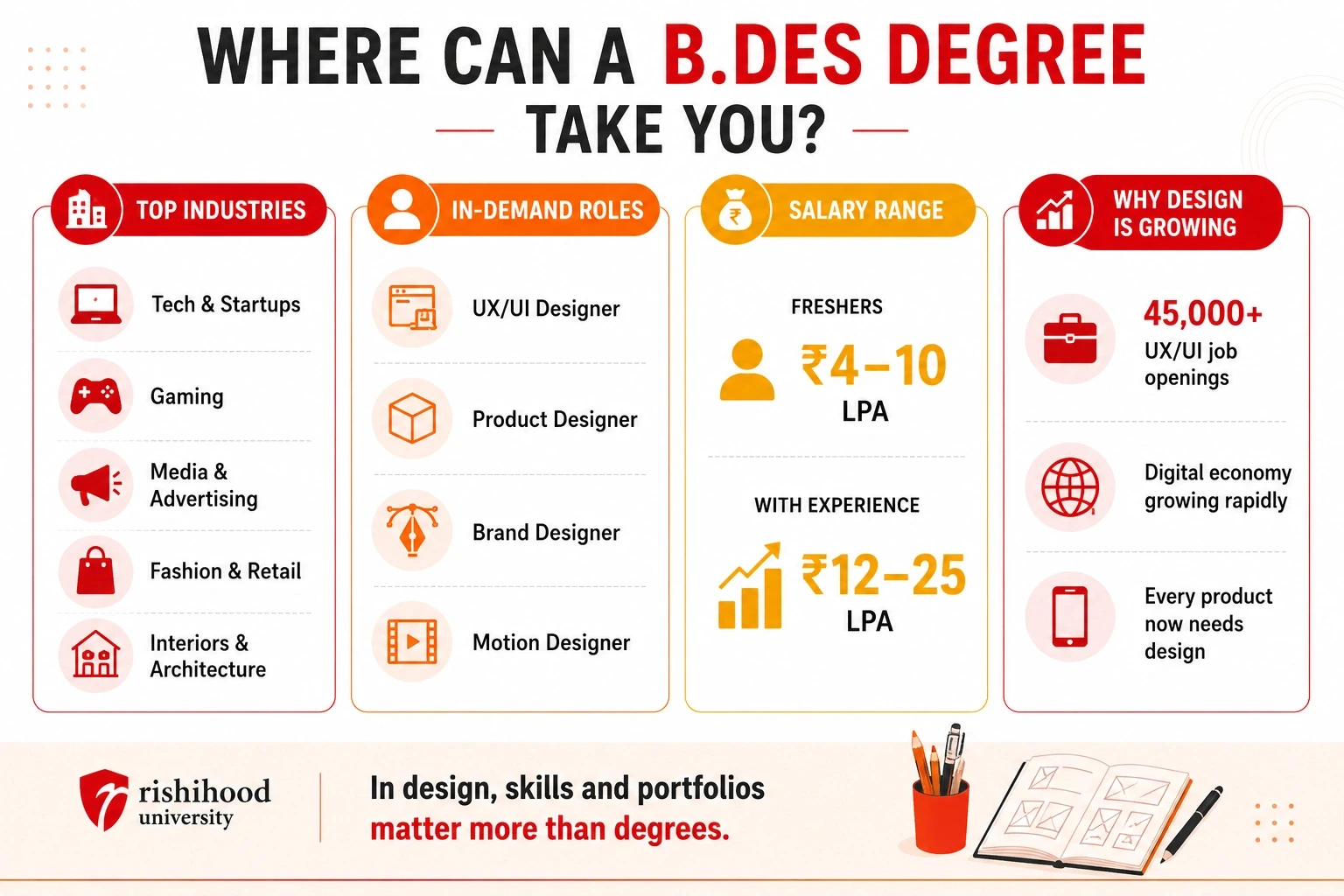
Design roles exist across industries, from tech and startups to media, retail, and manufacturing. For instance, the media and entertainment sector alone is projected to grow at a 13.5% CAGR.
Industry demand
The demand for designers is growing faster than the supply. As of mid-2025, there were over 45,000 active job listings for UX/UI designers across various sectors.
Graduates of a B.Des course can work across multiple sectors:
Sector | Where designers work |
Technology and Startups | App design, product design, UX research |
Fashion and Retail | Brand design, visual merchandising, packaging |
Media and Advertising | Campaigns, editorial design, motion graphics |
Architecture and Real Estate | Interior design, space planning, visualisation |
Gaming and Entertainment | Game UI, character design, set design |
Manufacturing and FMCG | Product design, packaging, industrial design |
Education and EdTech | Learning design, UI/UX, content visualisation |
Government and Public Sector | Communication design, wayfinding, civic design |
A key advantage of a design degree is the transferability of skills across industries. A graphic designer can turn to UX. A product designer can move into branding. As industries evolve, designers who keep learning can enjoy broader career paths with long-term growth opportunities.
Salary scope after B.Design in India
The salary after completing a B.Design course varies based on specialisation, skills, and portfolio strength.
Entry-level salary: Fresh graduates typically earn between ₹4–10 LPA, depending on their college and portfolio.
Mid-level growth: With 3–5 years of experience, salaries can grow to ₹12–25 LPA, especially in product-based companies and startups where design directly impacts business outcomes.
Bachelor of Design colleges in India and Delhi NCR
India has a growing number of design colleges. However, quality, reputation, and career outcomes vary significantly across institutions. At the top level, institutes like National Institute of Design (NID), National Institute of Fashion Technology (NIFT), and IIT Bombay IDC School of Design are known for their rigorous selection process, strong faculty, and industry credibility.
However, these institutes are highly competitive, with limited seats.
Delhi NCR as a design hub
Delhi NCR has emerged as one of the strongest regions for design education. With startups, tech companies, media houses, and creative agencies concentrated in cities like Gurugram and Noida, students benefit from:
Access to internships and live projects
Exposure to real-world industry workflows
Better networking and job opportunities
This ecosystem makes NCR a practical choice for students who want both education and industry access.
A strong alternative within NCR
For students looking beyond highly competitive government institutes, universities like Rishihood University offer a strong alternative.
Located close to Delhi, Rishihood combines a focused campus environment with access to NCR’s industry ecosystem. Its B.Design program emphasizes hands-on learning, mentorship, and portfolio development—key factors that directly impact career outcomes in design.
Why study B.Des at Rishihood University, Sonipat?
Choosing the right college for a B.Des (Bachelor of Design) is less about brand names and more about outcomes. This is where Rishihood University stands out. This University is located on NH-44 (GT Road), right on the main highway connecting Delhi and Haryana.
The close proximity to NCR gives students access to internships, industry visits, and networking opportunities without compromising on academic immersion.
The B.Design course at Rishihood focuses on building job-ready designers, and integrates:
Design thinking and user-centric problem solving
Hands-on studio learning
Project portfolio from early semesters
Rishihood University also offers multiple scholarships and provides up to 100% tuition scholarships to deserving students.
Take the next step
If you’re serious about building a career in design, move beyond research and start exploring your options.
Book a campus visit
Admissions are open. The earlier you start, the better your portfolio, and opportunities.
FAQs
What is a B.Design course?
A B.Des is a 4-year undergraduate program that focuses on design thinking, creativity, and real-world problem-solving.
What is B.Des course eligibility?
The b des course eligibility is completion of 10+2 (any stream) from a recognised board, with most colleges requiring a minimum of 50% marks. Some institutes also conduct entrance exams or portfolio assessments.
What is the duration of a B.Des course?
A B.Des course typically has a duration of 4 years, divided into 8 semesters, including internships and a final capstone project.
What are B.Des course fees in Delhi NCR?
Fees for a B.Design program in Delhi NCR usually range between ₹15–₹25 lakh for private colleges and ₹5–₹15 lakh for government institutes, depending on the institution and facilities.
Which are the top Bachelor of Design colleges in India?
Top institutes include National Institute of Design (NID), National Institute of Fashion Technology (NIFT), and IIT Bombay IDC School of Design, and leading private institutes like Rishihood University.