Design
What is Product Design in B.Des? Career Scope & Industry Demand
Learn what Product Design in B.Des means, course details, subjects, tools, salary, career scope, industry demand, and top product design colleges in India and Delhi NCR
17 July 2026
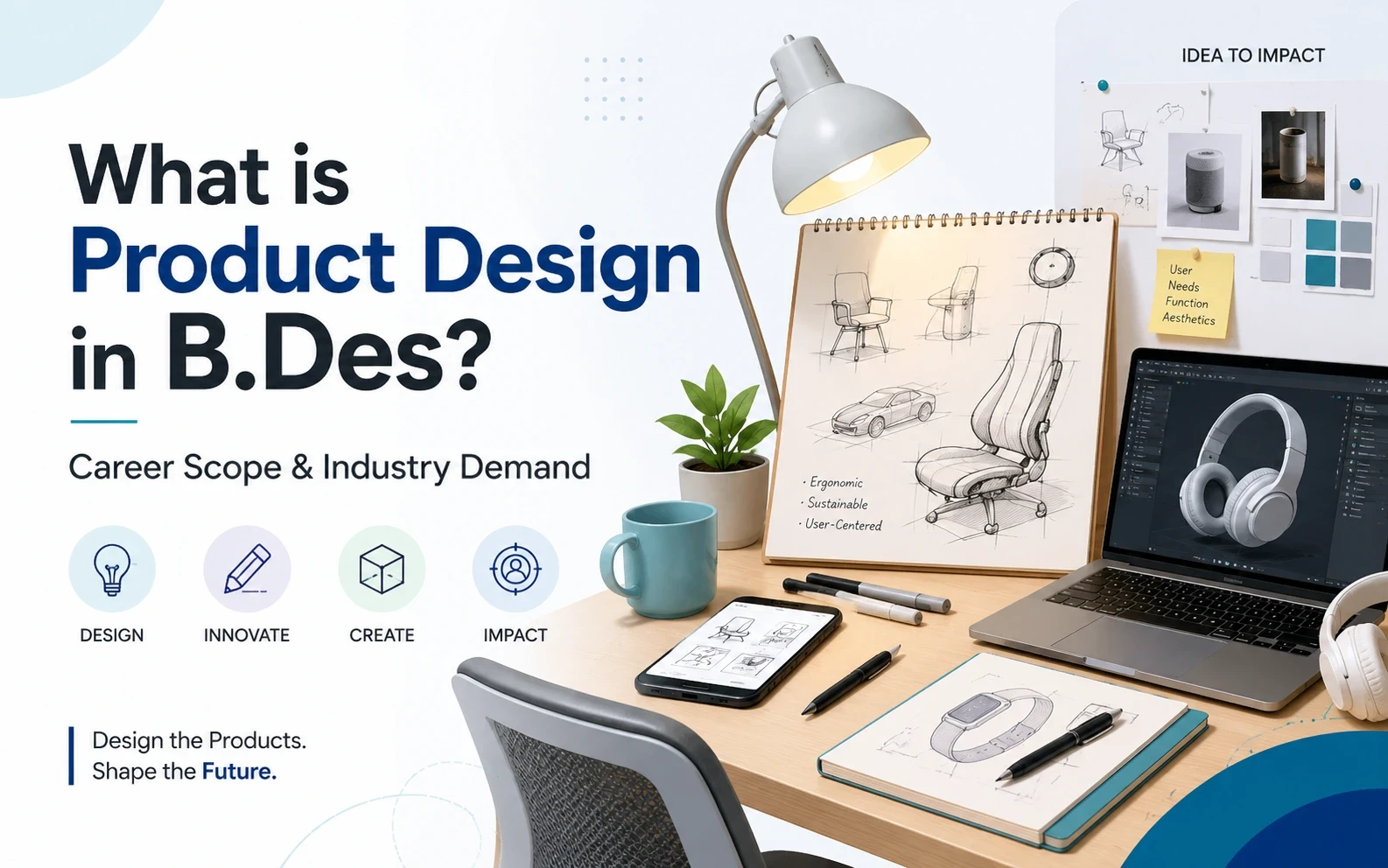
Table of Contents
Introduction
If you've ever wondered who designs the products people use every day—from smartphones and smartwatches to apps, furniture, medical devices, and consumer products—the answer is often product designers.
As India's startup and innovation ecosystem grows, companies are looking for professionals who can understand user needs, solve real problems, and create products people actually want to use. This has made Product Design one of the most exciting career paths for creative students after Class 12th.
Unlike UI/UX, which focuses mainly on digital experiences, or Industrial Design, which focuses on physical products, Product Design combines creativity, technology, research, and problem-solving to build meaningful products from idea to execution.
This guide explains everything you need to know about pursuing a B.Des in Product Design, including course subjects, career opportunities, salary prospects, industry demand, and how to choose the right college.
What is Product Design in B.Des?
Product Design in B.Des is the study of how products are imagined, researched, designed, prototyped, tested, and improved. The product can be physical, digital, or a combination of both.
A physical product may include furniture, appliances, wearables, packaging, consumer electronics, mobility products, assistive devices, lifestyle products, toys, tools, or medical devices. A digital product may include a mobile app, SaaS dashboard, fintech platform, e-commerce journey, AI tool, learning platform, or connected-device interface.
The core idea is user-centered problem-solving. Product designers study people, pain points, behavior, context, usability, materials, technology, and business goals. They do not design only for beauty. They design for usefulness, feasibility, desirability, accessibility, and market fit.
A product designer usually works through a process:
Understand the user problem
Conduct research and observation
Define the design challenge
Sketch and ideate possible solutions
Build prototypes
Test with users
Improve the design
Present the final solution clearly
In the Indian industry context, product designers are increasingly relevant because companies need better customer experiences, differentiated products, intuitive interfaces, and faster prototyping. Startups need designers who can turn early ideas into MVPs. Manufacturing brands need designers who can improve form, usability, and product experience. Digital companies need designers who can improve user journeys, retention, onboarding, and interface clarity.
In simple terms, Product Design in B.Des prepares students to solve real-world problems through design. Thinking About a Career in Product Design?
The best way to learn product design is by designing products. Explore how Rishihood University's B.Des in Product Design combines studio practice, industry exposure, and portfolio-building opportunities to prepare students for careers in design, innovation, and product development.
B.Des Product Design Course Details in India
A Bachelor of Design (B.Des) is typically a four-year undergraduate degree that prepares students to solve real-world problems through design. While the exact structure varies across institutions, most programs combine foundation learning, studio practice, design projects, research, digital tools, internships, and portfolio development.
At Rishihood University, the B.Des in Product Design follows an experiential learning approach where students learn by building, testing, prototyping, presenting, and refining ideas. The program combines studio-led learning with industry projects, mentorship from design leaders and practitioners, interdisciplinary collaboration, and portfolio-focused outcomes that prepare students for professional design careers.
B.Des eligibility generally requires completion of Class 12 from a recognised board. Students from commerce, humanities, science, and other streams can apply, subject to university admission criteria. Depending on the institution, admissions may involve entrance exams, portfolio reviews, interviews, studio tests, or aptitude assessments.
A typical B.Des Product Design journey may include:
Stage | Learning Focus |
Year 1 | Design foundation, visual thinking, form, materials, design history |
Year 2 | Design thinking, ergonomics, research methods, CAD, model-making |
Year 3 | Product studios, prototyping, manufacturing, sustainability |
Year 4 | Industry projects, internships, portfolio, capstone project |
Unlike theory-heavy undergraduate courses, a strong B.Des program is studio-led. Students learn through critique, iteration, experimentation, and making. Portfolio development remains central because employers evaluate not just final outcomes, but the research, thinking, prototyping, and decision-making behind them.
Learn from designers shaping the industry. |
Product Design Subjects and Software Tools
Students should not treat software as the full definition of design. Tools are important, but they support the thinking process. A strong product designer knows how to observe, ask better questions, sketch, prototype, test, explain, and improve.
At Rishihood University's School of Design, students develop these capabilities through an experiential learning approach that combines:
Studio-based learning and hands-on design projects
User research and design thinking methodologies
Prototyping, model-making, and experimentation
Mentorship from leading designers and industry practitioners
Industry projects and real-world problem-solving challenges
Exposure to emerging technologies, sustainability, and innovation
Portfolio development from the first year onwards
Interdisciplinary collaboration across design, business, and technology
The goal is not only to teach design tools, but to help students build the research, creativity, communication, systems thinking, and execution skills required to create products that people genuinely want and need.
Product Design vs UI/UX vs Industrial Design
Students often ask whether Product Design is the same as UI/UX. The answer depends on the context.
In many digital companies, the title “Product Designer” often refers to a designer who works on app or web experiences, similar to a UI/UX designer. In design education, however, Product Design is often broader. It can include physical products, digital products, systems, services, user journeys, materials, prototyping, and business fit.
Industrial Design is closer to physical product development. It deals deeply with form, materials, ergonomics, manufacturing, and mass production.
Field | Main Focus | Product Type | Best-Fit Student |
Product Design | Problem-solving across physical, digital, and hybrid products | Consumer products, devices, apps, services, systems | Students who like research, making, prototyping, and broad design thinking |
UI/UX Design | Digital user experience and interface flows | Apps, websites, SaaS dashboards, fintech platforms, digital products | Students who like psychology, digital tools, visual systems, and usability |
Industrial Design | Physical form, materials, ergonomics, and production | Appliances, furniture, vehicles, tools, electronics, medical devices | Students who like objects, manufacturing, sketching, model-making, and 3D thinking |
A student should not choose only based on which field sounds more popular. The better question is: Do I enjoy screens, objects, systems, research, business, or making things with my hands? The answer will help decide whether Product Design, UI/UX, or Industrial Design is the better fit.
This is also why strong design education goes beyond lectures. At Rishihood University's School of Design, students are regularly encouraged to apply concepts through hands-on activities, discussions, and speculative thinking exercises. For example, learners recently explored and visualized their predictions for the future of design, translating classroom conversations into tangible ideas and creative outputs. Such experiences help students develop the curiosity, critical thinking, and future-focused mindset that modern design careers demand.
See how Rishihood design students imagined the future of design. |
Skills Required for Product Design Careers
Product design careers require a mix of creative, technical, analytical, and communication skills. Designers must be able to explain why they made a decision, not only show what they created.
Important skills include:
Creative thinking
Problem-solving
User empathy
Observation and research
Sketching and visualization
Prototyping
CAD and digital tool proficiency
Material understanding
Communication and storytelling
Presentation skills
Collaboration with engineers and business teams
Feedback-taking and iteration
A strong product designer is comfortable with ambiguity. The problem may not be clear at the start. Users may say one thing and do another. A prototype may fail. Constraints may change. Good designers stay curious, test early, and improve through feedback.
This is also why design education is highly project-based. Students learn by doing, not only by reading theory. Every project becomes a chance to show thinking, process, and growth. At Rishihood University's School of Design, this learning is further enriched through interactions with industry practitioners. For example, students recently engaged with the founder of Happy Pets, who shared insights on what it takes to succeed as a product designer in today's rapidly evolving world.
Watch the Anil Reddy, Founder of Happy Pets and learn what modern product design careers demand |
Career Scope After B.Des Product Design in India
Career scope after B.Des Product Design in India is expanding because design is no longer restricted to studios or manufacturing companies. Product designers are now needed wherever companies are building products, services, interfaces, packaging, experiences, or systems.
Graduates can explore roles such as:
Career Role | What the Role Involves |
Product Designer | Designing physical, digital, or hybrid products based on user and business needs |
UX Designer | Improving app, web, or software user experience |
Industrial Designer | Designing physical products, tools, appliances, furniture, devices, or equipment |
Design Researcher | Studying users, behavior, context, and pain points |
CAD Designer | Creating technical models and 3D product visualizations |
Product Strategist | Connecting design decisions with business goals |
Packaging Designer | Designing packaging for D2C, FMCG, lifestyle, and retail brands |
Furniture Designer | Designing functional and aesthetic furniture products |
Mobility Designer | Working on EVs, vehicles, interiors, accessories, and transport systems |
Service Designer | Improving end-to-end service experiences and customer journeys |
Design Entrepreneur | Building a product, studio, brand, or independent design practice |
Consumer electronics companies need designers for devices and interfaces. Automotive and EV companies need designers for mobility experiences, interiors, accessories, charging systems, and connected products. D2C brands need packaging, product innovation, and customer experience design. Startups need designers who can build prototypes quickly and test user journeys. SaaS and fintech companies need digital product designers who can simplify complex workflows.
These opportunities are increasingly accessible to students who build strong portfolios and gain practical industry exposure during their degree. For example,Preksha Baid, a B.Design learner at Rishihood University, secured an internship with Happy Pets, where she will get practical exposure of industry during her undergraduate journey. Experiences like these help students translate classroom learning into real-world design practice and strengthen their career readiness.
Explore how Rishihood Design students are building portfolios, securing internships, and launching design careers. |
Freelancing is also possible, especially in UI/UX, packaging, product rendering, 3D visualization, branding, model-making, and design consulting. However, freelance income depends heavily on portfolio, client network, pricing, and project quality.
Higher education options include master’s programs in product design, interaction design, industrial design, service design, human-computer interaction, design management, or innovation strategy.
Apply now at Rishihood and explore the world of Design |
Industry Demand for Product Designers in India
Product design demand is rising because companies are competing on experience, not only price. In fintech, a confusing app can reduce trust. In EVs, poor ergonomics can affect adoption. In SaaS, a complicated dashboard can increase churn. In D2C, packaging and product usability influence repeat purchase. In AI products, interface clarity is critical because users need to understand what the system does and how to control it.
India’s startup growth has increased demand for designers who can translate ideas into usable products. Startups often need designers who can work on research, wireframes, prototypes, presentations, user flows, and early product decisions. Large companies need designers who can improve existing products, simplify experiences, and build consistent design systems.
Product designers are especially relevant in:
SaaS platforms
Fintech apps
EV and mobility companies
Consumer electronics
Smart devices
D2C brands
Healthtech
Edtech
Furniture and lifestyle brands
Packaging and retail
AI-enabled digital products
Design studios and innovation consultancies
The strongest demand is for designers who can show process, not just final visuals. Recruiters increasingly look for portfolios that explain the problem, research, user insight, design alternatives, prototyping, testing, and iteration. A good portfolio answers the question: How did you think?
This is why portfolio-led learning has become increasingly important in design education. At Rishihood University's School of Design, students build portfolios through studio projects, industry challenges, prototyping exercises, and real-world design problems throughout the four-year B.Des journey.
Explore student projects and portfolios from Rishihood's School of Design. |
Product Design Salary in India
Product Design salary in India depends heavily on portfolio quality, college exposure, tool proficiency, city, company type, internship experience, and whether the role is physical product design, UI/UX, or hybrid product design.
A realistic salary view is:
Experience Level | Indicative Salary Range |
Fresher / Junior Designer | ₹3 LPA – ₹6 LPA |
Strong fresher with portfolio and internship exposure | ₹5 LPA – ₹8 LPA |
Mid-level designer, 3–5 years | ₹8 LPA – ₹15 LPA |
Senior designer / lead role | ₹15 LPA – ₹30 LPA or more |
Digital product and UI/UX-linked roles may offer higher starting packages in SaaS, fintech, consumer tech, and funded startups. Physical product design roles may grow through consumer electronics, manufacturing, furniture, EV, medical devices, and lifestyle product companies.
Corporate roles may provide stability, structured teams, and brand experience. Startups may provide faster ownership and broader responsibilities. Freelancers can earn through UI design, packaging, renders, product visualization, or prototype projects, but income is variable.
The biggest salary driver is portfolio quality. A student from any college can improve employability by building 3 to 5 strong case studies that show research, problem framing, sketches, prototypes, iterations, and final outcomes.
Top Product Design Colleges in Delhi NCR and India
When evaluating a product design college in India, students should look beyond the course name. Product Design is a studio-based field, so infrastructure, mentorship, critique culture, workshops, labs, and portfolio outcomes matter.
A good product design college should offer:
Studio-based learning
Design foundation
Product sketching and visualization
CAD and prototyping support
Material labs or workshop exposure
User research training
Industry-linked projects
Internship support
Portfolio development
Faculty with design and industry experience
Exposure to business, entrepreneurship, and technology
Delhi NCR is relevant because it connects students to startups, design studios, D2C brands, technology companies, mobility firms, manufacturing networks, retail businesses, and cultural markets. A campus in or near Delhi NCR can help students access internships, exhibitions, founder interactions, live briefs, and client projects.
Rishihood University in Sonipat can be understood through this lens. Its location near Delhi NCR gives students a campus environment while keeping them connected to a larger design, startup, and business ecosystem. Rishihood’s School of Design offers design education with Product Design-related pathways, and the university’s B.Design program is positioned as a four-year undergraduate program with specializations such as UX/UI, Communication Design, and Lifestyle/Product Design.
For a B.Des student, this matters because design learning improves when students work with real users, real materials, real businesses, and real constraints. A university environment that combines studio learning with entrepreneurship, mentorship, industry exposure, and portfolio development can help students graduate with stronger employability evidence.
Students should not choose a product design college only by looking at fees, city, or brochure design. They should ask:
What kind of portfolio will I graduate with?
Will I work on live projects?
Will I get access to studios, workshops, labs, and critique?
Will I learn both physical and digital product thinking?
Are internships part of the learning journey?
Is there exposure to startups, industry mentors, and business thinking?
Does the college help students build a professional design identity?
The best bachelor of design colleges in India do not only teach software. They teach students how to observe, question, build, test, present, and improve.
Discover how Rishihood Design students learn through industry projects, mentorship, and experiential learning. |
FAQs
1. What is Product Design in B.Des?
Product Design in B.Des is an undergraduate design specialization focused on researching, designing, prototyping, testing, and improving products. These products can be physical, digital, or hybrid. The course teaches students how to understand users, solve problems, work with materials and tools, and create products that are useful, desirable, and feasible.
2. Is Product Design a good career in India?
Yes, Product Design is a strong career option in India because companies are investing more in user experience, digital products, consumer technology, EVs, D2C brands, smart devices, SaaS, fintech, and startup innovation. Career growth depends on portfolio quality, internships, software skills, problem-solving ability, and communication.
3. What is the salary after B.Des Product Design?
Freshers in Product Design usually start around ₹3 LPA to ₹6 LPA. Strong portfolios with internship experience and digital product exposure can move closer to ₹5 LPA to ₹8 LPA. Mid-level designers with 3 to 5 years of experience can reach ₹8 LPA to ₹15 LPA, while senior designers and leads can earn higher depending on company, city, and specialisation.
4. Is Product Design better than UI/UX?
Product Design is not automatically better than UI/UX. It depends on the student’s interest. UI/UX is more focused on digital interfaces, apps, websites, and software experiences. Product Design is broader and can include physical products, digital products, systems, services, and prototypes. Students who like screens and digital behavior may prefer UI/UX. Students who like objects, making, research, materials, and broader problem-solving may prefer Product Design.
5. Which entrance exams are required for B.Des?
Entrance requirements vary by institution. Some colleges accept national or university-level design entrance tests, while others use aptitude tests, studio tests, portfolio reviews, interviews, or Class 12 marks. Students should always check the official admission process of the university they are applying to.
6. Which colleges offer Product Design in Delhi NCR?
Several private universities and design institutes in and around Delhi NCR offer B.Des or design-related programs. Students should evaluate them based on faculty, studios, workshops, labs, portfolio outcomes, internships, industry exposure, and placement support. Rishihood University in Sonipat near Delhi NCR is one option students can explore for B.Design education with product, UX/UI, communication, and lifestyle design pathways.
7. What should a Product Design portfolio include?
A strong Product Design portfolio should include sketches, research, user insights, problem statements, ideation, prototypes, testing, iterations, and final outcomes. It should show how the student thinks, not just how well they render. Three to five well-documented case studies are better than many unfinished projects.