Business
What Type of Questions Are Asked in BBA Entrance Exam?
BBA entrance exams typically have 100–150 questions across 3–5 sections, testing quant, logic, English, and sometimes GK. Apply in BBA entrepreneurship course
20 April 2026
TL;DR
Table of Contents
In India, a Bachelor's in Business Administration (BBA) has quickly become one of the most popular undergraduate courses for students interested in corporate careers. A BBA program today is not just another undergraduate degree, but a gateway into careers in business, consulting, finance, startups, and leadership roles.
As the demand for industry-ready graduates rises, top colleges rely on these entrance exams to identify students who can think critically, communicate clearly, and solve real-world problems.
Read on to discover what type of questions are asked in BBA entrance exam along with the complete entrance exam syllabus for BBA, and explore BBA colleges in India without entrance exam.
BBA Entrance Exams 2026
A BBA degree in India typically ranges from 3-5 years depending on the program structure with some universities offering an undergraduate degree in 3 years while some offering a speciality in the 4th year (eg. Rishihood University BBA Entrepreneurship Program) and courses like Integrated Program in Management from IIM Indore/Rohtak offering dual degrees running through 5 years offering students a BBA + MBA degree.
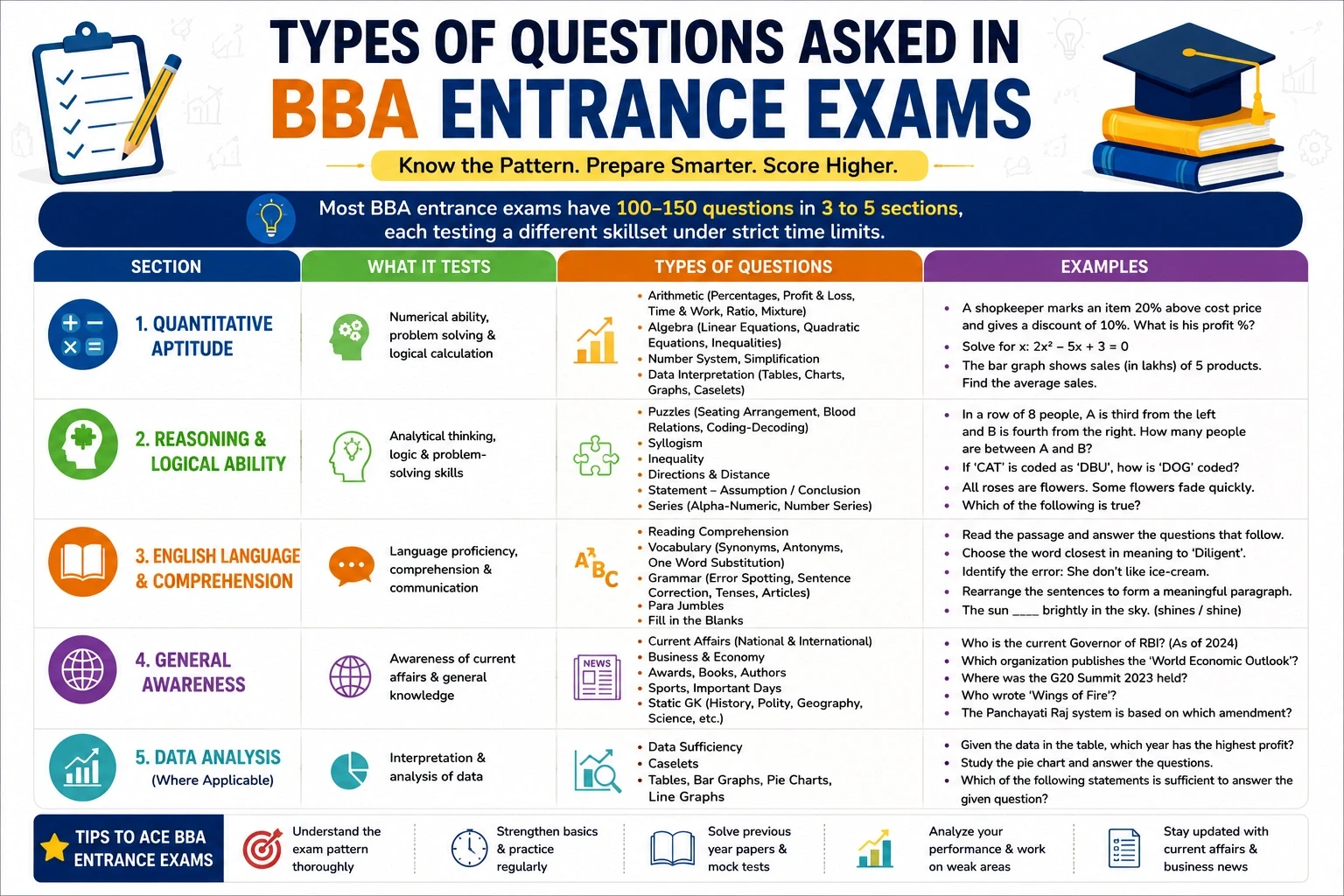
Exams like CUET and IPU CET in Delhi NCR are one of the most popular exams to get into some of India's most competitive BBA programs. Most BBA entrance exams have 100 to 150 questions in 3 to 5 sections, each testing a different skillset under strict time limits with some universities also conducting interviews for its admission processes.
Here are the most sought after BBA entrance exams you should know about in 2026:
CUET UG (General Test for BBA/BMS)
Course Duration: 3 to 4 years
With ~14 lakh applicants in 2025, CUET BBA UG Exams conducted by the National Testing Agency (NTA) is the largest exam for undergrad admissions offering BBA/BMS/BFIA courses. CUET scores are accepted in most colleges country-wide, consisting of over 250+ universities. Some of the top colleges that accept CUET scores include:
Shaheed Sukhdev College of Business Studies
Delhi Technological University
Deen Dayal Upadhaya College
Banaras Hindu University
Exam Name | Conducting Body | Course Offered | Eligibility | Exam Pattern (Sections + Questions + Time) | Last Date of Application | Exam Date |
CUET UG (General Test for BBA/BMS) | National Testing Agency (NTA) | BBA / BMS / BBM | Class 12 with ≥50% | 100 Questions, 120 Mins (60 + 60) i) General Test: Quant, Reasoning, GK - 50 Questions ii) Language Test: 50 Questions | March 22, 2025 | May 15 – May 31, 2025 |
IPU CET BBA
Course Duration: 3 years
Guru Gobind Singh Indrapastha University conducts the Common Entrance Test (CET) for admission into BBA courses in over 44 affiliated colleges under IP university. Some of the top colleges that accept these scores include:
Maharaja Agrasen Institute of Management Studies (MAIMS)
Vivekananda Institute of Professional Studies (VIPS).
Maharaja Surajmal Institute (MSI)
Other top options include JIMS Rohini, RDIAS, and IITM Janakpuri
Exam Name | Conducting Body | Course Offered | Eligibility | Exam Pattern (Sections + Questions + Time) | Last Date of Application | Exam Date |
IPU CET BBA | GGSIPU | BBA | Class 12 with ≥50% | 100 Questions, 150 mins i) English Language & Comprehension (25) ii) Logical & Analytical Ability (25) iii) Quantitative Aptitude (25) iv) General Awareness (25) | April 10, 2025 | April–May 2025 |
NPAT (NMIMS)
Course Duration: 3 to 4 years
Conducted by Narsee Monjee Institute of Management Studies, NPAT is the official entrance test conducted annually for admission to various management UG Programs including BBA, BCom, BSC. (Finance) etc.
Exam Name | Conducting Body | Course Offered | Eligibility | Exam Pattern (Sections + Questions + Time) | Last Date of Application | Exam Date |
NPAT (NMIMS) | NMIMS University | BBA, BCom (Hons). BSC Finance | Class 12 with ≥50% | 120 questions, 120 mins i) Quantitative & Numerical Ability (40) ii) Reasoning & General Intelligence (40) iii) Proficiency in English (40) | May 20, 2025 | Jan 1 – May 25, 2025 |
SET (General)
Duration 3-4 years
Conducted by Symbiosis International University, the Symbiosis Entrance Test (SET) is the official entrance test conducted annually for admission to their UG BBA program.
Exam Name | Conducting Body | Course Offered | Eligibility | Exam Pattern (Sections + Questions + Time) | Last Date of Application | Exam Date |
SET (General) | Symbiosis International University | BBA | Class 12 with ≥50% | 60 questions, 60 mins i) General English (16) ii) Quantitative (16) iii) General Awareness (16) iv) Analytical & Logical Reasoning (12) | April 12, 2025 | May 5 & May 11, 2025 |
Christ University Entrance Test
Duration: 3 years
The Christ University Entrance Test is the entrance exam for the university for their BBA Undergraduate Program. After clearing the exam, candidates are also required to clear the Micro Presentation (MP) and Personal Interview (PI).
Exam Name | Conducting Body | Course Offered | Eligibility | Exam Pattern (Sections + Questions + Time) | Last Date of Application | Exam Date |
Christ University Test | Christ University | BBA, BBA (Accountancy) | Class 12 pass (min. 50%) | 100 questions, 90 mins + PI & Micro Presentation - English (25) - Reasoning (25) - Quantitative Aptitude (20) - Data Analysis (20) - General Knowledge (10) | April 2025 | April–May 2025 |
RSAT (Rishihood Scholarship and Aptitude Test)
Duration: 3-4 years
The RSAT conducted by Rishihood University is the entrance process for the university’s BBA Entrepreneurship Program. Rishihood’s admission process ensures that students are evaluated on:
Aptitude
Personality
Communication
Entrepreneur mindset
Aligning with its entrepreneurship focused curriculum, Rishihood’s admission process is designed to identify potential future founders, leaders, and builders, instead of chasing just high test scores.Students can also apply using CUET scores, SAT India scores, the RSAT (Rishihood Scholastic Aptitude Test), or other national tests followed by a personal interview that evaluates genuine entrepreneurial curiosity, not just exam scores. This makes it one of the more accessible and holistic admission processes for BBA in the Delhi NCR region.
Exam Name | Conducting Body | Course Offered | Eligibility | Exam Pattern (Sections + Questions + Time) | Last Date | Exam Date |
RSAT | Rishihood University | BBA (Entrepreneurship) | 10+2 (any stream) | Stage 1: Aptitude Test (Quant, LR, English – no fixed Q publicly) Stage 2: Video Response Stage 3: Psychometric Test Stage 4: Personal Interview | Round 1: Nov 15, 2025 - Jan 31, 2026 Round 2: Feb 1, 2026 - Mar 31, 2026 Round 3: Apr 1, 2026 - Jun 30, 2026 |
Common Types of Questions Asked in BBA Entrance Exams
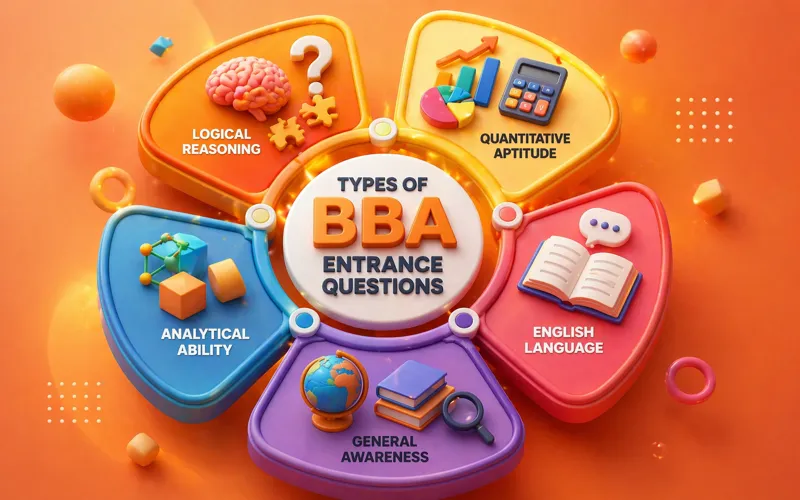
The exam pattern for BBA entrance exams (CUET, IPU CET, NPAT, or SET) generally focus on 3-4 core disciplines i.e., Quant, Logic, English with some universities also testing the candidates with GK and Current Affairs. However the main focus of BBA exams pertains to evaluating the analytical and communication skills of the candidate.
1. Quantitative Aptitude / Numerical Ability
This section of the exam focuses on testing a student’s mathematical skill set. Although the syllabus majorly focuses on school level mat, the questions are framed in multi-step word problems designed to slow down and test the conceptual understanding of concepts beyond their ability to memorize formulas. Speed and accuracy drive this section more than mathematical depth.
Topics covered:
Number Theory Logarithms
Square Roots
Fraction and Decimals
HCF and LCM
Commercial Math
Data Sufficiency Test
Ratio and Proportion
Profit And Loss
Data Interpretation
Surds and Indices
Compound and Simple Interest
Simplification
Partnership
Percentage
Mensuration Area
Approximation
Volume
Quantitative Comparison
Data Comparison
Average
Discounts
Sample question types:
Q. A trader marks his goods 35% above cost price and offers a 10% discount. What is his profit percentage?
Q. A cistern is filled by two pipes in 12 and 15 hours respectively. Both are opened together, but after 4 hours one pipe is closed. In how many more hours will the cistern be full?
Q. The following table shows the monthly revenue (in ₹ lakhs) of five companies over Q1 and Q2. If Company B's Q2 revenue increased by 18% over Q1, what is its Q2 revenue?
Exam-wise weightage:
CUET General Test: approximately 15–18 questions within the 50-question section.
IPU CET: 25 questions.
NPAT: 40 questions (highest of any BBA exam).
SET: 16 questions.
Christ Entrance Test: 20 questions
What makes it hard:
DI sets in IPU CET and NPAT often combine two data sources - a table and a chart, requiring cross-referencing under time pressure. Students who only practise standalone sums frequently struggle here.
2. Logical Reasoning / Reasoning Ability
The Logic and Reasoning ability section of BBA Entrance exams evaluate the candidate’s ability to think structurally, identify patterns and solve problems. Skills that mainly indicate the aptitude rather than the ability to memorize formulas.
Topics covered:
Number Test
Logical Diagram (Venn Diagram)
Relationship Test
Insert Missing Sequence Test
Classification (Odd Man Out) Test
Time Sequence Coding & Decoding
Statement Arguments
Mathematical Operations
Statement Conclusion
Data Sufficiency Test
Data Arrangement Test
Logic Test
Raking Test
Statements Assumptions
Sample question types:
Q. A is the father of C. D is the mother of C. B is the brother of A. How is B related to D?
Q. If MARKET is coded as LZSJDS, what is the code for INVEST?
Q. Six people — P, Q, R, S, T, U — sit around a circular table facing the centre. P sits opposite
Q is to the immediate right of P. S is not adjacent to T. Where does U sit?
Q. Statements: All books are pens. Some pens are pencils. Conclusions: I. Some books are pencils. II. All pencils are pens. Which conclusion follows?
Exam-wise weightage:
CUET General Test: ~5 questions
IPU CET: 25 questions
NPAT: 40 questions
SET: 12 questions
Difficulty note: Seating arrangement and blood relation sets in IPU CET are moderate difficulty, averaging 2–3 minutes each. CUET tends to include more abstract visual reasoning - a category that seems simple but ends up being challenging under exam stress and time constraints. Practicing this section is key to performing well during exams.
3. English Language and Comprehension
Effective communication and a large vocabulary are essential in managerial positions. It takes time and consistent reading and speaking of the language to develop a solid command of it. Since language is not something that can be mastered overnight or even with months of practice in general, many applicants struggle in this area of the test. Nonetheless, reading English-language materials on a regular basis would undoubtedly assist the applicant be ready for this portion by familiarizing them with the language and its usage.
Topics covered:
Reading Comprehension
Para-jumble
Idioms and Phrases
Fill in the Blanks
Rearrangement of words in sentences and paragraphs
Spotting errors, spelling errors, and checking for inappropriate usage of words
Para Completion
Antonym, Synonym, Confusing Words
Idioms and Phrases
Analogies
Sample question types:
Q. [After a 300-word passage on global supply chains]: The author's primary concern in the second paragraph is to
(a) argue for protectionism (b) highlight interdependence of economies (c) criticise free trade agreements (d) describe historical trade patternsQ. Identify the grammatically correct sentence:
(a) She is one of those students who works hard.
(b) She is one of those students who work hard.Q. Rearrange sentences P, Q, R, S into a coherent paragraph.
P: However, behavioural economists disagree.
Q: Classical theory assumes humans make rational decisions.
R: They point to consistent patterns of bias in financial choices.
S: This challenge has reshaped policy design globally.Q. Choose the antonym of EPHEMERAL:
(a) Transient (b) Enduring (c) Fragile (d) Vivid
Exam-wise weightage:
CUET Language Test: 50 questions (40 to be attempted)
IPU CET: 25 questions
NPAT: 40 questions
SET: 16 questions
Practical tip:
Most Reading Comprehension passages in BBA Entrance exams revolve around topics related to Business, Technology or Social Science. Literature and Fiction are seldom chosen for this exam. Hence, reading newspapers and magazines like The Hindu’s Business section and Mint magazine can significantly help in getting acquainted with preparation for this section.
4. General Knowledge and Current Affairs
The candidate's general knowledge of the world and industry insights are tested in this phase. A candidate needs to be naturally inclined and curious in order to perform well in this part. Regularly reading up on the
Topics covered:
Current Affairs — national and international news from the past 6–12 months
Indian Economy: RBI policies, Union Budget, GST, key economic indicators
Business and Corporate News: major mergers, IPOs, CEO appointments
Science and Technology: recent space missions, AI developments, national schemes
Static GK: capitals, currencies, national symbols, Indian geography
Indian Constitution and Governance: fundamental rights, key amendments, institutions
Sports: major tournaments, Indian award winners, record holders
Sample question types:
Which institution regulates the securities market in India?
Name the Indian space mission that successfully demonstrated docking technology in early 2025.
The term 'Fiscal Deficit' refers to ____ ?
Who was appointed as the Chief Election Commissioner of India in [year]?
Which Indian city hosted the Global Investors Summit in 2025?
GK is NOT tested in every BBA exam.
SET (Symbiosis) does not include a GK section. NPAT does not have dedicated GK questions.
IPU CET, however, allocates 25 full questions to General Awareness, making it a deciding factor for students targeting IP University-affiliated colleges in Delhi NCR. If IPU CET is on your list, GK cannot be treated as secondary preparation.
Best Colleges for BBA in India in 2026
When evaluating the best colleges for BBA Programs, candidates must carefully assess:
The course curriculum (specializations, electives etc.)
The placement report and ROI
Alumni and networking opportunities
Here are some of the top colleges for BBA Programs in India:
Shaheed Sukhdev College of Business Studies (SSCBS), Delhi University
Shaheed Sukhdev College of Business Studies, or SSCBS, is one of the most competitive BBA/BMS schools in India. It accepts applicants through CUET UG, with cutoffs usually exceeding the 98–99 percentile and about 80–90 spots each course. It is one of the highest ROI undergraduate programs in India because of its reputation for top-tier placements, where students have landed jobs in consulting and analytics with packages reaching ₹20+ LPA (top roles).
Rishihood University (BBA Entrepreneurship), Sonipat, Delhi NCR
Rishihood University's BBA Entrepreneurship program is unique among others in the Delhi NCR belt since it treats entrepreneurship as a core curriculum rather than an elective. While other BBA programs educate you on how organizations operate for three years, Rishihood's program focuses more on how to create a business.
Students begin working on real enterprise problems in their first semester and get access to a $5 million startup fund that they call a Makers’ Fund at the university.
Rishihood University’s tie up with Central Wyoming University and repeated guest lectures from professors from MIT Boston, attests to the exposure the students get with a chance to study in Wyoming which is a top b-school globally. Rishihood University’s BBA outcomes show entrepreneurial focus and interdisciplinary competence.
NMIMS (Narsee Monjee Institute of Management Studies), Mumbai
NMIMS (Mumbai): The BBA program at NMIMS is extremely competitive, with over 600 students admitted each year across campuses via NPAT. Strong business exposure is seen on the Mumbai campus, where students intern and work in marketing, consultancy, and BFSI firms. Its proximity to India's financial hub greatly increases industry access and internship opportunities starting in Year 1.
Symbiosis Centre for Management Studies (SCMS), Pune
In 2025, SCMS Pune (Symbiosis) reported 95.29% placements, with a median pay of ₹6.89 LPA and the top package of ₹17 LPA (international) and ₹10 LPA (domestic). KPMG, Accenture, and ICICI Bank are among the top recruiters, emphasizing solid industry integration and reliable placement results.
Christ University, Bangalore
Christ University (Bangalore) blends structure with scale, enrolling more than a thousand BBA students across campuses. Tests, interviews, and micro-presentations are used in the selection process to weed out applicants based on factors other than academics. It places a strong emphasis on regular industry exposure in addition to academics and is well-known for its high internship participation rates (80%+ students).
BBA College Admissions Without Entrance Exams in India
Apart from the rigorous BBA entrance exams, there are also quite a few colleges that accept students without these national exams via various other means:
1. Merit-Based Admission for Class 12
BBA students are admitted to numerous private and prominent universities, such as Lovely Professional University, Jain University, Amity, and others, based only on their Class 12 grades. Students who score higher than a predetermined percentage cutoff—typically 55–65% overall—are qualified to apply immediately.
2. Management Quota seats
Many deemed universities and private institutions reserve a set percentage of seats (often 10–15%) under management quotas. The competitive merit list is not used to fill these seats. The institution's management committee has the last say over admission, and students in this category usually pay a higher tuition structure. The precise quota percentages differ between each college and state due to state requirements.
3. International/NRI Category
At most private universities, NRI-sponsored students are given separate seats. Higher tuition costs apply, and admission is determined by academic performance and a nomination from an NRI relative.
4. Written exams and interviews at the institute level
Instead of a traditional entrance exam, several smaller private universities administer a basic aptitude test or group discussion round. They function as a simple screening method and are typically less competitive.
Is BBA really worth it in 2026?
When pursued with purpose, a BBA from the appropriate university is worth the effort. Every year, more than 1.2 lakh students enroll in BBA programs in India, yet the results vary greatly depending on where and how you study.
A BBA can deliver strong ROI, but only if you choose the right kind of program for your goals. Your network, projects, and internships open doors; a degree by itself could give you good knowledge on management concepts, but that alone may not always guarantee a top career.
Rishihood University BBA in Entrepreneurship: Why It's Different
Rishihood University is creating something radically different at a time when the majority of BBA programs in India still take a classroom-first, theory-heavy approach. Their curriculum is intended for students who want to lead, build, and make a significant impact early in their careers.
The university gives students exposure to multinational professors, global viewpoints, and cross-border learning experiences. Rishihood’s BBA learners learned concepts like Swiftonomics from Mike Hoyt, Central Wyoming College and learned about Entrepreneurship for Social Good from Johnathan Fleming, MIT Professor, who visited Rishihood University as a visiting faculty.
Moreover, the university also has many startups incubating at their venture studio. The result is that students graduate not only with a degree but also with experience, exposure, and a clear direction. This could mean starting a business, joining a fast-growing company, or continuing their education abroad.
FAQs
How many questions are asked in BBA entrance exams in Delhi NCR?
IPU CET BBA has 100 questions across 4 sections — English (25), Logical Reasoning (25), Quantitative Aptitude (25), and General Awareness (25) with a total duration of 150 minutes. CUET UG has 100 questions split between a General Test (50 Q) and a Language Test (50 Q), with candidates attempting 40 questions in each section within 60 minutes per section.
Is IPU CET BBA tougher than CUET?
They're comparable in overall difficulty but differ in character. IPU CET's GK section requires specific current affairs recall and is often considered its hardest component. CUET's Language Test is more linguistically demanding, with longer reading comprehension passages and more nuanced grammar questions. Students who are strong in GK typically find IPU CET more manageable; strong readers tend to do better in CUET. Overall, IPU CET has a higher per-question time allowance (1.5 minutes vs 1.2 in CUET), which matters.
What type of math questions come in BBA entrance exams?
All Class 10-level arithmetic and basic algebra: percentages, profit and loss, simple and compound interest, time-speed-distance, time and work, ratio and proportion, and data interpretation using charts and tables. No trigonometry, calculus, or advanced algebra appears in any BBA entrance exam.
The difficulty comes from multi-step word problems and complex DI sets, not mathematical complexity.
Is General Awareness compulsory in all BBA exams?
No. IPU CET allocates 25 questions to General Awareness. SET (Symbiosis) includes 16 GK questions.
NPAT does not test GK. CUET's General Test includes some current affairs content but doesn't label it as a separate GK section.
If you're targeting IPU-affiliated colleges in Delhi NCR, GK preparation is non-negotiable.
Can I get BBA admission in Delhi NCR without an entrance exam?
For government and centrally funded institutions — no.
DU requires CUET. IP University requires IPU CET for merit seats.
However, several private colleges in Delhi NCR offer management quota admissions, and universities like Amity (Noida), Rishihood (Sonipat), and Sharda (Greater Noida) have flexible admission processes.
Rishihood University in particular accepts CUET scores but also runs its own RSAT, allowing students without national exam scores to still apply through a personal interview process.
What is the syllabus for BBA entrance exams in Haryana NCR?
For colleges in Haryana NCR, including Rishihood University (Sonipat), O.P. Jindal Global University (Sonipat), and Manav Rachna University (Faridabad), the standard BBA entrance syllabus. Rishihood's admission process adds a personal interview component that evaluates entrepreneurial thinking and initiatives, a dimension no textbook section can prepare you for, except through genuine curiosity and lived experience.