Business
Why BBA Students Are Skipping Placements and Choosing Startups Instead
Learn why BBA students in India are choosing startups over placements, with salary comparison, Delhi NCR ecosystem context, entrepreneurship courses, family business pathways, and risk analysis.
20 July 2026
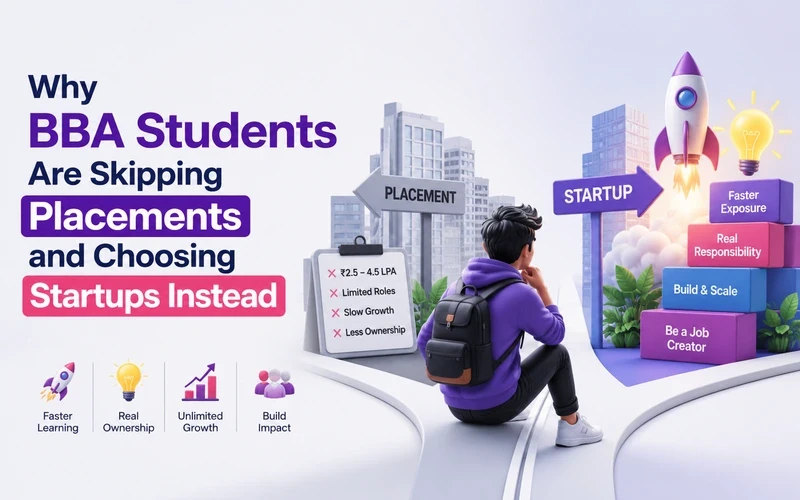
Table of Contents
Introduction
A few years ago, most BBA students followed a predictable path: earn a degree, secure a placement, gain work experience, and perhaps pursue an MBA later. Today, that path is changing.
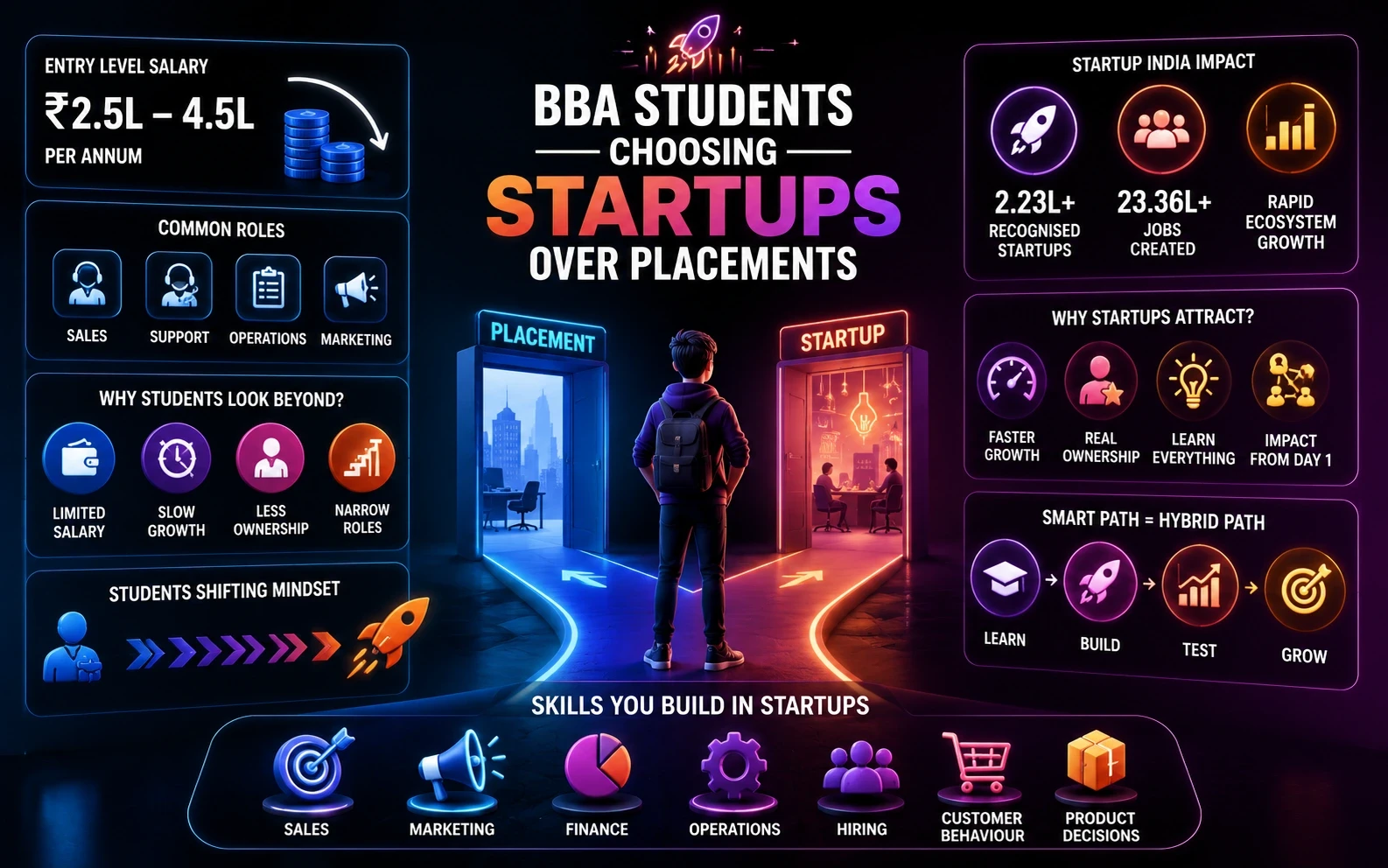
India's startup ecosystem has grown rapidly, with over 2 lakh DPIIT-recognised startups by December 2025 and more than 2.23 lakh recognised startups by April 2026. Together, they have already created over 23.36 lakh jobs. For students, this means entrepreneurship is no longer a niche career reserved for IIT graduates, MBA founders, or those with significant capital. It is becoming a realistic option for commerce students, aspiring entrepreneurs, and future business leaders.
The shift is especially visible across Delhi NCR and Haryana, where students are surrounded by startups, founders, incubators, investors, and innovation hubs. As startup culture continues to grow, many BBA students are beginning to ask a new question: Should I wait for a job, or start building something of my own?
This article explores why more BBA graduates are choosing startups over placements and what students should consider before making that decision.
Why BBA Students Are Skipping Placements in India
The first reason is salary expectation. Many BBA placements begin around ₹2.5 LPA to ₹4.5 LPA. For students who have already run a small Instagram store, helped in a family business, freelanced, managed a campus event, or built a micro-venture, the entry-level corporate salary may feel limiting.
The second reason is role quality. Many BBA placements are concentrated in sales, customer support, coordination, operations, trainee roles, or basic marketing positions. While these roles can provide valuable experience, students who want ownership, experimentation, and faster decision-making often find startups more appealing.
The third reason is independence. Startup-minded students want responsibility earlier. In a startup, they may contribute to marketing, product development, customer acquisition, operations, and business strategy within a short span of time.
The fourth reason is cultural influence. Founders are now visible on social media, podcasts, business competitions, college festivals, and Shark Tank India. Entrepreneurship has become aspirational, not just risky.
This shift is also influencing how business education is evolving. At Rishihood University's BBA Entrepreneurship program, students are encouraged to build, test, and validate ideas through industry projects, founder interactions, mentorship, startup ecosystem exposure, and initiatives such as BYOB (Build Your Own Brand), where learners create and launch their own brands while still in college.
See how Rishihood students build businesses through BYOB. |
The result is a mindset shift: many BBA students no longer want to be only job seekers. They want to test whether they can become job creators.
Entrepreneurship Courses After 12th and Student Shift
Entrepreneurship courses after 12th are gaining attention because students want business education that is practical, not only theoretical. A BBA in entrepreneurship, startup courses in India, and entrepreneurship-focused undergraduate pathways help students learn opportunity identification, business models, financial planning, marketing, customer validation, pitching, and venture building.
This shift is not simply about rejecting jobs. It is about replacing a job-seeking mindset with a skill-building mindset. Students want to understand how companies are built, how customers are acquired, how unit economics work, how ideas are tested, and how founders manage uncertainty.
Even students who eventually take placements benefit from entrepreneurial learning because it makes them more proactive inside organisations. A student who understands customer discovery, pricing, sales funnels, and cash flow can perform better in business development, marketing, operations, and growth roles.
For commerce students after 12th, entrepreneurship education also feels closer to their background. Many students already hear business conversations at home around sales, retail, accounts, trading, customers, suppliers, or family business decisions. A structured BBA course can turn that exposure into a more disciplined startup approach.
This is why the question is changing from “Which job will I get after BBA?” to “What can I build, test, manage, or scale after BBA?”
BBA Course in India vs Startup Skill Requirements
A standard BBA course teaches marketing, HR, finance, operations, business law, economics, accounting, organisational behaviour, and strategy. These subjects are useful, but startups require students to apply them under uncertainty.
In a startup, marketing is not only a theory exam. It becomes customer acquisition. Finance is not only balance sheets. It becomes cash flow survival. HR is not only recruitment theory. It becomes hiring the first team member. Operations is not only process design. It becomes vendor follow-up, delivery timelines, quality control, and customer complaints.
BBA Subject | Startup Skill Application |
Marketing | Customer discovery, branding, digital campaigns, sales funnels |
Finance | Cash flow, pricing, unit economics, fundraising basics |
HR | Team hiring, culture, founder communication, incentives |
Operations | Vendor management, fulfilment, supply chain, process control |
Business Law | Company registration, contracts, compliance awareness |
Entrepreneurship | Business model, MVP, pitching, market validation |
Business Communication | Investor pitches, customer calls, sales conversations, team coordination |
Economics | Market sizing, demand patterns, pricing behaviour, competition analysis |
The gap appears when students study these subjects only for exams. A startup requires application. Students must know how to speak to customers, make a basic financial model, design a pitch deck, test a landing page, run a campaign, track leads, and manage feedback.
This is why practice-led BBA programs are becoming more relevant. Students need classrooms, but they also need incubators, live projects, founder mentorship, business simulations, internships, and venture-building opportunities.
Explore mentorship opportunities learners get at Rishihood |
BBA Placement Reality for Students in India
BBA placements are useful, but students should understand their limits. Entry-level business roles often pay less than engineering, MBA, or specialised technology roles. Corporate recruiters may prefer MBA graduates for management trainee roles, strategy roles, consulting, product management, or higher-paying business functions.
This means many BBA graduates start in execution-heavy roles before moving into planning or management. They may begin as sales executives, marketing associates, customer success trainees, HR executives, operations coordinators, or business development associates.
There is nothing wrong with this path. Sales, operations, HR, and marketing roles can teach discipline, targets, communication, customer behaviour, reporting, and corporate structure. These are valuable skills for any future entrepreneur.
At the same time, outcomes often improve when students build practical experience before graduation. At Rishihood University, learners gain exposure through internships, live projects, founder interactions, and startup-focused experiences. This has helped students secure opportunities across startups and growth-stage companies. For example, Chakshu Verma secured a placement at L5.ai with a package of ₹7 LPA, while Sarhana Pande gained early startup exposure through a Founder's Office Internship at Climate Action LIVE
Explore how Rishihood students are building careers through placements, internships, and entrepreneurial experiences. |
But students with entrepreneurial ambition may feel that three years of college followed by a low-autonomy role does not match their goals. They may prefer joining a startup, building their own venture, or working in a family business where they can take responsibility faster.
The better question is not "placement or startup?" The better question is:
Which path gives me faster learning, manageable risk, and long-term alignment?
For some students, that answer is placement. For others, it is a startup job. For some, it is family business. For the most practical students, it may be a hybrid route.
Startup Ecosystem for Students in Sonipat, Haryana and Delhi NCR
Students in Sonipat and Haryana benefit from proximity to Delhi NCR’s startup network. Gurugram has strong startup, fintech, D2C, mobility, SaaS, consulting, and corporate activity. Delhi offers policy, media, creator, education, consumer-market, and founder community exposure. Noida has technology, IT services, product, media, and startup offices.
This ecosystem allows students to attend founder events, find internships, work with early-stage companies, and test ideas with real users. For BBA students, that exposure matters because entrepreneurship cannot be fully learned through textbooks. It is learned by doing, meeting, testing, failing, iterating, and pitching.
Colleges near this region can create an advantage through:
Incubation centres
Entrepreneurship cells
Founder talks
Pitch competitions
Live consulting projects
Startup internships
Investor connects
Market access programs
Mentorship networks
Campus venture studios
Rishihood University’s location in Sonipat, near Delhi NCR, can be positioned as a practical bridge between campus learning and market exposure. Its BBA in Entrepreneurship is a residential undergraduate program designed around venture-building, startup exposure, and entrepreneurial learning. Rishihood also highlights its Venture Studio ecosystem, where students can work on startup ideas while still in college.
For startup-minded BBA students, this matters because the right environment can reduce the distance between an idea and its first experiment.
Family Business and Entrepreneurship
Many BBA students do not begin with a blank slate. They come from families involved in retail, manufacturing, trading, services, real estate, food, logistics, education, healthcare, construction, or local businesses. For them, skipping placements may not mean launching a risky new venture. It may mean joining and modernising an existing business.
Family business and entrepreneurship is a powerful combination because perceived risk is lower. The student may already have access to products, customers, suppliers, capital, staff, or operational knowledge. A BBA course can help them bring structure.
For example:
Family Business Challenge | BBA Learning That Helps |
Weak branding | Marketing, positioning, consumer behaviour |
Poor cash tracking | Finance, accounting, budgeting |
Low digital presence | Digital marketing, e-commerce, content strategy |
Unclear team roles | HR, organisation behaviour, leadership |
Inventory issues | Operations, supply chain, process control |
No expansion plan | Strategy, market research, entrepreneurship |
This is one reason BBA vs BCom becomes an important decision. BCom may be stronger for accounting, taxation, and commerce depth. BBA may be more useful for students who want management, marketing, entrepreneurship, leadership, and business-building exposure.
For a family-business student, BBA can become a practical toolkit. Instead of entering the business only as the “next generation,” the student can enter with a plan: improve systems, professionalise operations, build a digital channel, create a brand, track finances, and explore expansion.
Risk vs Reward: Placement vs Startup Comparison
Startups are attractive, but they are not automatically better. A placement gives stable income, brand experience, structure, mentorship, and a safer learning path. A startup gives ownership, speed, creativity, and upside, but also uncertainty, irregular income, failure risk, and emotional pressure.
Path | Reward | Risk | Best Fit |
Placement | Stable salary, structured learning, corporate brand | Limited autonomy, slower responsibility, fixed role | Students who want predictable income and formal training |
Startup Job | Fast learning, broad role, founder exposure | High workload, changing priorities, uncertain stability | Students who like ambiguity and ownership |
Own Startup | High upside, independence, real business learning | Income volatility, failure risk, funding pressure | Students with support, resilience, and a validated idea |
Family Business | Existing base, lower setup risk, practical learning | Family pressure, legacy systems, unclear roles | Students with business background and modernisation plan |
Hybrid Path | Job income plus side venture learning | Time management, slower venture growth | Students testing entrepreneurship safely |
The reward of entrepreneurship is real, but the risk is also real. Students should not romanticise startups only because they see success stories online. For every funded founder, many students shut down ideas quietly because customers did not buy, costs were too high, team members left, or execution became difficult.
A mature BBA student should ask:
Do I have a real customer problem?
Have I tested demand?
Can I survive without stable income for some time?
Do I have mentors?
Do I understand basic finance?
Can I handle rejection and uncertainty?
Is this a business or just an exciting idea?
Risk does not mean students should avoid startups. It means they should test before jumping.
How Colleges Support Startups
The best entrepreneurship college in India is not defined only by classroom subjects. It is defined by the support system around student ideas.
A good college should help students understand not only how to pitch but also how to validate demand, calculate costs, price correctly, register legally, manage cash flow, speak to customers, and build a small team.
Important college-level support systems include:
Entrepreneurship cells
Business incubators
Startup bootcamps
Founder mentorship
Pitch events
Investor connects
Prototype support
Legal and compliance guidance
Market-access programs
Startup internships
Alumni founder networks
Live venture-building projects
Government schemes also matter. Startup India provides DPIIT recognition, compliance benefits, IPR support, tax-related support for eligible startups, and access to schemes and resources. The Fund of Funds for Startups scheme has also supported investment through SEBI-registered Alternative Investment Funds, and government data shows supported funds investing thousands of crores into selected startups.
Students may also explore state startup policies, MSME schemes, Atal Innovation Mission resources, incubation grants, university-linked startup programs, and state-level entrepreneurship missions. These schemes do not remove risk, but they reduce friction for serious founders.
For BBA students, the best college ecosystem is one that allows them to test ideas before graduation. A student should be able to run a small experiment, get feedback, improve the model, pitch to mentors, and understand whether the idea deserves more time.
This is where venture-building ecosystems can play an important role. At Rishihood University, students have access to the Venture Studio, which supports aspiring founders through mentorship, validation, industry connections, and hands-on venture development. The focus is not only on learning entrepreneurship but on practicing it.
The impact of such ecosystems can be seen through ventures such as Bohcado, Kixar, Tru Pahadi, and Hastakala, which have emerged from the Rishihood ecosystem. These ventures demonstrate how student and founder ideas can evolve into real businesses when supported by the right mentorship, experimentation, and execution environment.
Career Decision for Commerce Students
Commerce students should not romanticise startups or blindly accept placements. They should use a structured decision framework.
Choose placement if you need financial stability, corporate training, brand experience, and time to understand industries.
Choose a startup job if you want broad exposure, faster responsibility, and founder-side learning but are not ready to launch your own venture.
Choose your own startup if you have a validated idea, support system, risk capacity, financial discipline, and execution ability.
Choose family business if there is a real opportunity to modernise or scale the existing business.
Choose a hybrid path if you want to test entrepreneurship safely while building skills through internships, freelance work, or a job.
A hybrid route is often the smartest for BBA students. A student can take a job while building a side venture, join a startup before founding one, or use college incubation to test an idea before deciding whether to skip placements.
Entrepreneurship is not a personality label. It is a series of decisions under risk. BBA students should choose the path that gives them learning, resilience, financial responsibility, and long-term alignment.
Not sure whether you want a job, a startup, or both? |
FAQs
1. What is the salary difference between placement and startup paths in college?
BBA placements may start around ₹2.5 LPA to ₹4.5 LPA for many freshers. Startup income can be lower, higher, or irregular depending on the role, incentives, funding, equity, or business revenue. A startup job may give faster learning, while a placement may give more predictable income.
2. Is entrepreneurship risky after graduation?
Yes. Entrepreneurship involves income uncertainty, failure risk, customer rejection, funding pressure, and emotional stress. But risk can be reduced through market validation, mentorship, incubation, financial planning, internships, and hybrid career paths.
3. Is BBA in entrepreneurship a good course?
Yes, BBA in entrepreneurship can be a good course if the program includes live projects, incubation, market testing, finance, digital business, pitching, mentorship, and founder exposure. It should not be only classroom theory.
4. Should BBA students skip placements?
Not always. Students should compare salary, learning, risk capacity, family support, financial needs, and long-term goals before deciding. For many students, a hybrid path is better than fully rejecting placements.
5. Can family business students benefit from BBA?
Yes. BBA can help family business students professionalise marketing, finance, operations, HR, branding, digital channels, customer management, and expansion decisions. It can help them modernise an existing business instead of starting from zero.
6. Is BBA better than BCom for entrepreneurship?
BBA may be better for students who want management, marketing, entrepreneurship, leadership, and business-building exposure. BCom may be better for students who want deeper accounting, taxation, commerce, and finance foundations. The better choice depends on the student’s career goal.
7. What startup skills should BBA students build?
BBA students should build skills in customer research, sales, digital marketing, Excel, cash flow, pricing, pitch decks, business communication, CRM tools, market validation, and basic legal/compliance awareness.