Technology
Why Most B.Tech Graduates Are Unemployable? How to Stay Ahead?
Why most B.Tech graduates struggle to find jobs in India and how students can stay ahead in 2026. Covers skill gaps, AI disruption, hiring trends, salaries, and internships.
20 June 2026

Table of Contents
Introduction
India produces over 1.5 million engineering graduates every year, but most of them struggle to find a job that matches their degree.
There is a sharp contradiction. A recent report says that engineering graduates have an employability rate of 70.15%, with computer science and IT engineers at 80% and 78% respectively. While at the same time another report says that 83% of 2024 engineering graduates remained unemployed or without internships, even after being marked "employable" on paper.
Getting a B.Tech degree is no longer enough. The real differentiator is whether a student graduates with industry-relevant skills, project experience, and the ability to adapt to rapidly changing technologies.
As entrepreneur Naval Ravikant says:
"Learn to build. Learn to sell. If you can do both, you will be unstoppable."
This article focuses on why so many B.Tech graduates struggle, what the 2026 job market actually looks like, and the specific skills, projects, and choices that keep students ahead of the curve.
Why Are So Many B.Tech Graduates Unemployable in India?
Ask any mid-level hiring manager of a tech company what happens when they open a fresher role. Within days, hundreds of resumes arrive. After a basic coding screen, the shortlist collapses. The problem is not a shortage of B.Tech degrees, but a shortage of graduates who can actually do the job.
One reason is the scale of engineering education in India. The country has more than 5,000 institutions offering engineering courses. When companies receive countless applications for a few openings, academic qualifications alone are rarely enough to stand out.
The second challenge is the gap between academic learning and workplace expectations. Many engineering programs focus heavily on exams, theory, and structured lab exercises. While these fundamentals matter, employers increasingly look for candidates who can solve real-world problems, work on projects, and apply their knowledge in practical situations.
India's overall graduate employability has risen from 33% a decade ago to over 50% today, showing the system is improving. But improvement on paper does not always translate to job-readiness. The core issue is investment in the right kind of training. Anand Mahindra, Chairman of Mahindra Group, has said it is crucial to invest in education and training to build a workforce equipped with the skills needed to succeed.
What Employers Actually Want From Engineering Graduates in 2026
If India's engineering employability challenge is not caused by a shortage of jobs, what exactly are employers looking for?
The answer has changed significantly over the last three years.
CGPA is not the only criterion
When a company opens a job for a fresh B.Tech graduate, they are not sitting there hoping for someone with a 9.2 CGPA. They are hoping for someone who can actually do the work.
In fact, 73% of recruiters today ignore which college a candidate is from. They care about talent and skills instead. The degree gets you into the room. What you can actually do gets you the job.
So what do companies actually want?
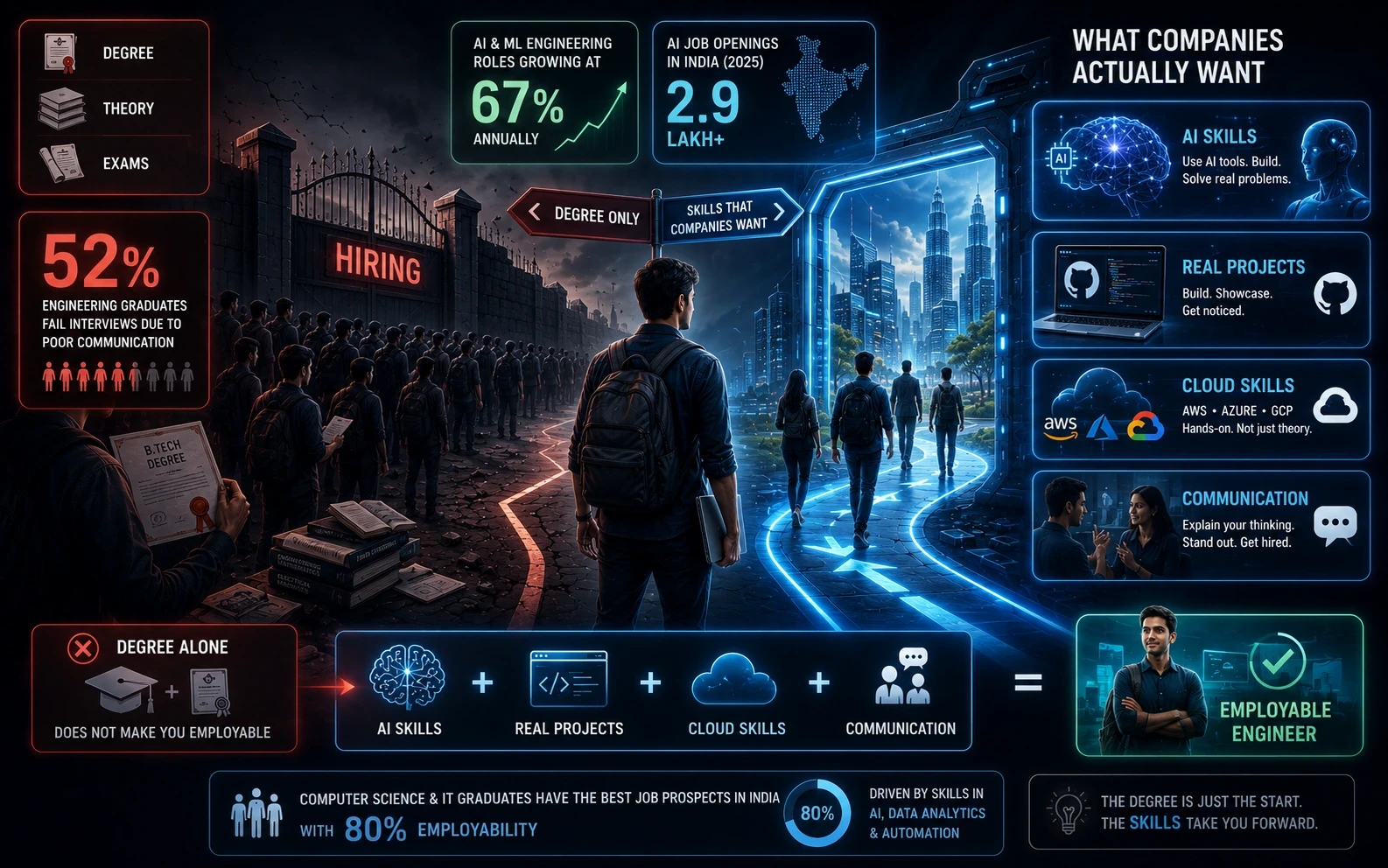
First: They want someone who knows how to use AI tools. Not just someone who has read about artificial intelligence in a textbook. Someone who has actually used it to build or solve something real.
NASSCOM says there are over 2,90,000 AI job openings in India in 2025 alone. AI and ML engineering roles are growing at an estimated 67% annually. The demand is enormous. The problem is that very few graduates are actually ready for it.
Second: They want real project experience. Not the mini-project you submitted in your seventh semester. Something you built because you were curious. Something on your GitHub profile that a hiring manager can review and see in action.
Third: They want people who can communicate.
52% of engineering graduates fail their job interviews because they could not explain their thinking clearly.
That means almost more than half of all rejections have nothing to do with coding skills.
Fourth: Companies need engineers who know platforms like AWS, Azure, or Google Cloud. Not theoretically, but practically.
The India Skills Report 2026 found that Computer Science and IT graduates have the best job prospects in India, with 80% employability. However, this advantage mainly comes from having skills in AI, data analytics, and automation.
The degree alone does not make you employable. The skills inside the degree do.
This is exactly the gap Rishihood University is designed to close.
Most engineering colleges hand you a syllabus and wish you luck. Rishihood takes a different approach from day one.
The B.Tech in Computer Science and AI programme at Rishihood, built in partnership with Newton School of Technology and co-created with industry experts from Google, Microsoft, and KPMG India, is structured around the exact four things employers ask for.
You start writing real code from Semester 1. Python and HTML-CSS are not third-year subjects here, they are how you begin. By your third year, you are working on actual backend systems and team-based software projects. There is even a course on storytelling, because knowing how to explain your ideas and work is an important part of succeeding in tech interviews.
Then comes something most engineering colleges simply do not offer: a mandatory six-month internship mid-degree, where students step out of the classroom and into a company or startup to apply their learning in real-world environments.
Moreover, 93% of Rishihood’s second-year students secure internships, earning an average stipend of ₹25,000 per month, demonstrating that they are gaining real-world skills and opportunities well before graduation.
And if you want to build your own startup, Rishihood's Makers Fund, backed by $5 million, gives students access to actual seed funding, mentorship from CTOs and VCs, and international exposure through global study treks.
A real example is from a Rishihood University student team. Starting as an idea sketched on sticky notes, their startup Inculcate, focused on reviving and sharing India's traditional knowledge systems, went on to raise its first round of funding at a valuation of Rs 5 crore from the Indian School of Business, with support from Rishihood University.
One of the key questions employers increasingly ask is:
"Have you built anything real?"
At Rishihood, the answer is yes, before you even graduate.
B.Tech Computer Science and Engineering Careers in India
For students exploring engineering after Class 12, one specialization continues to dominate industry demand: B.Tech Computer Science and Engineering (CSE).
The reason is simple. Nearly every industry today runs on software. Banks rely on digital platforms, retailers depend on ecommerce systems, hospitals use data-driven applications, and manufacturers increasingly integrate automation and connected technologies into their operations.
Here are the main career paths open to a B.Tech CSE graduate in 2026, and what each one pays.
Software Developer / Full-Stack Engineer
This is the most common career path for CSE graduates. Software developers build websites, apps, and digital products. Fresh graduates typically earn ₹3.5–6.5 LPA at IT services companies, ₹8–15 LPA at startups and product companies, and ₹25–45 LPA at top tech firms. The biggest factor behind this salary gap is skills and project experience.
AI and Machine Learning Engineer
AI is one of the fastest-growing fields in technology today. India is expected to need more than 1 million AI and ML professionals by 2026. Entry-level salaries typically range from ₹8–25 LPA, while experienced professionals can earn ₹30–50 LPA or more.
Data Scientist / Data Engineer
Companies rely on data to make decisions, creating strong demand for data professionals. Entry-level data scientists typically earn ₹6–10 LPA, while Data Engineers earn ₹8–20 LPA. Salaries grow significantly with experience and specialised skills.
Cloud Engineer / DevOps Engineer
Cloud platforms power most modern applications. Professionals in cloud and DevOps roles help companies build, manage, and scale their technology infrastructure. Salaries commonly range from ₹10–28 LPA, with demand continuing to rise.
Cybersecurity Analyst
As businesses become more digital, protecting systems and data has become critical. Cybersecurity professionals typically earn ₹6–15 LPA at the start of their careers, with strong growth opportunities due to a major shortage of skilled talent.
Popular CSE Career Paths and Salary Ranges
Career Path | Typical Fresher Salary |
Software Engineer | ₹4–10 LPA |
Data Engineer | ₹6–12 LPA |
AI/ML Engineer | ₹8–15 LPA |
Cloud Engineer | ₹6–12 LPA |
Cybersecurity Analyst | ₹5–12 LPA |
DevOps Engineer | ₹6–12 LPA |
It's important to note that employers care less about the exact degree title and more about demonstrable skills. Whether a student pursues a traditional B.Tech degree, a specialised B.Tech Artificial Intelligence program, or another emerging technology discipline, long-term career success depends on practical experience, adaptability, and continuous learning.
Rishihood University offers a different approach to engineering education. Founded by a Section 8 non-profit, it focuses on helping students build skills, gain real-world experience, and develop a sense of purpose. From startup funding opportunities to unique campus experiences, it aims to prepare students for more than just a job.
How AI Is Changing Engineering Jobs
Artificial intelligence has become one of the biggest concerns among students pursuing a B.Tech degree.
Most engineering students are today asking:
Will AI replace software engineers?
Will coding become obsolete?
Will entry-level jobs disappear?
The honest answer is: It depends on what kind of engineer you become.
What AI is already doing
AI can now write basic code, generate test cases, summarise documents, and automate repetitive tasks. Work that once took junior engineers hours can often be completed in minutes.
As a result, many entry-level coding, testing, and data-processing tasks are becoming automated. Students who rely only on basic coding skills may find fewer opportunities in the future.
What AI cannot do
AI is powerful, but it still cannot think creatively, make complex decisions, understand human needs, or design entirely new solutions from scratch.
It also cannot replace engineers who know how to build, manage, and improve AI systems.
In fact, AI is creating new career opportunities in fields such as AI engineering, AI operations, ethical AI, and advanced data analytics.
Which jobs are most at risk?
The more repetitive a job is, the easier it is for AI to automate it.
Roles facing the biggest risk include:
Basic software testing
Manual data entry and processing
Simple IT support
Generic coding with no specialisation
Instead of asking, "Will AI replace me?", ask:
"Am I learning the skills that AI cannot replace?"
How Rishihood prepares students for an AI-driven future
At Rishihood, AI is not treated as an optional subject that students encounter in their final year. It is built into the learning experience from the beginning.
Students learn how to use AI tools, solve real-world problems, and work on practical projects under the guidance of industry experts. The goal is simple: help students become creators of technology, not just users of it.
By the time they graduate, students are prepared to work with AI and take advantage of the opportunities it is creating.
Rishihood goes beyond academics. Along with technical skills, it places a strong emphasis on ethics, values, and leadership. For aspiring entrepreneurs, the Utsaha Incubation Centre provides mentorship, resources, and support to turn ideas into ventures.
Skills Engineering Students Must Learn Beyond the B.Tech Syllabus
What separates an employable B.Tech graduate from an unemployable one is not covered in semester exams. It is built in parallel, often starting from the first or second year.
Git and GitHub: Most software teams use Git and GitHub to manage code and collaborate. Students who have already worked on shared projects and understand version control have a clear advantage when they start their careers.
Cloud Platforms: Cloud computing powers most modern applications today. Building even a simple project on platforms like AWS or Azure can help students stand out from others who have only learned the concepts in the classroom.
Data Structures and Algorithms (DSA): DSA forms the foundation of problem-solving in computer science. It is also a key part of technical interviews at many product and technology companies.
AI Tools: AI tools have become an essential part of a software engineer's toolkit. Students should learn not only how to use AI tools effectively but also how to verify and improve the results they generate.
Communication Skills: Technical knowledge alone is not enough. Employers also look for candidates who can explain their ideas clearly, work well in teams, and communicate confidently with clients and colleagues.
Resume, LinkedIn, and Project Portfolio: A strong portfolio of projects often makes a bigger impact than a long list of certificates. Students should maintain an updated LinkedIn profile, showcase their work on GitHub, and clearly explain what they built and what they learned from each project.
B.Tech Specializations With Strong Future Demand in India
For many students, B.Tech Computer Science remains the most flexible pathway into software engineering, AI, cloud computing, and data-related careers. Some fields, especially those related to AI and cloud computing, are growing much faster than others.
Specialization | Demand Outlook in 2026 and beyond | Why |
Computer Science Engineering | Very High | Computer science and IT engineers maintain 78-80% employability, the highest among engineering streams |
AI and Machine Learning | Very High | AI specialist demand has surged over 300% since 2024, against a 53% skills deficit |
Cybersecurity | High | Cybersecurity, particularly zero-trust architecture, is among the hottest skill areas across Indian GCCs in 2026 T |
Data Science | High | More than 1,200 GCCs in India already run embedded AI and machine learning capabilities |
Cloud Computing | High | NASSCOM expects cloud technologies to account for 8% of India's GDP by 2026 and generate 1.4 crore new jobs |
Electronics and Embedded Systems | Moderate | Steady demand from manufacturing, automotive, and IoT, though growth is slower than software-led streams |
Robotics and Automation | Moderate, Growing | Tied to Industry 4.0 adoption; demand is rising but from a smaller base |
For most students, the practical takeaway is not to pick a niche specialization name on a degree certificate. It is to build skills in AI, cloud, or cybersecurity regardless of which core branch the degree is officially labelled under, since most hiring today is skill-based rather than title-based.
This is also where the choice of program structure starts to matter. At Rishihood University, the B.Tech in CS and AI or CS and Data Science is built with the curriculum shaped by inputs from Google and Microsoft experts. Cloud platforms, AI tools, and project-based learning are part of the core program, preparing students to be job-ready from day one.
Why Some Engineering Students Get Great Jobs While Others Don't ?
Two students can graduate with the same B.Tech degree, similar grades, and comparable technical knowledge, yet end up with very different career outcomes.
The difference is often not intelligence or talent. It is exposure.
Students who secure strong placements spend their college years in environments that encourage experimentation, collaboration, and industry engagement. They are surrounded by peers who discuss emerging technologies and actively explore opportunities beyond the classroom.
Location can also play a role. Engineering students studying in or near technology hubs such as Delhi NCR and Sonipat, often gain easier access to startup events, networking opportunities, industry meetups, and company interactions. These experiences help students understand how the industry operates long before they enter the job market.
While a strong ecosystem can provide an advantage, students who actively seek learning opportunities can build impressive career outcomes from almost anywhere.
How to Build an Employable Engineering Profile Before Graduation
A common misconception among engineering students is that employability begins in the final year of college.
In reality, employers start evaluating a candidate's readiness long before graduation. By the time companies visit campuses for placements, the strongest candidates have often spent years building skills, gaining experience, and creating evidence of their capabilities.
A Practical Employability Roadmap
By graduation, engineering students should ideally have:
A portfolio of 3–5 meaningful projects
A well-maintained GitHub profile
At least one internship, research project, or industry experience
Familiarity with modern development and collaboration tools
A professional LinkedIn profile and resume
Experience working in teams through hackathons, competitions, or projects
The students who remain employable in 2026 and beyond will not necessarily be the ones who know the most technologies. They will be the ones who can consistently learn, adapt, and demonstrate their ability to create value in a rapidly changing world.
The Future of Engineering in India: What Students Should Expect
The next decade of engineering will be shaped by AI-assisted software development, cloud-native infrastructure, cybersecurity, semiconductors, robotics, and intelligent automation.
India is simultaneously investing in AI, digital public infrastructure, semiconductor manufacturing, and advanced technology ecosystems. As a result, demand for engineers is unlikely to disappear. However, the nature of engineering work will continue to evolve.
Is a B.Tech Degree Still Worth It?
Yes, but the degree alone is no longer enough.
India's employability gap is not due to a lack of engineering jobs. The challenge is that industry requirements are changing faster than traditional education. Students who build projects, gain practical experience, and keep learning new skills are far better positioned for success.
For Class 12 students, the question is not whether a B.Tech degree is worth it. The real question is how you will use those four years to become job-ready and future-ready.
Build More Than a Degree at Rishihood University
The future belongs to engineers who can combine technical knowledge with real-world problem-solving. For students considering B.Tech admission in 2026, choosing the right learning environment can make a significant difference. While understanding B.Tech course details is important, it is equally important to evaluate factors such as internships, industry projects, mentorship opportunities, and real-world learning experiences.
At Rishihood University, engineering education goes beyond classroom instruction. Through industry projects, hands-on learning, interdisciplinary experiences, internships, and mentorship from practitioners, students are encouraged to develop the skills and mindset needed for the future of work.
Explore Rishihood University's B.Tech programs and discover how you can build an engineering career that is ready for the opportunities of tomorrow.
FAQs
Is a B.Tech degree still worth it in 2026?
Yes. A B.Tech degree remains valuable, especially in fields such as Computer Science, AI, Cybersecurity, Cloud Computing, and Data Engineering. However, employers increasingly expect practical skills and project experience alongside academic qualifications.
Why are many B.Tech graduates unemployable in India?
Many graduates struggle because of gaps in practical skills, problem-solving ability, industry exposure, and communication skills. Employers often seek job-ready candidates who can apply their knowledge in real-world situations.
Which B.Tech specialization has the best scope in 2026?
Computer Science Engineering, AI & Machine Learning, Cybersecurity, Data Science, and Cloud Computing are among the most in-demand specializations due to rapid growth in India's technology ecosystem.
Will AI replace software engineering jobs?
AI is automating repetitive coding tasks, but it is also creating new opportunities in AI engineering, cybersecurity, cloud infrastructure, and product development. Engineers who learn to work with AI tools are likely to remain in high demand.